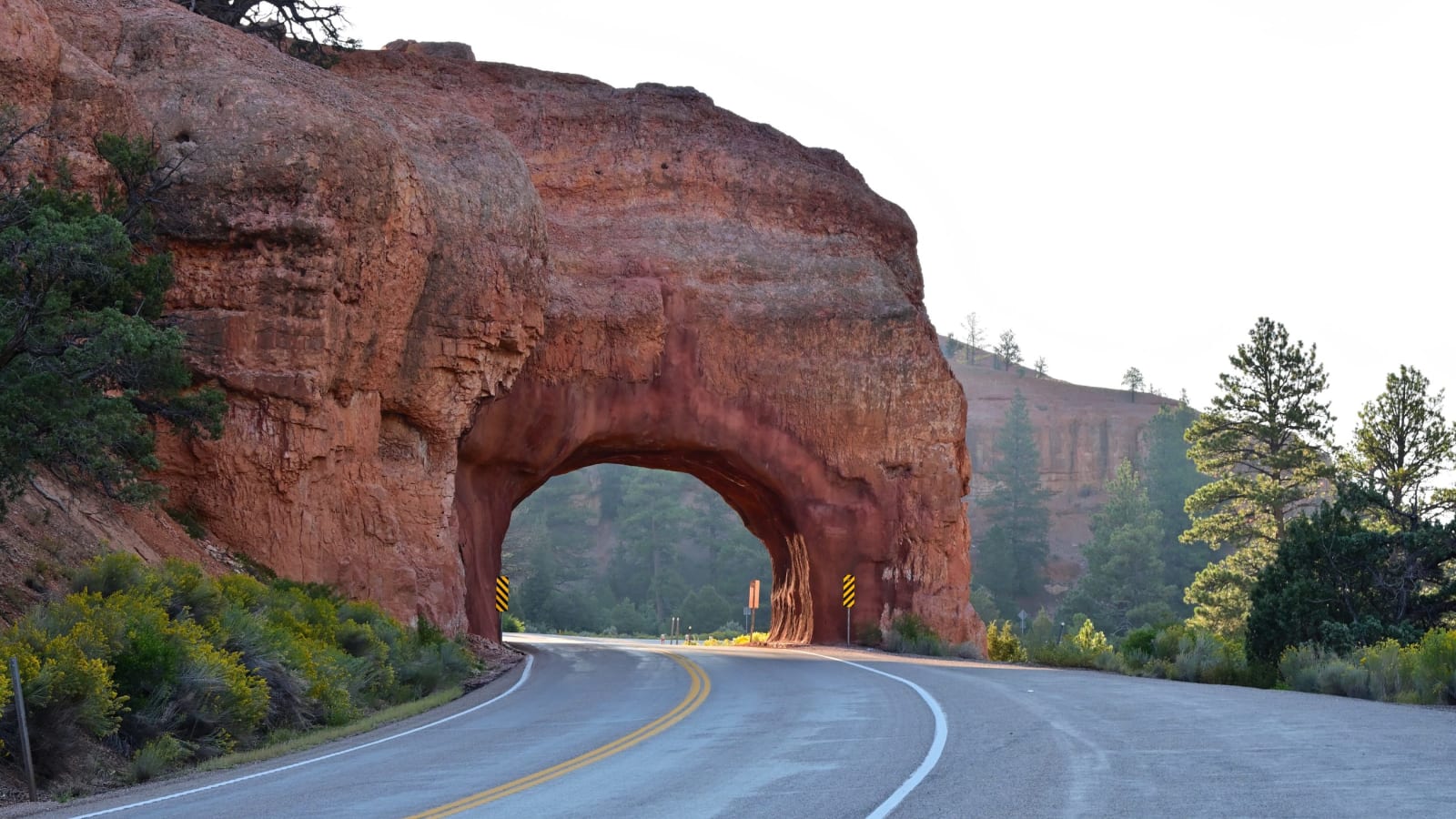
Highway 12 Scenic Byway
A 124-mile All-American Road through southern Utah's red-rock canyons, alpine forests, and slickrock wilderness — widely regarded as one of the most scenic drives in America.
The Route at a Glance
Highway 12 isn't a road you take to get somewhere. It's a road you take because the drive itself is the destination.
Stretching 124 miles between Panguitch and Torrey through some of the most geologically dramatic terrain in North America, Utah's Highway 12 is one of only forty-three roads in the United States to earn the federal All-American Road designation — the highest honor a scenic byway can receive. To qualify, a road must possess features so exceptional they don't exist anywhere else in the country. Highway 12 clears that bar within its first ten miles.
The route begins near Bryce Canyon, where pink-and-orange hoodoos stand in silent amphitheaters carved by ten million years of frost and rain. It threads through the slickrock canyons of Grand Staircase-Escalante National Monument — a landscape so remote and rugged that it was the last region of the contiguous United States to be mapped. Near Boulder, the road climbs over the Hogback, a knife-edge ridge with thousand-foot drop-offs on both sides and no guardrail, before ascending Boulder Mountain to 9,600 feet, where aspen groves and trout lakes feel a continent away from the desert below. It ends at the western gateway to Capitol Reef National Park, where the Waterpocket Fold buckles the earth into a 100-mile geological wave.
What makes Highway 12 extraordinary isn't any single overlook or trailhead — it's the sheer compression of landscapes. In a single afternoon you can stand in a slot canyon at noon and an alpine meadow by evening. The towns along the route are small, deliberate places: Tropic, Henrieville, Cannonville, Escalante, Boulder, Torrey. Most have fewer than 500 residents. Many didn't have paved access until the 1980s. Boulder was the last town in the lower forty-eight to receive its mail by mule train, a tradition that ended in 1939.
Drive it slowly. The speed limit suggests fifty-five; the road suggests thirty-five. There are pullouts every few miles and reasons to stop at most of them. Plan at least a full day end-to-end, two if you want to hike. The best months are May through October — winter snow closes the higher passes — though September and early October, when the aspens turn gold against the red rock, are the unofficial peak.
The Drive, Stop by Stop
18 stops along the route, in driving order from Panguitch to Torrey. 3 of them sit off the road itself — the distance is noted on each.
- 1
- 2
- 3
- 4
- 5
- 6
- 7
- 8
- 9
- 10
- 11
- 12
- 13
- 14
- 15
- 16
- 17
- 18
Markers Along This Road
Roadside plaques and monuments worth a pull-over — small history, standing exactly where it happened.
Building the Million-dollar Road
At Head of the Rocks Overlook — CCC crews started blasting the Lower Boulder Road through the slickrock in 1935, and when it opened on June 21, 1940, it was the first all-season road between Escalante and Boulder, a town still getting its mail by mule that same year.
Minerals in the Mesas
At the milepost 27 pullout two miles west of Henrieville — a late-1930s Henrieville mine shipped thousands of tons of bentonite to the Glen Canyon Dam site for the coffer dam, and local men donated their own time and machinery to finish the Cottonwood Road that hauled it; in the 1940s the Shakespear mine near Tropic blasted coal that came out by horse-drawn trailer.
Old Boulder Mail Trail
At the Escalante Cemetery pullout — James Schow won the 1902 mail contract at two hundred dollars a year, running mules twice a week over the Death Hollow trail to Boulder, and the glass insulators from the 1910 telephone line can still be seen in the treetops.
Second Powell Expedition
At the milepost 41 pullout west of Henrieville — in 1871 this country was part of the last uncharted territory in the continental United States, and Highway 12 follows the second Powell expedition's exact route from Henrieville to Head of the Rocks.
The Longest Shortcut
The Hole-in-the-Rock wayside tells the story of 234 people and 83 wagons who left in the fall of 1879 to shortcut to the San Juan — and found the Colorado River 1,800 feet below them, so they blasted a road down the crevice and drove the first wagon through on January 26, 1880.
Stories Along This Route
Go deeper into the history and character of this drive.
That's the drive. Take your time, pull over often, and let Highway 12 Scenic Byway do what it does best.
← Explore more of Open Road Guide