 brewbooks / CC BY-SA 2.0
The Story
Kiva Koffeehouse is the kind of place that makes you wonder about the person who built it, because no reasonable person would have attempted what they did. Perched on a cliff above Highway 12 between Escalante and Boulder, this small, round coffeehouse was constructed by hand over the course of 13 years from local sandstone, heavy timbers, and a vision that apparently included serving espresso with a 100-mile canyon view. The builder, Brad Langford, quarried the stone himself, hauled the timbers, and assembled the structure piece by piece on a ledge overlooking the Escalante River canyon. The result looks like something a medieval hermit might have built if medieval hermits had access to Italian espresso machines.
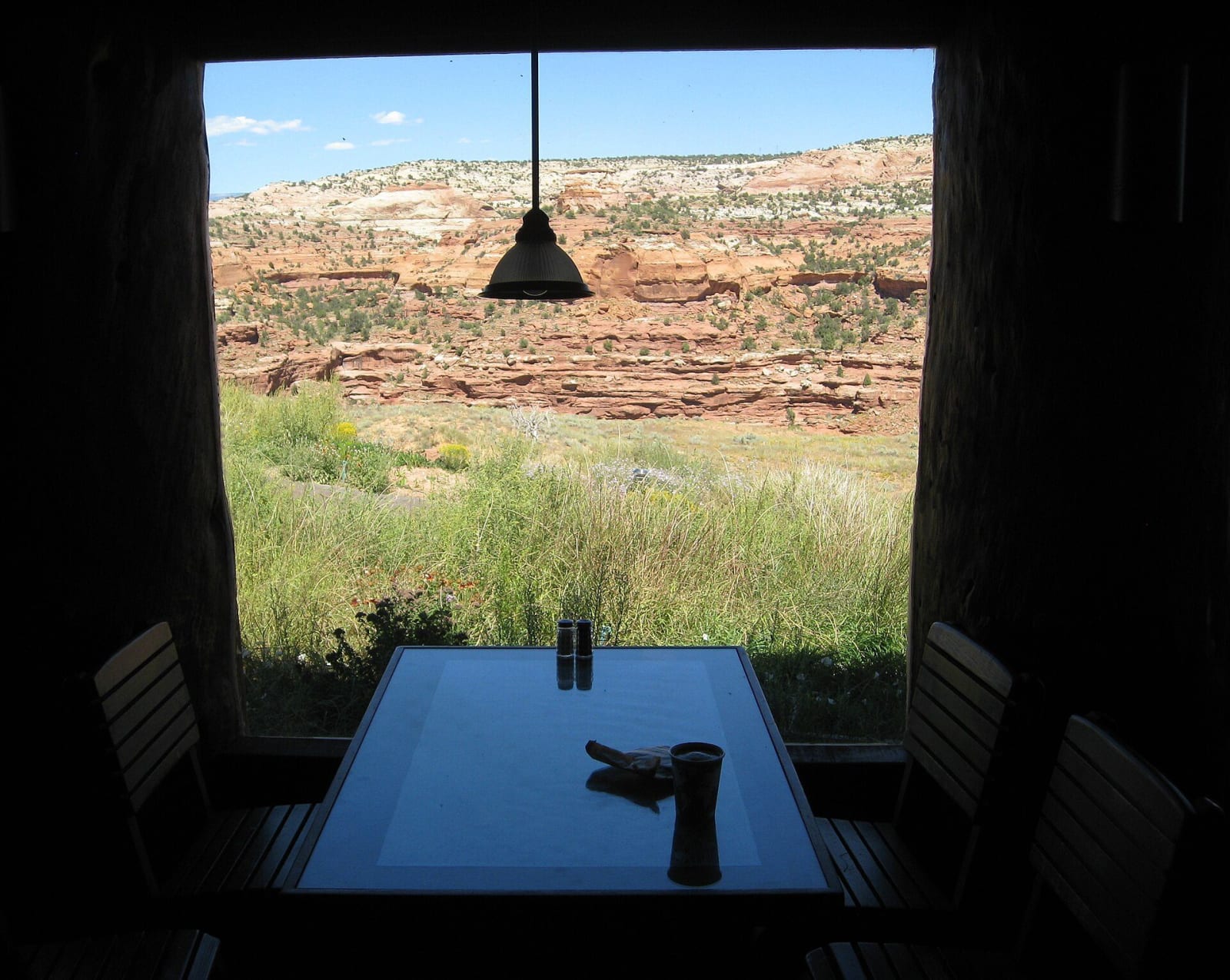
The building is circular, echoing the kiva structures built by Ancestral Puebloan peoples throughout the Southwest — underground ceremonial chambers that were the spiritual and social centers of their communities. Langford's kiva is above ground rather than below, but the reference is intentional and respectful. The thick sandstone walls, the heavy wooden beams, and the intimate scale create an atmosphere that feels ancient even though the building is relatively new. Stepping inside from the bright desert sun, your eyes adjust to the dim interior, and the first thing you notice is the view — a wall of windows looking out over hundreds of miles of canyon country stretching south toward the Grand Staircase.
The menu is deliberately simple. Coffee, espresso drinks, pastries, and light fare. This is not a restaurant trying to be everything. It is a coffeehouse that understands its single greatest asset is the view from its windows, and everything else — the food, the service, the pace — is calibrated to support the experience of sitting still, holding a warm cup, and looking at one of the most spectacular landscapes on Earth.
The coffeehouse sits at roughly 7,000 feet elevation on a stretch of Highway 12 that is consistently ranked among the most scenic drives in America. The road clings to narrow ridgelines and traverses slickrock hogbacks with thousand-foot drops on both sides, and the Kiva occupies a spot where the terrain opens up just enough to reveal the full depth of the Escalante canyon system. From the windows and the outdoor deck, you can see the creamy domes of Navajo Sandstone, the dark gash of the Escalante River cutting through the rock, and layer after layer of cliffs stepping down toward the Colorado River and Lake Powell in the far distance. On a clear day the view extends well over a hundred miles.
The hours are limited and seasonal — the Kiva is typically open from April through October, and the daily schedule can vary. Calling ahead or checking current hours is advisable, because arriving at a closed Kiva after driving an hour of winding mountain road is a specific kind of disappointment. When it is open, the pace inside matches the landscape outside — slow, unhurried, and resistant to the urgency that most of modern life insists upon. People linger here. They sit for an hour over a single coffee, watching the shadows shift across the canyon walls, and nobody rushes them.
The location places the Kiva at the midpoint of one of the great driving days in the American West. To the east, Highway 12 descends through Boulder and over Boulder Mountain, with views of Capitol Reef and the Henry Mountains. To the west, it passes through Escalante, over the Hogback, and into the red rock country around Bryce Canyon. The Kiva is the natural rest stop between these two worlds — a place to pause, caffeinate, and process the visual overload that Highway 12 delivers with relentless generosity.
The 13-year construction timeline is worth sitting with. Thirteen years of hauling stone, fitting walls, solving engineering problems on a cliffside site with no easy access. Thirteen years of working on a building whose only purpose is to give people a place to drink coffee and look at a canyon. In an era of rapid construction and disposable architecture, the Kiva is a monument to the idea that some things are worth building slowly and carefully, by hand, from materials that come from the land the building sits on. The sandstone walls will be here long after the espresso machine breaks down.
Kiva Koffeehouse is not a destination in the way a national park is a destination. It is a pause — a deliberate interruption in the forward motion of a road trip, a place that asks you to stop moving and start seeing. The canyon is not going anywhere. The coffee is hot. The view is the same one that has been here for millions of years and will be here for millions more. Sit down. Look out the window. There is no hurry.
Visitor Info
On the Map
Nearby
The closest stops worth working into your route
Historical markers nearby
Roadside plaques and monuments within a short detour