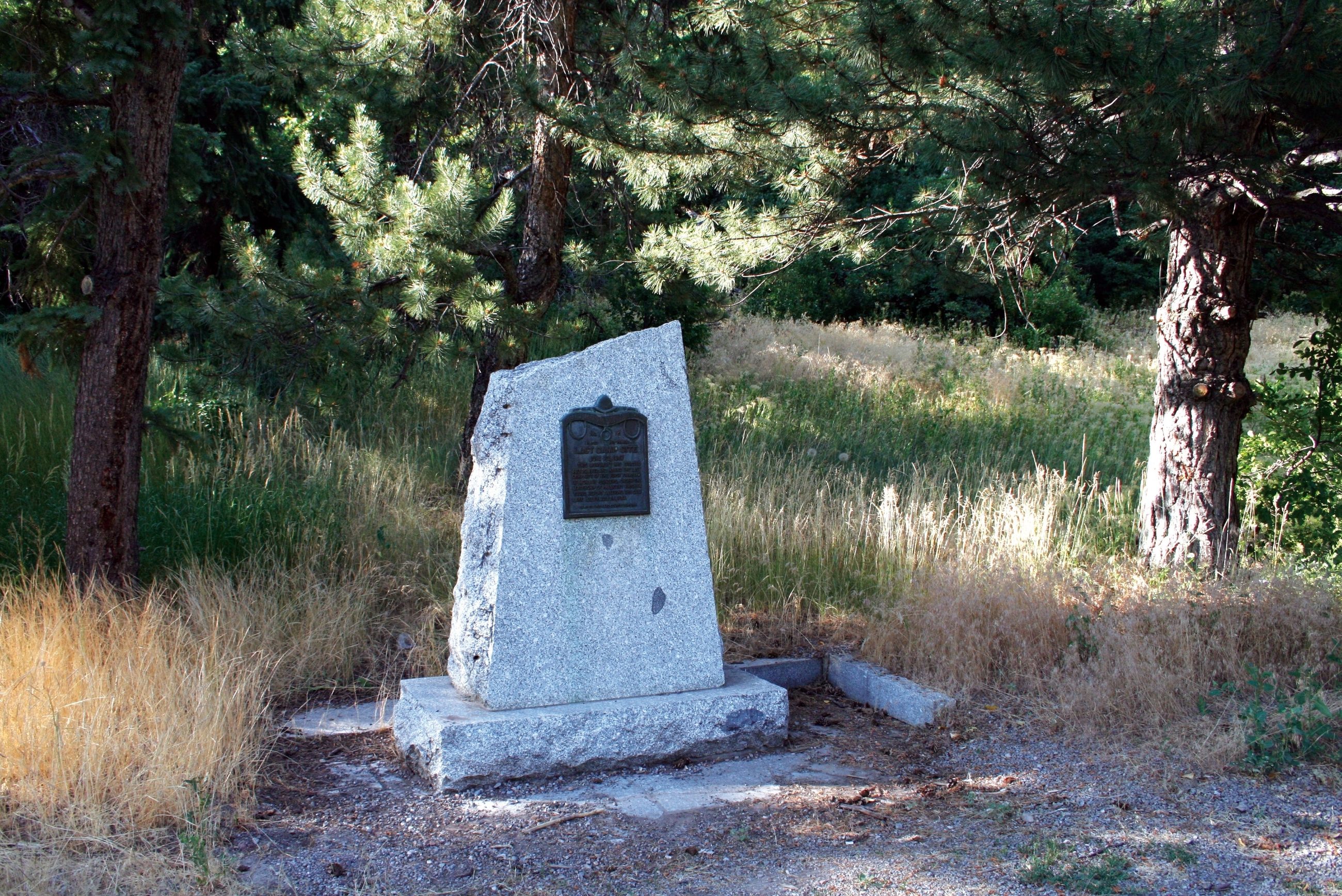
The most interesting sentence on a Utah historical marker is usually the last one.
The front matter is the history — the dates, the names, the hardship compressed into sixty words of cast bronze. But down at the bottom, in smaller letters, sits the line almost nobody reads: *erected by*. Follow that line from pullout to pullout and a second story emerges, one the front of the plaque never quite tells — the story of who has spent the last hundred and twenty-five years deciding what Utah should remember.
Take the marker on the old descent into Hurricane, just off Highway 9. The front tells how a whirlwind tore the top off Erastus Snow's buggy here in 1863 — "Well, that was a hurricane," he said, and the name stuck to the fault, then the bench, then the town. The bottom says: Daughters of Utah Pioneers, Hurricane Camp, 1937. Sit with that date. In the depths of the Great Depression, in a farm town barely three decades old, a group of women — many of them daughters of the very canal-diggers the town was built on — organized themselves, raised money almost nobody had, and paid to cast their grandparents' story in bronze.
They were not acting alone. They were part of the largest, longest-running, least-noticed community project in the state.
The relic call
It started with a party. In 1897, Salt Lake City threw a jubilee for the fiftieth anniversary of the pioneers' arrival, and the organizers put out a relic call: bring your artifacts, your heirlooms, your wagon-train memorabilia, for display. People brought wagonloads — and when the celebration ended, an astonishing number of them simply left their relics behind, including, by the society's own account, the council wagon Brigham Young rode into the valley. Utah had just discovered that it owned a past, that the generation who lived it was dying, and that nobody was in charge of keeping it.
Four years later, on April 11, 1901, Annie Taylor Hyde — a daughter of church president John Taylor, born in a wagon box shortly after her parents reached the Salt Lake Valley — gathered forty-six women of pioneer descent in her home and organized the Daughters of Utah Pioneers. The rules were precise the way only a lineage society's rules can be: membership required descent from an ancestor who arrived before May 10, 1869 — the day the transcontinental railroad was completed, and therefore, by definition, the day the pioneer era ended. The Daughters organized themselves into local "camps," incorporated in 1925, and when the Depression arrived they began, of all things, placing markers — deciding that what a broke state needed most was permanence.
They have since placed more than six hundred. Two of them, a year apart, stand along Highway 9: the Hurricane Camp's 1937 marker, and the Zion Park Camp's 1938 monument to Nephi Johnson, the first settler to ride up the Virgin River into Zion Canyon — his Paiute guides declined to enter, and he went on alone to the Narrows, "where the sun is seldom seen." And the camps never stopped. Sixty years later, in 1997, the Escalante Camp marked the Old Boulder Mail Trail along Highway 12, where James Schow's two-hundred-dollar-a-year contract once ran the mail by mule over Death Hollow twice a week. Same organization, same act of remembering, three generations apart.
The chorus widens
The men took another thirty-two years to get organized. A Provo chapter formed in 1928, and in 1933 the Sons of Utah Pioneers incorporated in Salt Lake City — with one telling difference. Where the Daughters guard the bloodline, the Sons will take anyone: no pioneer ancestry required, only an interest in the people who came. Their markers run later and lean technical — the 1987 monument near the spot where, on August 6, 1904, wagonloads of neighbors watched eleven years of hand-dug canal work pay off as Virgin River water finally gushed onto the Hurricane Bench, and the 2014 marker at the mouth of Logan Canyon mapping the canal network that crews dug from 1860 onward, running as many as thirty-two teams of horses at once.
And then marker-placing escaped the lineage societies entirely. Garfield County put up its own marker in 1997, carrying the full account — and all seven names — of the men who walked to Parowan on their quilts in the winter of 1864. The town of Rockville, population a few hundred, marked its 1924 Parker truss bridge in 1996, the only one of its kind left in Utah. The Utah State Road Commission planted a marker at the foot of temple hill on US-89, looking up at the 1888 Manti Temple. The Division of State History tagged Ephraim's 1871 co-op building. Even the American Society of Civil Engineers arrived, in 2011, to claim the Zion–Mount Carmel Tunnel for the engineers. Read enough erected-by lines and the roadside reorganizes itself into a directory of everyone who ever loved a place enough to bolt its story down.
The hunt goes statewide
The newest layer arrived in 2021, and it inverted the whole tradition. The Natural History Museum of Utah — planning since its fiftieth anniversary — launched Explorer Corps on Memorial Day weekend: twenty-nine medallions, one in every Utah county, crafted by O.C. Tanner and installed by a crew that drove roughly six thousand miles top to bottom placing them. Where the Daughters placed markers so the past would not be forgotten, the museum placed them so the present would go looking — an app and a printed passport track your visits, and the inaugural summer's "Race to 29" dared people to find them all.
Two lifelong Utahns named Francene and Kenneth Spencer celebrated their fifty-sixth wedding anniversary that June by doing exactly that: twenty-five hundred miles in fifteen days, the first people known to reach all twenty-nine. Which is, when you think about it, the same impulse that filled Annie Taylor Hyde's parlor in 1901 — the conviction that you do not really know your state until you have stood where its stories happened. The Utah County medallion stands at the Timpanogos Cave visitor center on the Alpine Loop, honoring a cave system found in 1887 by a logger who followed cougar tracks up the canyon wall.
Reading the small print
We have started mapping these markers along our route guides — twenty-six so far, from the Dewey Bridge on Highway 128 to the Fruita schoolhouse on Highway 24, each one checked against the road so you will actually pass it. The history on the front of each plaque belongs to the state. The small print at the bottom belongs to the neighbors — the camp, the county, the town council, the museum staff who decided this particular story was worth the price of bronze.
The relay is still running, and it still has gaps. Somewhere in storage sits the disassembled cabin of Ebenezer Bryce, the man whose name is on the canyon, waiting — like a fair amount of Utah history — for someone to decide it deserves a marker. On your next drive, pull over for the bronze. Read the front. Then read the bottom line, and tip your hat to the rememberers.