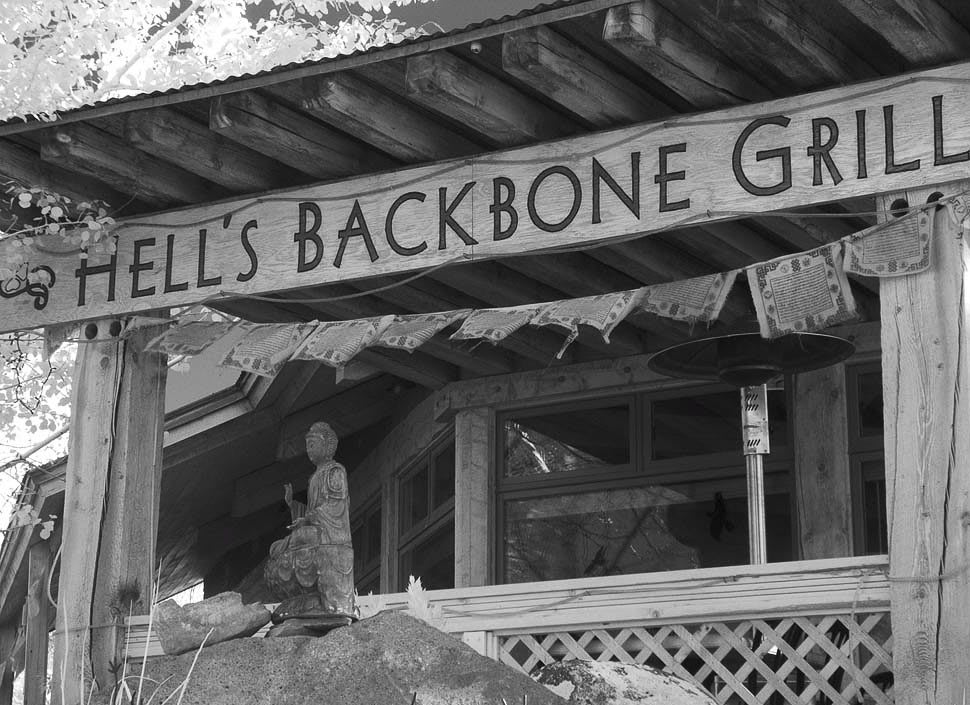
 Greg Willis / CC BY-SA 2.0
The Story
Hells Backbone Grill should not exist. A James Beard Award-recognized restaurant in Boulder, Utah — a town of fewer than 250 people that did not have a paved road until 1971 and received its mail by mule until 1940. A farm-to-table pioneer in a place so remote that the nearest grocery store is an hour away. A restaurant founded by two Buddhist women who moved to one of the most isolated communities in the lower 48 and built something that food critics from New York and San Francisco now fly across the country to experience. Everything about it defies probability, and everything about it works.
Blake Spalding and Jen Castle opened Hells Backbone Grill in 2000, driven by a vision that was simultaneously simple and radical — cook with what grows here, honor the land that produces it, and feed people food that tastes like the place it comes from. They started a farm on the edge of town, growing vegetables, herbs, and fruit in the same high-desert soil that Mormon pioneers had cultivated a century earlier. They raised heritage breed livestock. They foraged wild ingredients from the surrounding national forest and monument lands. And they built a menu that changes with the seasons because it has to — when your ingredients come from the field behind the restaurant, you cook what is ready and nothing else.
The food is rooted in the culinary traditions of the rural Southwest but executed with a sophistication that reflects Spalding and Castle's training and travels. Breakfast might be a plate of eggs from their own hens with roasted chiles, house-made tortillas, and salsa from tomatoes picked that morning. Dinner might be grilled lamb from a ranch down the road, served with root vegetables pulled from their garden and a sauce built from herbs growing within sight of the kitchen window. The menu reads like a love letter to the landscape — each dish connected to a specific place, a specific season, a specific relationship between the kitchen and the land.
The James Beard Foundation recognized Hells Backbone Grill as a semifinalist for Best Chef in the Mountain region, and the restaurant has appeared in publications ranging from the New York Times to Bon Appetit. But the awards and press coverage, while deserved, miss something essential about the experience. This is not a restaurant that feels like it is performing for critics. It feels like it is feeding its neighbors — which it is, along with the hikers, climbers, and road trippers who stumble into Boulder and discover that the best meal of their trip is waiting in a town that barely appears on the map.
The setting amplifies everything. Boulder sits on Highway 12, one of the most scenic roads in America, with the slickrock wilderness of Grand Staircase-Escalante to the south and the forested heights of Boulder Mountain to the north. The restaurant occupies a modest building that could be mistaken for a well-maintained ranch house, with a patio that looks out toward the red rock cliffs and a vegetable garden that guests are welcome to walk through. The scale is intimate — the dining room seats maybe 50 — and reservations are essential during the busy season. Walk-ins are possible but risky, especially on summer weekends when every room in Boulder is booked.
The Buddhist practice of the owners is not advertised but it is present in the details. The pace is unhurried. The staff is warm without being performative. The food is prepared with a mindfulness that you can taste even if you cannot articulate it. There is a meditation garden on the property, and the overall atmosphere is one of intentional calm — remarkable for a restaurant kitchen during a dinner rush, but consistent with a philosophy that treats cooking as a practice rather than a performance.
The farm itself, which the owners have documented in a cookbook and memoir, operates on principles of sustainability that go beyond buzzwords. They compost. They rotate crops. They save seeds. They use irrigation methods adapted from the pioneer-era ditches that still carry water through Boulder. The farm is not a marketing prop — it is the foundation of the entire operation, and the direct connection between soil and plate is what gives the food its distinctive character. You are not eating ingredients that were selected from a catalog and shipped across the country. You are eating food that grew in the dirt you can see from your table.
Hells Backbone Grill is the kind of place that changes how you think about food and place. It demonstrates that great cooking does not require a major city, a large market, or a wealthy clientele. It requires attention, skill, good soil, and a willingness to let the landscape dictate the menu. Spalding and Castle built something extraordinary in an extraordinarily unlikely location, and the fact that it has thrived for over two decades is proof that their vision was not naive — it was prophetic. The farm-to-table movement that swept American dining in the 2010s was something Hells Backbone Grill had been doing since before most people knew the phrase existed.
Make a reservation. Drive to Boulder. Eat dinner on the patio as the sun drops behind the red cliffs. And understand that the best meal in Utah is not in Salt Lake City or Park City. It is in a town of 250 people at the end of a road that used to be a mule trail.
Visitor Info
On the Map
Stories featuring this place
Go deeper into the history and character of this stop
Nearby
The closest stops worth working into your route
Historical markers nearby
Roadside plaques and monuments within a short detour