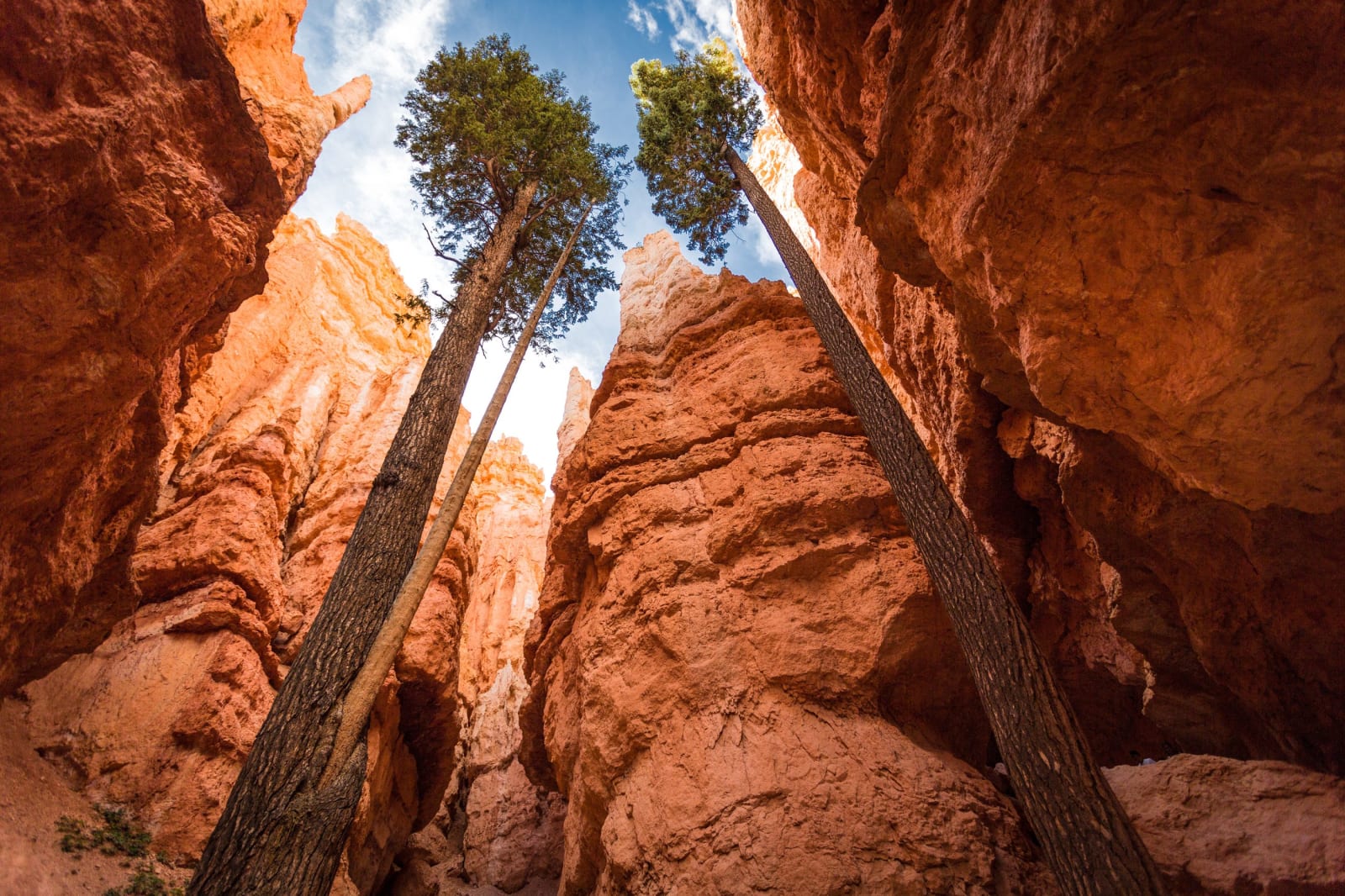
 Andrew Smith / CC BY-SA 2.0 via Wikimedia Commons
The Story
The first thing you need to know about Bryce Canyon is that it is not a canyon. It is a series of natural amphitheaters eroded into the eastern edge of the Paunsaugunt Plateau, and the formations inside them — thousands of tall, thin spires of rock called hoodoos — exist nowhere else on Earth in this concentration or variety.
Hoodoos form when water seeps into cracks in the rock, freezes, expands, and breaks off pieces. Bryce gets over 200 freeze-thaw cycles per year — more than almost anywhere in the Southwest — which is why the erosion here is so aggressive and the shapes so intricate. The rock layers alternate between harder dolomite and softer limestone and mudstone, so the resistant layers cap the softer ones below, creating the distinctive top-heavy pillars that look like chess pieces, castle towers, or robed figures standing in silent congregation.
The main amphitheater — the one you see from Sunset Point and Inspiration Point — contains the densest forest of hoodoos in the park, and the view from the rim is genuinely disorienting. Your brain struggles to process the scale. Are those pillars ten feet tall or a hundred? The answer is often the latter, but the uniformity of the formations plays tricks on depth perception. Walking down among them on the Navajo Loop Trail resolves the confusion instantly. The hoodoos tower over you, glowing orange and white and pink, and the trail switchbacks steeply through Wall Street, a narrow corridor between 100-foot walls that barely lets in the sky.
The Queen's Garden Trail connects to the Navajo Loop and is widely considered one of the best short hikes in any national park. The combination loop is about three miles, drops 600 feet, and passes through a wonderland of hoodoos, natural windows, and towering fins. If you do only one hike in Bryce, do this one. Start at Sunrise Point, descend through Queen's Garden, connect to Navajo Loop, and climb back out through Wall Street. The whole thing takes two to three hours and will fundamentally change how you understand erosion. The trailheads sit a short walk from Bryce Canyon Lodge, the rustic timber-and-stone hotel the Union Pacific Railroad built on the rim in 1925, now a National Historic Landmark and one of the last grand railroad-era park lodges still operating in its original form.
What many visitors miss is that Bryce sits at nearly 8,000 feet elevation — significantly higher than Zion or the Grand Canyon. This means cooler temperatures, ponderosa pine forests on the rim, and genuine winter snowfall that turns the hoodoos into something from a fantasy novel. Snowy Bryce is one of the most spectacular sights in the American West, and far fewer people see it.
The park also holds one of the darkest night skies in North America. On a clear, moonless night, you can see roughly 7,500 stars with the naked eye — compared to fewer than 500 from most cities. The Milky Way arcs overhead with enough brightness to cast faint shadows, and the park runs regular astronomy programs and full-moon hikes that draw stargazers from across the country.
The 18-mile scenic drive along the rim hits thirteen viewpoints, each offering a slightly different perspective on the amphitheaters. Bryce Point gives you the widest panoramic view. Natural Bridge frames a perfect arch against the forest. Rainbow Point, at the southern end, sits at 9,115 feet and offers views that stretch to Navajo Mountain over a hundred miles away.
Bryce is also a critical stop on the geological layer cake that defines southern Utah. The Grand Staircase — a sequence of cliffs stepping upward from the Grand Canyon to Bryce — represents hundreds of millions of years of Earth history. The rocks at the bottom of the Grand Canyon are nearly two billion years old. The rocks at the rim of Bryce are roughly 50 million years old. Standing at Bryce, you are looking at some of the youngest exposed rock in the entire staircase, and the hoodoos you see today will be gone in a few million years, replaced by new ones forming behind them. The landscape is literally walking backward, retreating about a foot every 65 years. You are watching the Earth reshape itself in slow motion.
Visitor Info
On the Map
Stories featuring this place
Go deeper into the history and character of this stop
Nearby
The closest stops worth working into your route
Historical markers nearby
Roadside plaques and monuments within a short detour