The Story
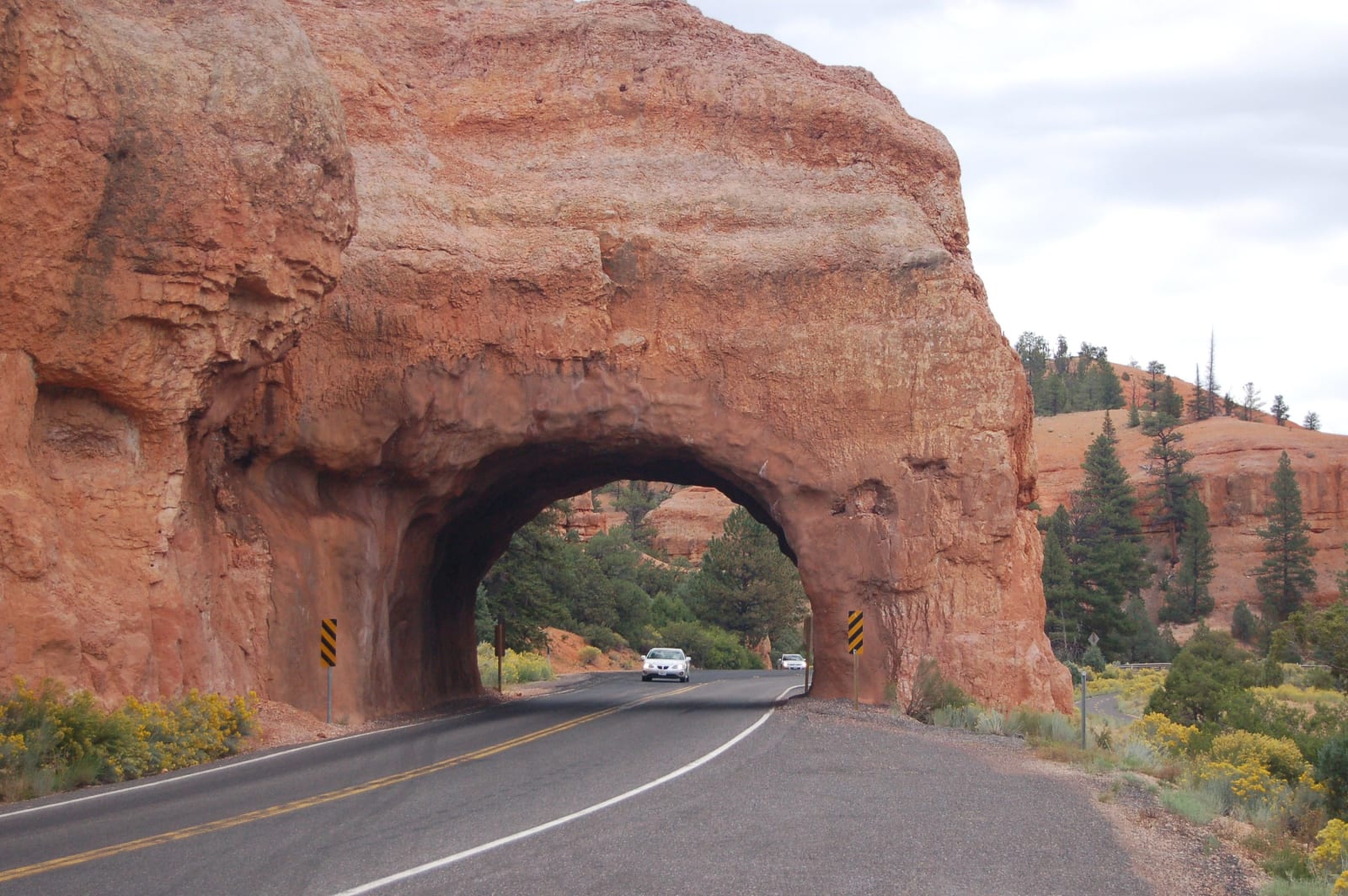
Red Canyon is the opening act for Bryce Canyon, and it is so good that some visitors never make it to the headliner. The canyon lines Highway 12 about 10 miles west of Bryce, and the first encounter is theatrical — you drive through two natural tunnels carved through fins of crimson Claron Formation limestone, and the rock on either side of the road is so vividly red, so close, and so sculpted that it feels like entering a set designed by someone who thought subtlety was overrated. The arches over the highway frame the road ahead in curves of blazing red stone, and the impulse to pull over is immediate and overwhelming.
The color is the first thing you notice and the last thing you forget. Red Canyon's rock is the same Claron Formation that builds the hoodoos at Bryce Canyon — limestone, siltstone, and mudstone deposited in ancient lake beds roughly 35 to 55 million years ago — but here the iron oxide content is higher, producing reds and oranges so saturated they look painted. Bryce tends toward pinks, creams, and soft oranges. Red Canyon is a full-throated crimson that deepens in the afternoon sun until the canyon walls look like they are generating their own light. The contrast between the red rock and the dark green ponderosa pines growing from cracks and ledges in the cliff faces creates a color combination that is almost aggressively beautiful.
The canyon offers an excellent trail system that is often overlooked by visitors racing to reach Bryce. The Arches Trail, a short loop of about a mile, passes through several small natural arches carved into the canyon walls — intimate, close-up arch experiences that reward slow observation rather than distant viewpoint photography. The Thunder Mountain Trail, accessible for both hikers and mountain bikers, winds through hoodoo formations and pine forest along the canyon rim, offering perspectives on the red rock that the highway cannot provide. The Losee Canyon Trail drops into a narrower side canyon with formations that rival anything in the Bryce amphitheaters.
The mountain biking in Red Canyon has developed a reputation that extends well beyond the local area. The trail system connects to the broader Thunder Mountain network and eventually to a route that reaches all the way to Bryce Canyon, offering a multi-day bikepacking experience through some of the most colorful terrain in the state. The trails are well-built and well-maintained, with a mix of singletrack and wider paths that accommodate different skill levels. The combination of red rock scenery, ponderosa pine forest, and moderate elevation — roughly 7,000 to 8,000 feet — creates riding conditions that are pleasant from late spring through early fall.
The Red Canyon Visitor Center, operated by the Dixie National Forest, sits along Highway 12 near the western entrance to the canyon and provides information on trails, geology, and the broader region. The staff are knowledgeable and can help visitors plan hikes and rides based on fitness level and time available. The visitor center also serves as a useful orientation point for travelers heading to Bryce Canyon, Kodachrome Basin, and the Grand Staircase-Escalante region.
The campground at Red Canyon is small, pleasant, and significantly easier to reserve than the campgrounds at Bryce Canyon National Park. Sites are set among the pines with red rock walls visible through the trees, and the experience of camping here — the smell of ponderosa bark warming in the sun, the sound of Steller's jays arguing in the canopy, the red walls glowing at sunset — is as satisfying as any campground in the region. The proximity to Bryce means you can camp at Red Canyon, drive ten minutes to the national park for the day, and return to a campsite that costs less and feels more intimate.
Red Canyon exists in Bryce Canyon's shadow, and that shadow is both its burden and its blessing. The burden is that most visitors treat it as a scenic drive-through on their way to the more famous park, never stopping to hike or explore. The blessing is that the trails and formations remain relatively uncrowded even during peak season, and the experience of walking through the red hoodoos without competing for trail space is increasingly rare in southern Utah.
The canyon is a preview of Bryce in the same way that a trailer is a preview of a film — it shows you the visual vocabulary, establishes the color palette, and builds anticipation for what is coming. But Red Canyon is not just a preview. It is a destination in its own right, with formations, trails, and colors that stand on their own merits. The arches over the highway alone are worth the stop. The trails are worth the morning. And the color — that impossible, saturated, light-from-within red — is worth whatever time you can spare.
Visitor Info
On the Map
Nearby
The closest stops worth working into your route
Historical markers nearby
Roadside plaques and monuments within a short detour