The Story
Escalante Petrified Forest State Park is where you walk among trees that are 150 million years old and no longer made of wood. The petrified logs scattered across the hillside above Wide Hollow Reservoir are Jurassic-era conifers — trees that grew in a lush, subtropical forest when this part of Utah was a floodplain teeming with dinosaurs — and they have been transformed, molecule by molecule, into solid stone. The bark is still visible. The growth rings are still countable. The knots and branch scars are still in place. But every organic cell has been replaced by silica, turning what was once a living tree into a geological artifact that weighs thousands of pounds and will last essentially forever.
The petrification process is slow and specific. The trees died and were buried rapidly — likely by volcanic ash or flood sediment — in conditions that excluded oxygen and prevented normal decay. Over millions of years, silica-rich groundwater percolated through the buried wood, and the dissolved silica gradually replaced the organic material cell by cell, preserving the microscopic structure of the wood in crystalline detail. The result is a fossil that looks exactly like a tree but rings like a bell when you tap it — because it is no longer wood. It is quartz, chalcedony, and agate, colored by trace minerals into shades of red, yellow, purple, and cream that make each piece a natural mosaic.
The Petrified Forest Trail is a short loop — about a mile — that climbs through badlands of colorful Morrison Formation mudstone past dozens of petrified logs and fragments. The Morrison Formation is the same layer of Jurassic sediment that has produced dinosaur fossils across the American West, and the petrified wood here is contemporaneous with the Allosaurus and Diplodocus bones found at sites like Cleveland-Lloyd and Dinosaur National Monument. These trees were alive when dinosaurs were the dominant land animals on Earth, and they were growing in a forest that would have been unrecognizable to modern eyes — conifers and tree ferns in a warm, wet landscape that looked more like modern Louisiana than modern Utah.
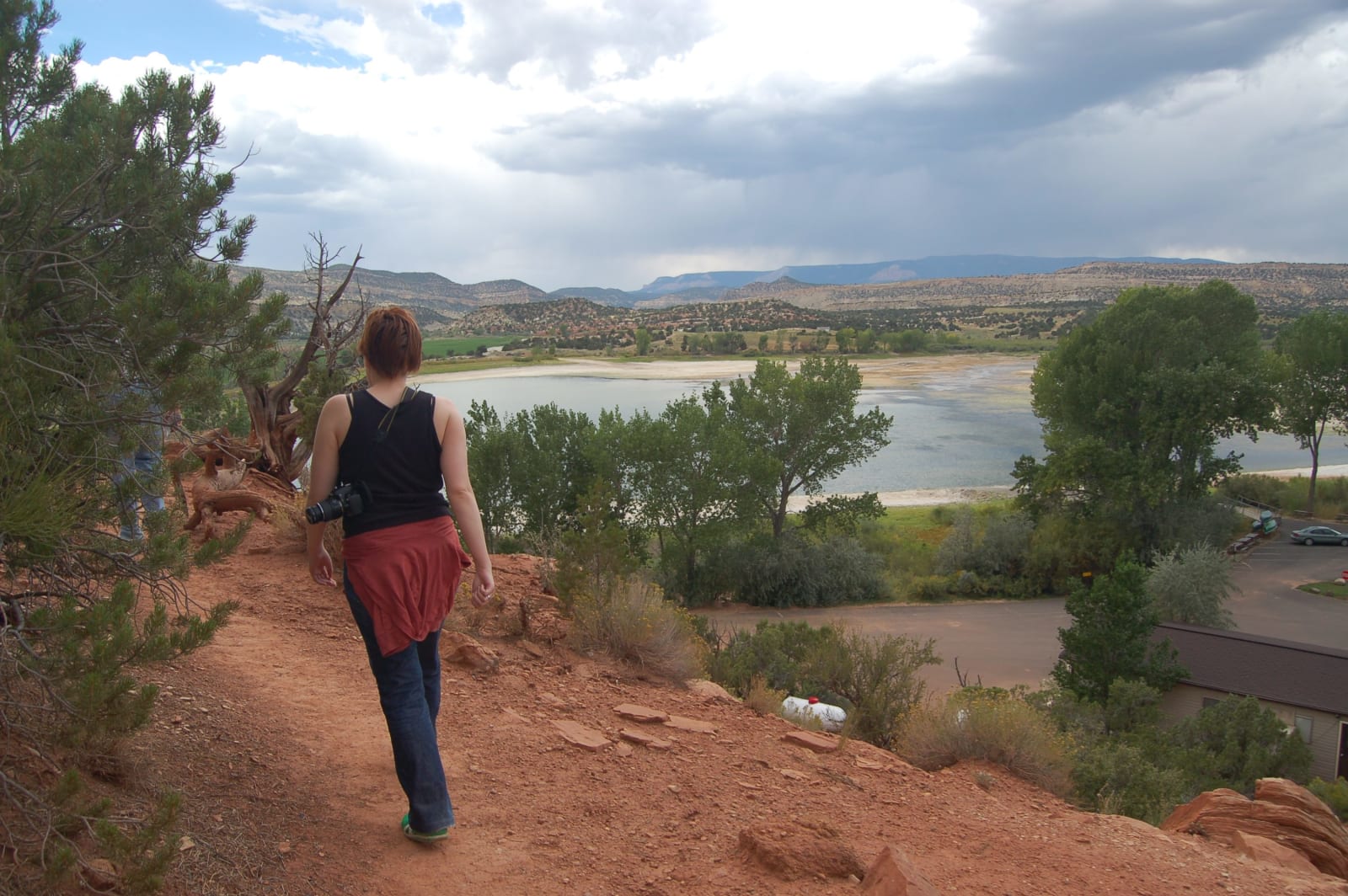
The trail climbs through exposures of the Morrison Formation that are vividly colored — bands of purple, gray, green, and red mudstone that record changing environmental conditions during the late Jurassic. The badlands topography — eroded hills and gullies with little vegetation — gives the landscape a stark, almost lunar quality that contrasts sharply with the reservoir and cottonwood trees visible below. The petrified logs are scattered across the hillside in positions that suggest they were transported by water before burial — tumbled and rearranged by ancient floods that deposited them in the sediment that would eventually preserve them.
Some of the logs are large — several feet in diameter and ten or more feet long — and the detail preserved in the stone is extraordinary. Cross-sections reveal growth rings that paleobotanists can read for information about ancient climate — wide rings indicating wet years, narrow rings indicating drought. The colors within individual pieces can be spectacular, with bands of red jasper, white chalcedony, and purple amethyst creating patterns that lapidaries would prize if the pieces were small enough to cut and polish. They are not. These are full-sized tree trunks, frozen in stone, and their scale reinforces the reality that these were living organisms in a functioning ecosystem, not decorative specimens.
The park also includes Wide Hollow Reservoir, a modest but pleasant body of water that offers swimming, kayaking, canoeing, and fishing for rainbow trout and bluegill. The reservoir sits in a red rock setting that is attractive without being dramatic, and the combination of water recreation and paleontological hiking makes the park unusually versatile — you can spend the morning walking among Jurassic trees and the afternoon paddling across a desert lake.
The campground is small, well-maintained, and positioned between the reservoir and the petrified forest trail, making it a convenient base for exploring both. Sites are shaded by cottonwood trees and offer views of the surrounding red rock hills. The campground is less heavily reserved than those in the national parks, and walk-in availability is often possible even during peak season.
The park sits just west of the town of Escalante along Highway 12, making it an easy stop for travelers heading to or from Grand Staircase-Escalante National Monument, Bryce Canyon, or Capitol Reef. The petrified forest trail takes about an hour, the reservoir activities take as long as you want them to, and the combination fits naturally into a day that might also include a slot canyon hike or a drive across the Hogback.
Collecting petrified wood from the park is strictly prohibited — federal and state law protects paleontological resources on public land, and the penalties for removal are significant. The temptation is understandable — the pieces are beautiful, and some are small enough to pocket — but the site's value depends on the wood remaining in place, in context, where it can be studied and appreciated by everyone who walks the trail. Leave it where it lies. It has been there for 150 million years. It can wait for the next visitor.
Visitor Info
On the Map
A story featuring this place
Go deeper into the history and character of this stop
Nearby
The closest stops worth working into your route
Historical markers nearby
Roadside plaques and monuments within a short detour