 NPS Photo / public domain via Wikimedia Commons
The Story
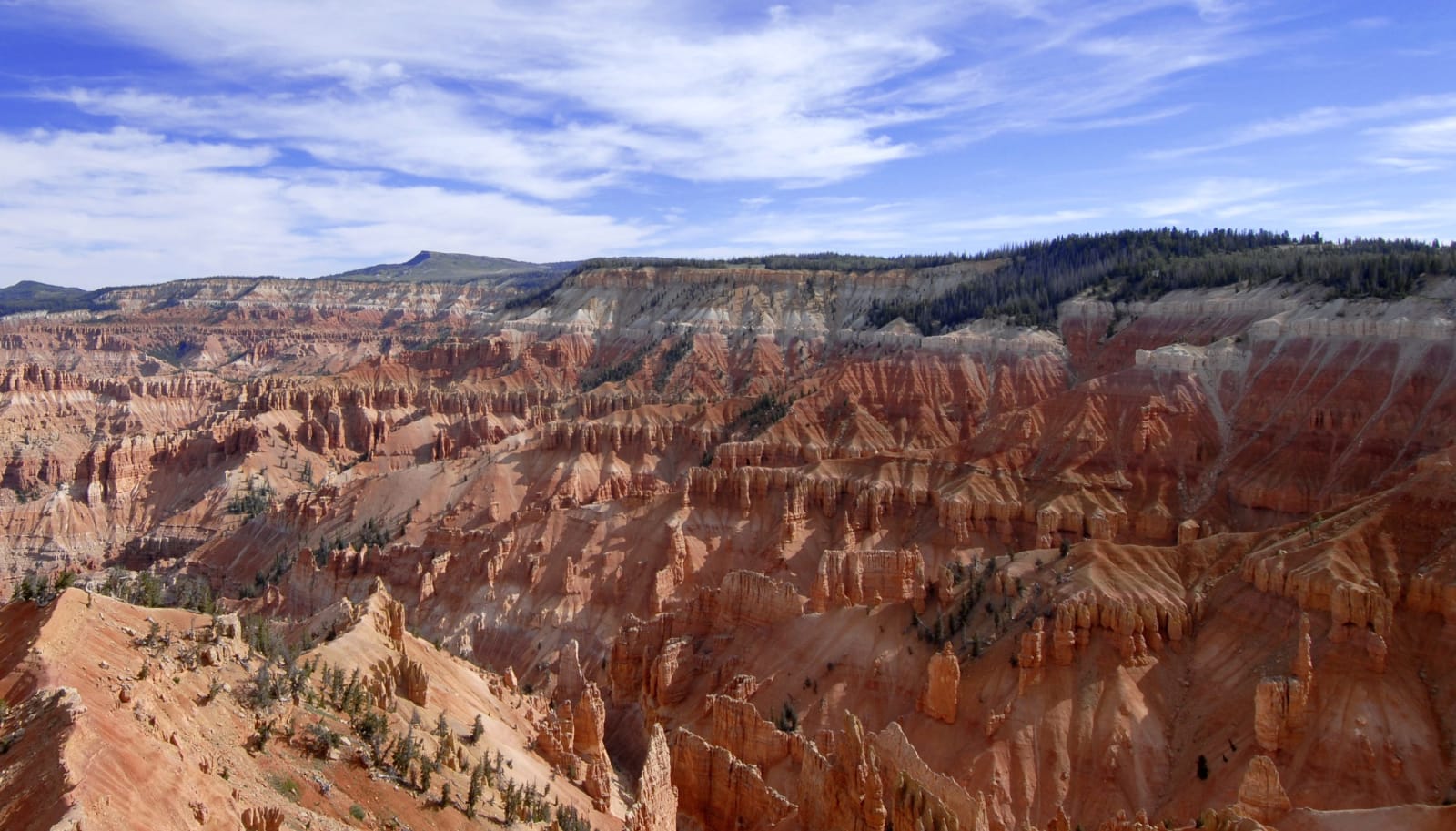
Cedar Breaks is Bryce Canyon's bigger, higher, less-visited sibling, and the family resemblance is unmistakable. A vast natural amphitheater — over 2,000 feet deep and three miles wide — has been carved into the western edge of the Markagunt Plateau, filled with the same hoodoos, fins, and spires of red, orange, and white rock that make Bryce famous. But Cedar Breaks sits at over 10,000 feet elevation, higher than the North Rim of the Grand Canyon, higher than any viewpoint at Bryce, and high enough that the rim is buried under snow from November through May. When the road finally opens in late spring, the wildflower meadows along the rim explode with color, and the combination of alpine flowers, subalpine forest, and a 2,000-foot abyss of painted rock is unlike anything else in the state. The northern approach climbs through Brian Head, Utah's highest town and its southernmost ski resort, on the plateau rim just up State Route 143.
The amphitheater was carved by the same processes that shaped Bryce — frost wedging, rain erosion, and the alternation of hard and soft rock layers creating the hoodoo shapes that define both parks. The rock is Claron Formation limestone and mudstone, deposited in ancient lake beds roughly 55 to 35 million years ago, and the colors come from varying concentrations of iron and manganese oxides — iron produces the reds and oranges, manganese contributes purples and lavenders. The palette at Cedar Breaks is arguably richer than Bryce's, with deeper purples and more vivid oranges, though the comparison depends on the light and the season and is best settled by visiting both.
The scenic drive along the rim runs about five miles between four main overlooks, each offering a different perspective on the amphitheater. Point Supreme, at the northern end near the visitor center, provides the most comprehensive view — the full sweep of the amphitheater laid out below, with hoodoo formations in the foreground and the distant desert visible through gaps in the rim. Sunset View lives up to its name with particular intensity — the west-facing orientation catches the last light of the day and sets the amphitheater on fire, the reds deepening to crimson and the shadows filling the canyons with indigo.
The Alpine Pond Trail is a two-mile loop through a meadow of wildflowers and bristlecone pines that circles a small natural pond near the rim. In July and August, the meadow fills with lupine, Indian paintbrush, columbine, and dozens of other species in a display that rivals any botanical garden. The trail is easy, the elevation is high enough that the air feels thin, and the combination of flowers, ancient trees, and canyon views makes it one of the most pleasant short walks in southern Utah.
The bristlecone pines deserve special attention. These gnarled, wind-twisted trees growing along the rim are among the oldest living things on Earth — individual specimens can exceed 4,000 years of age. They grow slowly, adding less than an inch of girth per century, and their wood is so dense and resinous that dead trees can remain standing for thousands of years after they stop growing. The Spectra Point Trail follows the rim through a grove of bristlecone pines, and standing next to a tree that was a seedling when the Egyptian pyramids were under construction is a temporal experience that Cedar Breaks shares with very few places on the planet.
The monument is small — only about 9,000 acres — and receives a fraction of the visitation that Bryce Canyon does, despite being only an hour's drive away. Part of this is practical — the road is closed by snow for more than half the year, and the operating season typically runs from late May through mid-October. Part of it is simply that Cedar Breaks lacks the name recognition of the national parks. It is a national monument, not a national park, and that distinction — which has more to do with congressional politics than geological significance — keeps it off many itineraries.
The winter closure creates its own opportunity. When the road is snowed in, the monument becomes accessible only by snowshoe or cross-country ski, and the Park Service runs guided snowshoe hikes to the rim on Saturday mornings during the winter season. Standing at the edge of a 2,000-foot amphitheater with snow crunching underfoot, steam rising from your breath, and the hoodoos below dusted in white is an experience that the summer crowds never get to have.
At night, Cedar Breaks becomes one of the finest stargazing locations in the American West. The elevation, the remoteness, and the absence of nearby cities combine to produce skies of extraordinary darkness. The Milky Way is not just visible — it is architectural, a glowing band of structure and detail that stretches from horizon to horizon. The monument hosts regular astronomy festivals that draw amateur astronomers with telescopes the size of small cannons, and the views through those instruments — of nebulae, galaxies, and star clusters rendered in vivid detail — are a reminder that the universe is considerably larger than even a 2,000-foot amphitheater can suggest.
Cedar Breaks is one of those places that makes you wonder why it is not more famous. The amphitheater is enormous and gorgeous. The wildflowers are world-class. The bristlecone pines are ancient. The night sky is pristine. And on most summer afternoons, you can stand at the rim and count the other visitors on one hand. That will not last forever, but for now, Cedar Breaks remains one of Utah's best-kept secrets — hiding in plain sight at 10,000 feet.
Visitor Info
On the Map
Stories featuring this place
Go deeper into the history and character of this stop
Nearby
The closest stops worth working into your route
Historical markers nearby
Roadside plaques and monuments within a short detour