 Aaron Zhu / CC BY-SA 3.0
The Story
Kolob Canyons is the part of Zion National Park that most visitors never see, and the people who do see it tend to speak about it in the hushed, possessive tones of someone who has found a secret room in a mansion everyone thinks they know. The Kolob section sits in the northwestern corner of the park, accessed by its own entrance off Interstate 15 near Cedar City — completely separate from the main Zion Canyon entrance near Springdale — and the five-mile scenic drive that climbs into the canyons reveals a version of Zion that is quieter, wilder, and in some ways more dramatic than the famous main corridor.
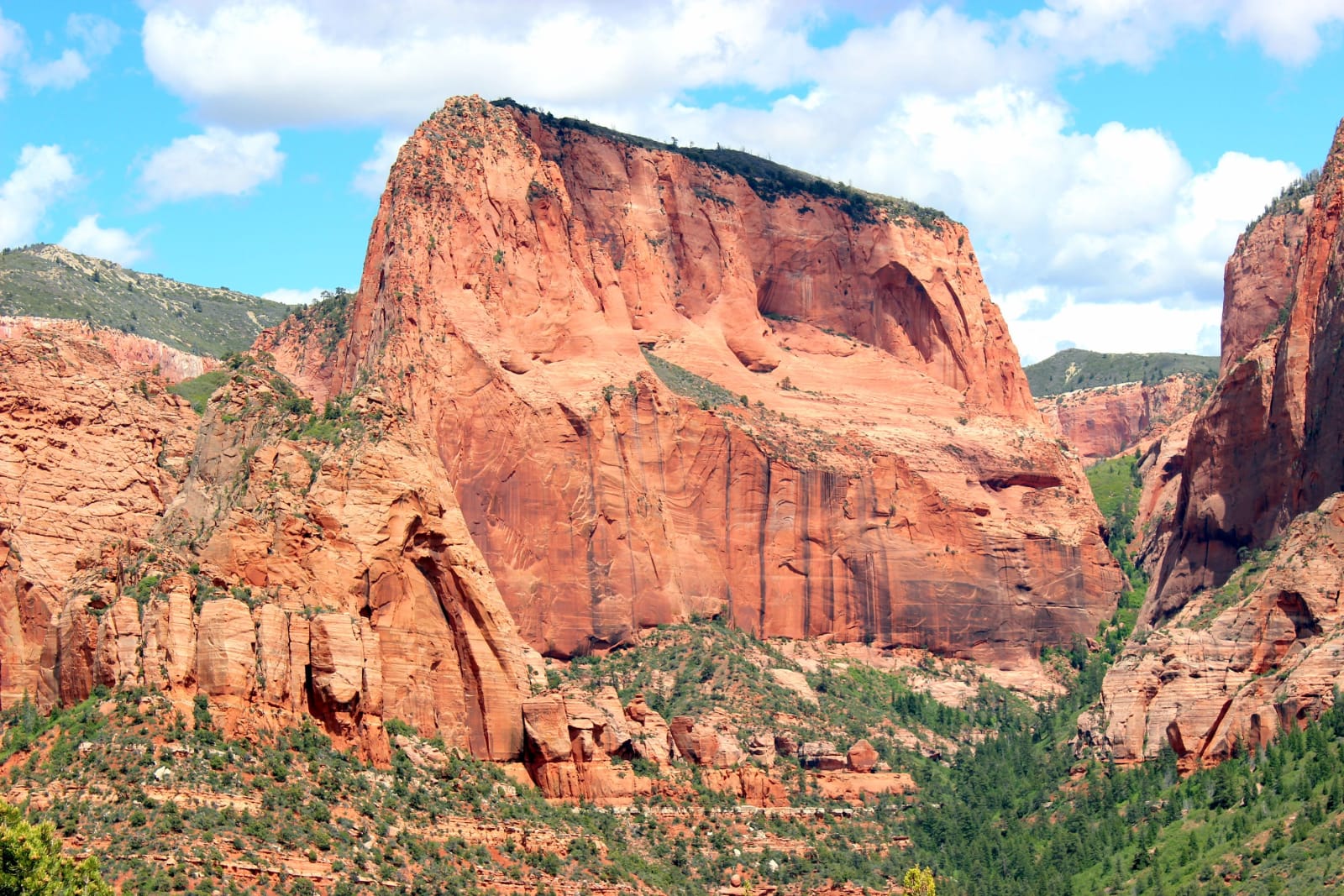
The finger canyons of the Kolob are a series of deep, narrow, parallel canyons carved into the western edge of the Kolob Terrace, and the rock walls that define them are among the tallest sheer cliffs in the world. The Navajo Sandstone walls rise over 1,500 feet in places, their surfaces streaked with desert varnish in patterns that look like dark waterfalls frozen on the cliff face. The scale is immense — the canyons are deep enough and narrow enough that the walls seem to lean toward each other overhead, creating a sense of enclosure that the wider main canyon does not produce.
The scenic drive climbs from the visitor center at the base through a series of switchbacks, passing viewpoints that look directly into the finger canyons. Each viewpoint offers a different perspective — some look down the length of a canyon toward the distant desert, others look across to the opposite wall, and all of them frame the red and cream sandstone in compositions that seem too perfectly balanced to be natural. The Timber Creek Overlook at the end of the road is the climax — a short half-mile trail that leads to a promontory with views stretching across the entire Kolob section and south toward the main body of the park.
Kolob Arch, deep in the backcountry accessible by a 14-mile round-trip hike, is one of the largest freestanding arches in the world. Measuring 287 feet in span, it rivals Landscape Arch in Arches National Park for the title of longest natural arch, depending on how the measurements are taken. The hike to reach it follows La Verkin Creek through a canyon of increasing beauty, passing waterfalls, hanging gardens, and campsites tucked into alcoves along the creek. The arch itself is visible from a distance, spanning a high alcove in the Navajo Sandstone like a bridge between two cliff faces. The hike is long enough and strenuous enough to filter out casual visitors, and reaching the arch — after seven miles of canyon hiking — produces a sense of earned discovery that drive-up viewpoints cannot replicate.
The Taylor Creek Trail, a moderate five-mile round-trip hike, offers a more accessible introduction to the Kolob backcountry. The trail follows the Middle Fork of Taylor Creek upstream through a narrowing canyon, passing two historic pioneer cabins — the Larsen Cabin and the Fife Cabin — before reaching the Double Arch Alcove, a massive curved overhang in the canyon wall. The alcove is not a true arch but a sweeping concavity carved by water seepage and frost action, and its scale — hundreds of feet wide and over a hundred feet high — dwarfs the hikers standing beneath it. The trail crosses the creek multiple times, and in spring the water can be ankle-deep, adding a playful element to an otherwise straightforward walk.
The geology of the Kolob section is the same Navajo Sandstone that defines the main canyon, but the erosion patterns are different. The finger canyons were carved by streams flowing west off the Kolob Terrace, cutting parallel channels into the sandstone along fracture lines. The result is a landscape of long, narrow canyons separated by tall, thin ridges — a corrugated terrain that looks from above like the pleated folds of a curtain. The uniformity of the rock type gives the Kolob section a visual coherence that contrasts with the more varied geology of the main canyon.
The Kolob Canyons visitor center, at the base of the scenic drive just off the interstate, is small but well-staffed. Rangers provide trail information, backcountry permits, and the kind of specific local knowledge that makes the difference between a good hike and a great one. The visitor center also sells the park pass that covers both the Kolob and main Zion entrances, so visitors heading south to Springdale can buy their pass here and skip the entrance line.
Kolob Canyons is 40 minutes from the main Zion entrance by highway, and most visitors who enter the park at Springdale never make it here. That separation is Kolob's defining characteristic — it has the geology, the grandeur, and the trails of a world-class national park section, but without the shuttle buses, the crowded viewpoints, and the timed entry permits that have become part of the main canyon experience. On a weekday in the shoulder season, you might hike the Taylor Creek Trail and see a dozen people. In the main canyon on the same day, you would see thousands.
The quiet is not an accident. It is a gift, offered by geography and interstate exit numbering to anyone willing to take a small detour from the expected route. Kolob Canyons is Zion without the crowds, and that distinction alone makes it one of the most valuable secrets in the Utah national park system.
Visitor Info
On the Map
Nearby
The closest stops worth working into your route
Historical markers nearby
Roadside plaques and monuments within a short detour