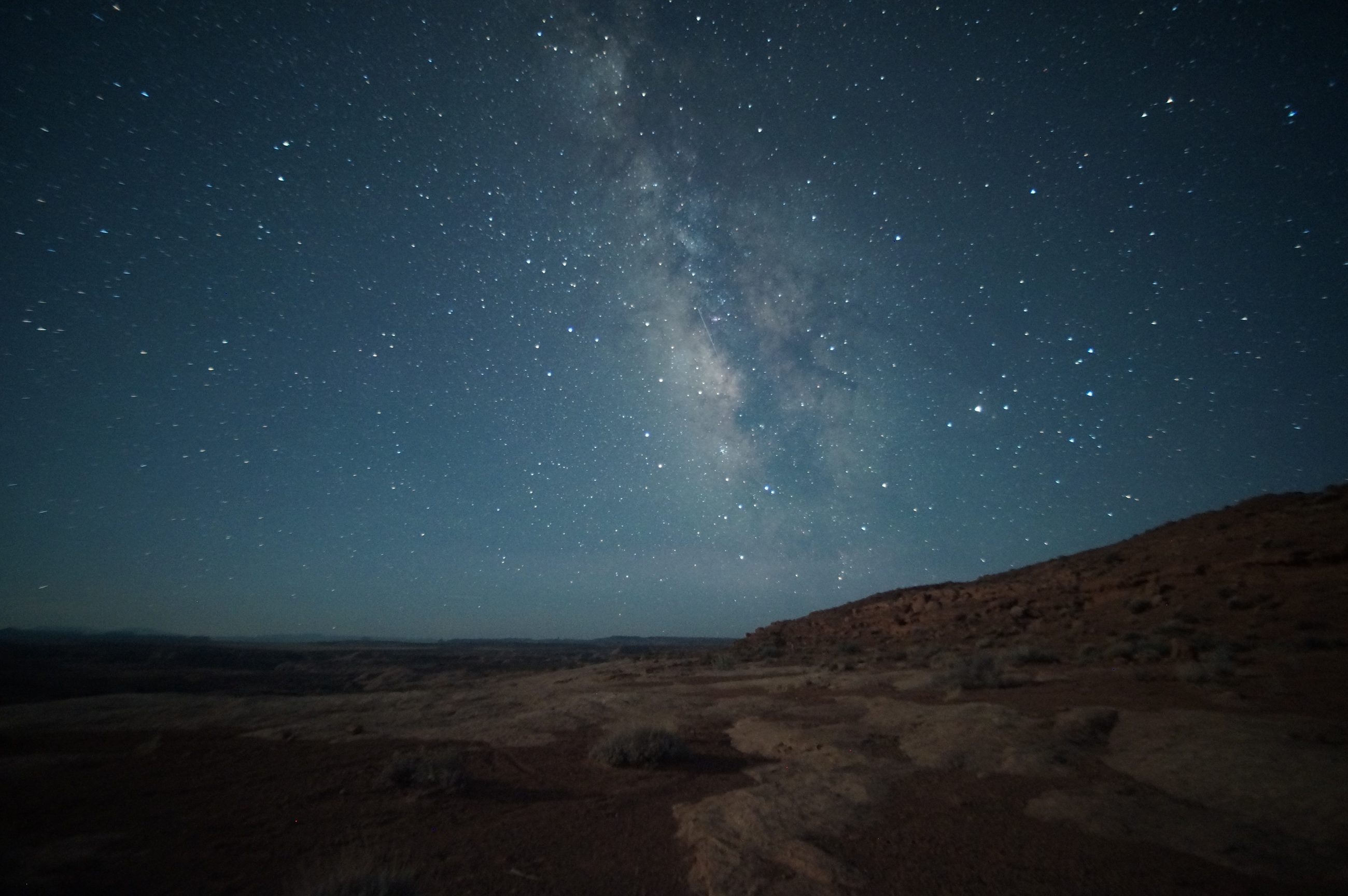
When an earthquake knocked the power out across Los Angeles before dawn in 1994, the emergency lines reportedly took calls from residents who had seen something strange overhead and wanted to know what it was: a vast, pale, silvery cloud stretched clear across the sky. It was not a cloud. It was the Milky Way — the arm of our own galaxy, the same one every human being before about a century ago saw on any clear night of their lives. The people of a great modern city had simply never seen it, because their own light had erased it, and the one night the lights went out it frightened them.
That is where most of us now live. And out on a few high, empty corners of Utah, the thing those Angelenos mistook for a cloud is just the sky — every clear night, exactly as it has always been. It has quietly become one of the rarest sights in the country.
A sky almost everyone has lost
The numbers are stark. A global atlas of night-sky brightness, assembled from satellite data and tens of thousands of ground measurements, found that the Milky Way is now hidden from a third of all humanity — and from roughly eighty percent of North Americans. More than ninety-nine percent of people in the United States live under a sky measurably brightened by artificial light, under the orange dome of skyglow that hangs over every town and bleeds for miles into the country around it.
And it is getting worse faster than almost anyone notices. A 2023 study built from tens of thousands of naked-eye star counts found the night sky brightening by about ten percent a year — a rate that doubles the glow roughly every eight years. Put concretely, a child born where two hundred and fifty stars are visible would, by the time they turned eighteen, be able to see only about a hundred. The night that all of human history unfolded beneath is being switched off within a couple of generations, almost no one having decided that it should be.
Why the Plateau kept its dark
The Colorado Plateau is the great exception — the largest single reservoir of natural darkness left in the lower forty-eight. The reasons are unglamorous and they stack up. Almost nobody lives out here, so there are no cities within a hundred miles to throw a dome of light into the sky. The land is high, and the air is bone-dry, so there is little moisture or dust to catch stray light and scatter it. And the nights run clear and cloudless for long stretches. The result is that the sky over this corner of Utah still does what skies did for every generation before the electric light: at a genuinely dark site the Milky Way is bright enough to cast a faint shadow on the ground, its pale band textured with dark dust lanes, and the stars are so thick that the constellations you thought you knew can be hard to find inside the crowd.
Utah, capital of the night
Utah has leaned into this harder than anywhere on Earth, and now holds the highest concentration of certified Dark Sky places in the world — parks, monuments, and whole towns that have rewritten their outdoor lighting to keep the night intact. It began here, too. On the sixth of March, 2007, Natural Bridges, far out on Cedar Mesa, became the first International Dark Sky Park ever certified, anywhere in the world — singled out for an almost total absence of light pollution that makes it one of the darkest units in the entire National Park System.
The roster has grown up around it. Dead Horse Point, on its cliff above a bend of the Colorado, was the first Utah state park to earn the designation. Capitol Reef and Goblin Valley hold some of the darkest skies in the center of the state; Bryce Canyon, with its thin, high air, has run astronomy programs and star parties for decades; and Cedar Breaks, perched above ten thousand feet, offers a window onto the sky from nearer to it than almost anywhere else you can drive. At each one, rangers point telescopes at the dark and the managers actively fight to keep it that way.
Why darkness is worth keeping
It is easy to file a dark sky under scenery — a pleasant bonus thrown in with the red rock. It is a great deal more than that. The night is half of the living world, and an enormous amount of life runs on real darkness. Billions of birds migrate at night and steer by the stars, and artificial light pulls them off their routes and into lit buildings, where they die by the million. Something like half of all insect species are nocturnal, and lights draw them in and exhaust them against the glass, fraying the food webs and the night-time pollination that depend on them. Bats, the courtship flares of fireflies, the hunting of every nocturnal predator — all of it is built for a night that is actually dark.
And for people, the loss runs deeper than a missed view. A sky full of stars is the oldest thing every human culture has shared. It is what our ancestors set their myths and calendars and sense of their own smallness against, the common ceiling over every civilization that ever existed — and we are, quietly, the first people in the history of the species to be losing it.
The pollution you can switch off
There is a piece of unexpected good news folded into all of this. Light pollution is almost unique among the ways we have fouled the planet, because it leaves nothing behind. It is not carbon banked in the atmosphere for a century or plastic shed into the ocean for good. It is just light — and the instant you shield a fixture so it throws its beam down instead of up, or simply switch it off, the dark comes straight back, the same night that was always waiting behind it. That is how Utah's small towns have reclaimed their skies: not through some heroic cleanup but by changing their bulbs and pointing them at the ground. Almost nothing else we have broken can be mended that quickly, or that cheaply.
Standing under the real one
The thing about a truly dark sky is that it cannot be faked, or borrowed from a photograph, or rushed. You have to drive out past the last town, switch off the headlights, and then wait — a full twenty minutes in the cold while your eyes give up on the day and adjust to the dark, until the faint stars swim up out of nowhere and the band of the galaxy resolves into focus overhead. What arrives is not a light show and not scenery. It is the actual sky, the real one, the one that nearly everyone alive has lost — still here, for now, over a few quiet corners of Utah that decided it was worth keeping the lights off.