The Story
Brian Head is the highest town in Utah, and it does not let you forget it. The drive up is the introduction: from the I-15 exit at Parowan, State Route 143 enters Parowan Canyon and climbs roughly 4,400 feet in under ten miles, a wall of switchbacks that delivers you, ears popping, to a town sitting at about 9,800 feet against the rim of the Markagunt Plateau. There is no gentle approach — you leave the high desert and arrive in spruce and aspen in the span of a single grade. Down on the desert floor the same Parowan exit serves, the Parowan Gap petroglyphs record centuries of Fremont and Paiute carving northwest of town.
The town exists because of the mountain and the snow. Brian Head Resort opened in 1964 as a single-chairlift operation and grew into Utah's southernmost ski area — and, at a base elevation around 9,600 feet, its highest. It now runs eight lifts across 71 runs and two peaks, catches something like 360 inches of snow a year, and holds a distinction no other Utah resort can claim: red-rock hoodoos, dusted with snow, standing in the same view as the ski runs, borrowed from the Cedar Breaks country next door. The town of Brian Head was incorporated about a decade after the resort opened, and it has stayed small — a strip of lodges, rentals, and restaurants strung along the highway, oriented toward the slopes in winter and the trails in summer.
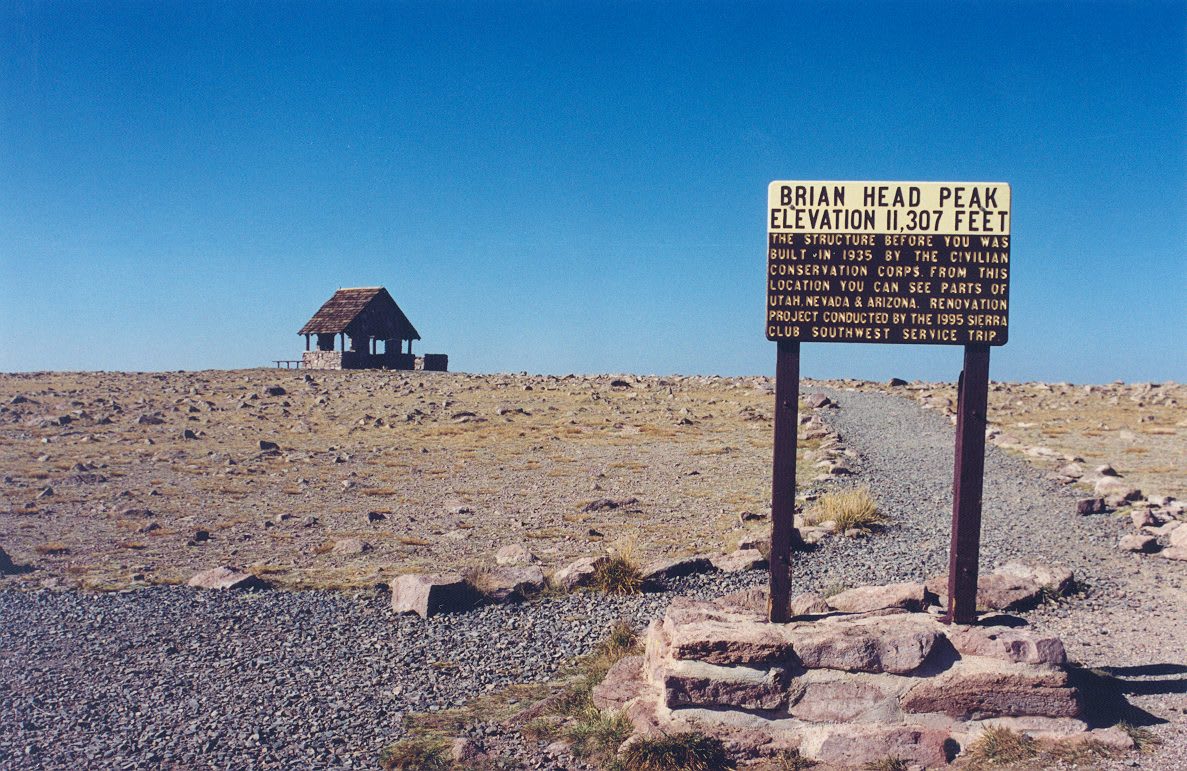
Because that is the other half of Brian Head: it is not only a winter town. When the snow goes, the resort runs its lifts for a mountain-bike park, and the high country opens to hiking, disc golf, and the cool air that draws people up from the furnace of the southern Utah desert in July. Above town rises Brian Head Peak, at 11,312 feet the highest point on the Markagunt Plateau, with a Forest Service stone shelter built by the Civilian Conservation Corps in 1934–35 still standing on its summit; a dirt road climbs the last stretch in summer to a viewpoint that, on a clear day, reaches a hundred miles in every direction.
Even the name is unsettled. The peak was once called Monument Peak, and the accounts of how it became "Brian Head" disagree — one credits a government surveyor named Bryan, another says Parowan residents renamed it in 1890 for the politician William Jennings Bryan — so the honest answer is that no one is certain. What is certain is the position: Brian Head sits in the middle of everything, within an easy drive of Cedar Breaks National Monument, Zion, and Bryce Canyon, which makes it less a single destination than a high, cool base camp for the whole plateau.
Visitor Info
On the Map
Stories featuring this place
Go deeper into the history and character of this stop
Nearby
The closest stops worth working into your route
Historical markers nearby
Roadside plaques and monuments within a short detour