There is a particular kind of town the West is full of: the kind that came up fast around a hole in the ground and then had to decide what to do when the ore ran out. Some died outright. Some hung on at a fraction of their peak, their grand buildings too solid to fall and too many to fill. A few reinvented themselves and never looked back. This trail follows that arc — the boom-and-bust story of Western mining — across three states and roughly a century, from the silver strike that built Nevada to a copper pit in Utah that is still being dug.
It is not one road. The stops are scattered across a quarter of the country, and stitching them into a single drive would take a determined couple of weeks. Follow it in pieces instead: a Comstock weekend, a run down the loneliest road, an Arizona copper loop. What holds it together is not geography but the pattern — the same story told in silver, in gold, and in copper, in towns that boomed on the same promise and met a dozen different ends.
Read them honestly. These strikes happened on land that was never empty — Newe, Nuwuvi, Diné, and Western Apache homelands, taken as the mines came in — and the work underground was done in large part by Cornish, Chinese, Mexican, and immigrant hands the boomtown histories tend to forget. The wealth that left these hills built cities somewhere else. What stayed behind is what you have come to see: the headframes and opera houses and Boot Hills, the arrested decay, and the one place at the end where the digging never stopped.
The stops
In order along the arc — not one road, but one story told thirteen ways.
Where it started. The Comstock Lode was the richest silver strike in American history, and the city stacked on top of it built Nevada — then shrank from twenty-five thousand people to under a thousand.
Visit Virginia City →The boom that overreached: ten thousand people chasing silver up a canyon on US-50, now under two hundred living among the brick shells the rush left behind.
Visit Austin →The exception. The 1900 strike here pulled Nevada back from the brink, and this is the one great camp that never quite became a ghost. Stay after dark for some of the blackest skies in the country.
Visit Tonopah →The purest boom-and-bust in the West: once the largest city in Nevada, now a few hundred souls among a castle courthouse, a grand hotel dark since the war, and a desert full of upended cars.
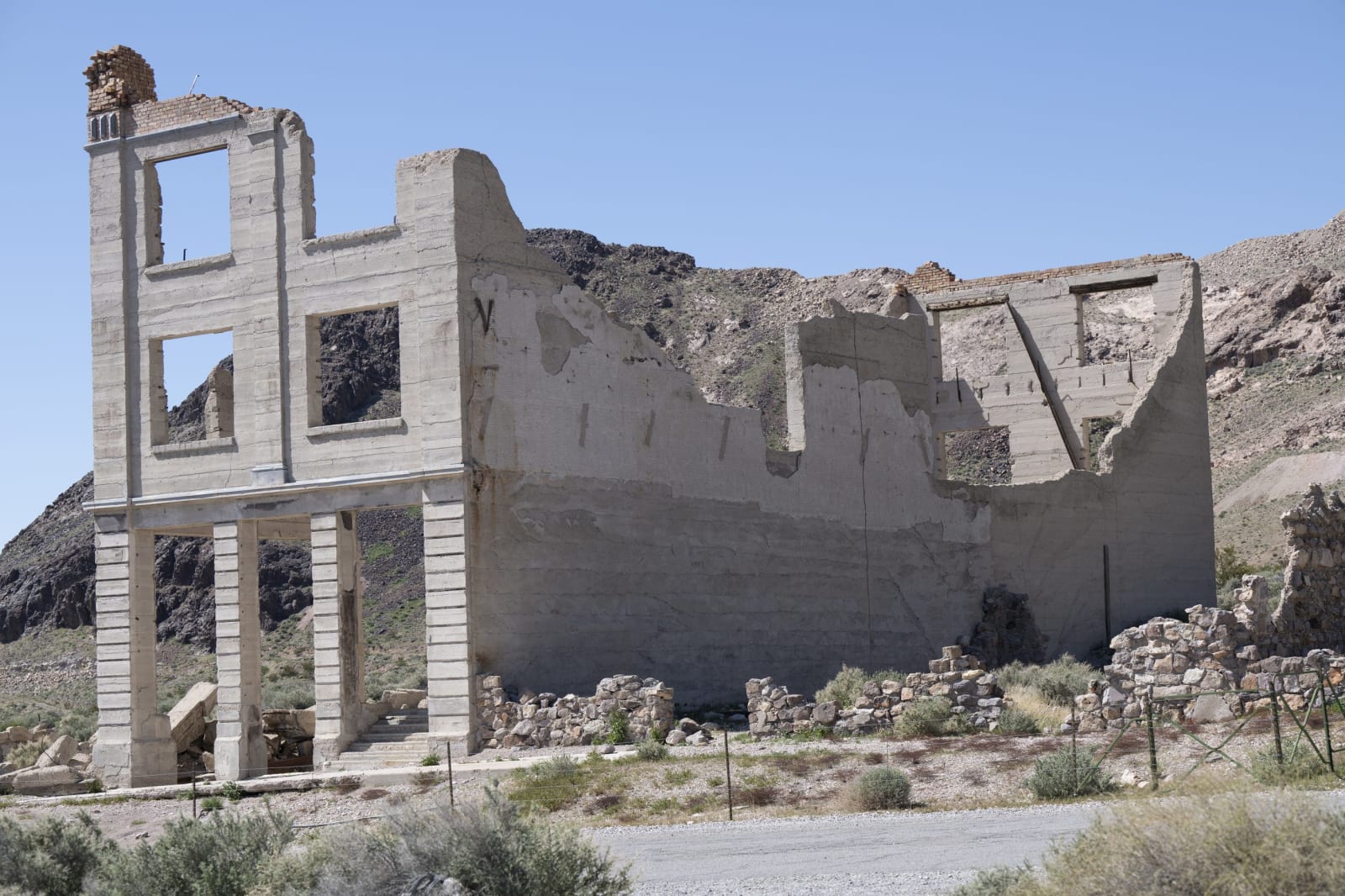
Visit Goldfield →Where the arc runs all the way to ghost. A stone city with an opera house and a marble-stepped bank rose and died inside a single decade — now the most photographed ruin in the West.
Visit Rhyolite →The long exhale. A gold camp frozen in arrested decay since 1911, beside a quarry of fifty-foot sea reptiles that died in this rock over two hundred million years before the miners arrived.
Visit Berlin-Ichthyosaur State Park →The wild card — the silver camp that, by legend, out-killed the entire Old West, with boots-on graves on Boot Hill and a courthouse that cost a fortune in graft before the first gavel ever fell.
Visit Pioche →Across the Colorado into Arizona gold. A Black Mountains camp that outlived its mines and is now run by the wild burros the miners left behind — reached by the wildest switchbacks left on Route 66.
Visit Oatman →The billion-dollar copper camp clinging to the thirty-degree face of Cleopatra Hill — and, at its low ebb, the self-styled largest ghost town in America. It came back as an arts town instead.
Visit Jerome →The silver strike named for a death that never came, staked in the middle of the Apache Wars. The mines flooded and closed; the legend of a thirty-second gunfight kept the town alive.
Visit Tombstone →The Queen of the Copper Camps, stacked up a canyon with nothing level left for houses — and the town that long tried to forget the 1917 deportation, when it loaded twelve hundred striking miners onto cattle cars and abandoned them in the New Mexico desert.
Visit Bisbee →Into Utah, and the most photogenic ghost town in the West — adobe and cottonwood on the Virgin River beneath Zion's cliffs, familiar from Butch Cassidy and the Sundance Kid.
Visit Grafton Ghost Town →The closer, and the counter-argument: the West's mining boom never really ended, it industrialized. This is the largest man-made excavation on Earth — three-quarters of a mile deep, two and a half miles across, and still widening.
Visit Bingham Canyon Mine →