 Jerrye & Roy Klotz MD / CC BY-SA 3.0
The Story
Tonopah is the boom town that refused to become a ghost. The silver strike here in 1900 set off Nevada's twentieth-century mining rush and pulled the state back from the brink, and where the camps it inspired — Goldfield, Rhyolite, a dozen others — flared and died inside a generation, Tonopah simply kept going. It is still here: about two thousand people, still the seat of Nye County, still the only real town for a hundred miles in any direction, planted at the lonely crossroads of US-6 and US-95 exactly halfway between Reno and Las Vegas. The Queen of the Silver Camps is now mostly a place people pass through — but it is one of the great places in Nevada to stop.
The mine is still here too, in the middle of town. The Tonopah Historic Mining Park spreads over a hundred acres on the original claims, right where the first ore came out, and unlike almost anywhere else you can walk straight into the workings — headframes, hoists, and ore bins preserved where they stood, with self-guided trails threading between them. The signature moment is the Burro Tunnel, where you stand on a steel grate and look straight down a five-hundred-foot stope into the dark, and feel in your stomach what these men did for a day's wage. There is no better place in the state to understand hard-rock silver mining, because you are standing in it.
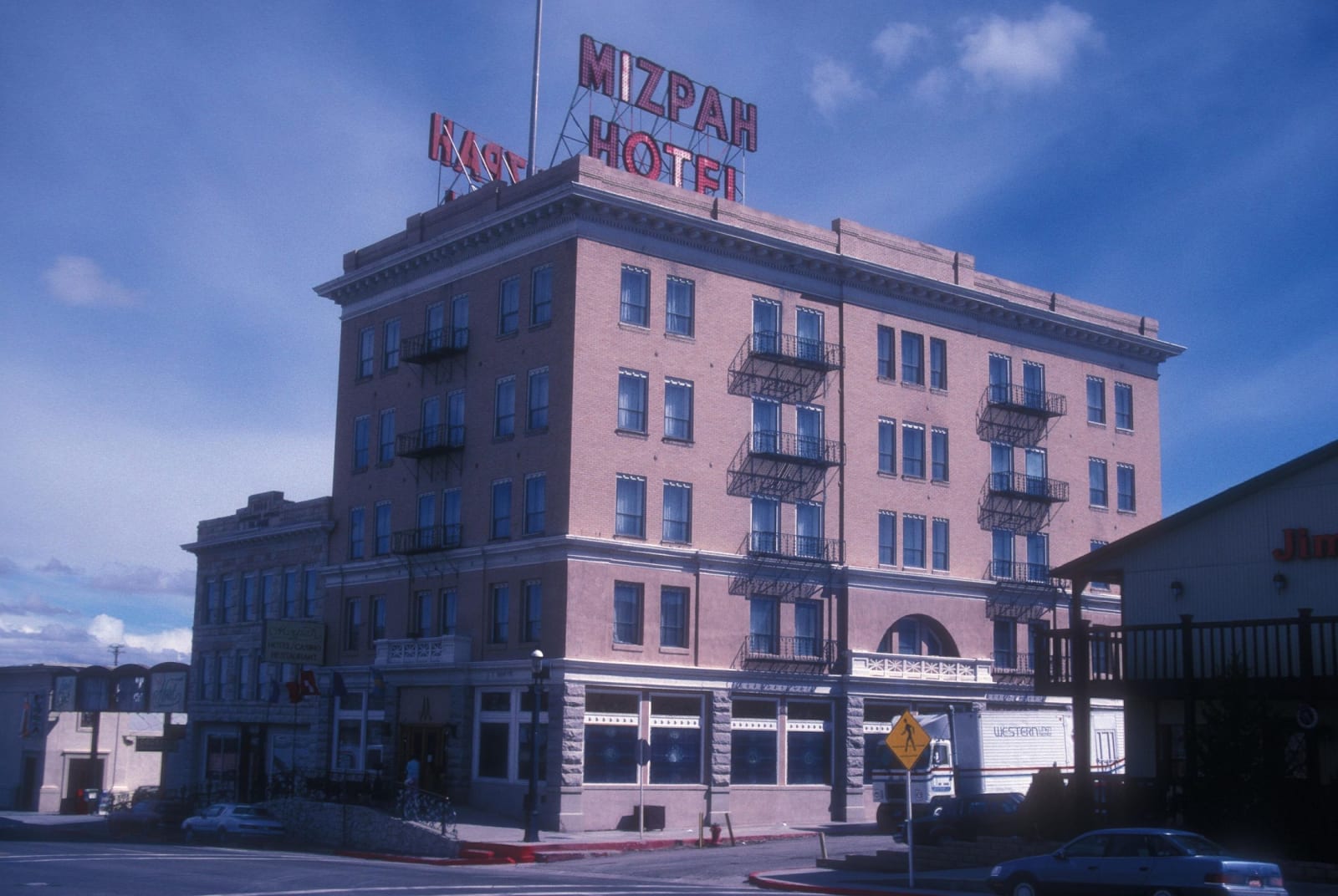
Downtown, the boom's good bones have been brought back to life. The Mizpah Hotel — built in 1907, five stories, once the tallest building in Nevada — has been restored to its full mahogany-and-brass glory and is the only Nevada hotel on the Historic Hotels of America roll; it trades cheerfully on its resident ghost, the Lady in Red, and pours a good drink in a lobby that looks the part. Across the street the Belvada, a 1906 bank turned boutique hotel, does the same. You can sleep in 1907 here, and eat well — not something most desert crossroads can offer.
And then there is the other Tonopah, the one that has made it a destination for the strange. At the north end of Main Street the Clown Motel — better than two thousand clown figurines crowding its lobby, custom clown paintings in every room — sits directly beside the Old Tonopah Cemetery, where the town's first generation lies under hand-cut headstones, plague victims and mine-fire dead among them. It is exactly as unsettling as it sounds, and entirely on purpose. Step outside after dark and the other draw takes over: USA Today named Tonopah the single best stargazing spot in America, and on a moonless night the Milky Way comes up so bright over the Stargazing Park that it nearly throws a shadow.
Overhead and out of sight is the modern desert. The Tonopah Test Range, off-limits at the edge of town, has tested nuclear weapons and ordnance for decades and quietly birthed the F-117 stealth fighter, which flew here in secret for years before the public ever saw it — Tonopah keeps that part to itself. What's here now for a traveler is a tidy, friendly, genuinely strange little town: the free Central Nevada Museum, a couple of saloons, the restored hotels, the mining park, and the Indigenous and Western Shoshone history the museum takes care to tell. It is a working place, not a reenactment.
It makes the natural base for the whole quarter — Goldfield is twenty-six miles south, the ghost towns of Belmont and Manhattan an easy drive up into the hills, and the long lonely highways to Rhyolite, Cathedral Gorge, and the Extraterrestrial Highway all begin here. Come for an afternoon in the mine and stay for the night sky. In a region built on what the desert gives up and then takes back, Tonopah is the one town that decided to stay.
Visitor Info
On the Map
Stories featuring this place
Go deeper into the history and character of this stop
Nearby
The closest stops worth working into your route
Historical markers nearby
Roadside plaques and monuments within a short detour