 Zongxianglee / CC BY 4.0 via Wikimedia Commons
The Story
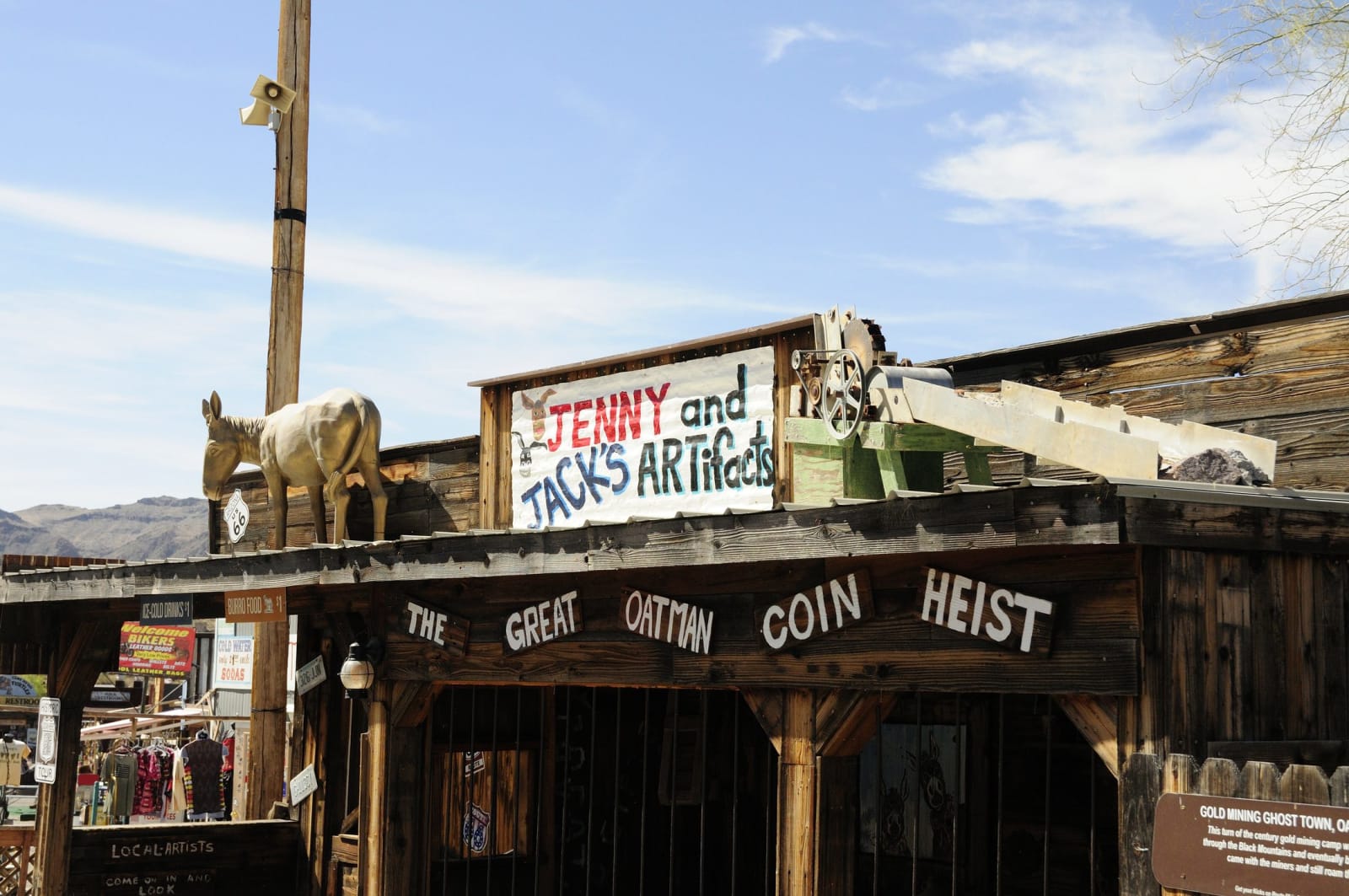
West of Kingman the old highway does something no interstate would ever be allowed to: it climbs straight into the Black Mountains on a set of cliff-edge switchbacks, tops out at Sitgreaves Pass, and drops into Oatman, a gold camp that should have died three times over and refused each time. Gold was found in these volcanic hills in 1863, but the real rush came in 1915, when two rich mines opened and thousands of prospectors poured in almost overnight; the district pulled roughly forty million dollars in gold from the mountains before the government shut the mines as nonessential to the war effort in 1942. When Route 66 came through, Oatman lived on travelers instead of ore. When Interstate 40 bypassed it, the travelers came back anyway — for the ghost town itself.
Today the town is run, more or less openly, by burros. The wild donkeys that wander the main street and shoulder up to visitors for a handout are descendants of the pack animals the miners turned loose when the mines closed; they graze in the mountains at night and clock in by morning, and federal law protects them. Around them the town trades in wooden sidewalks, staged gunfights, and the 1902 Oatman Hotel, the oldest two-story adobe building in Mohave County, which trades hard on the legend that Clark Gable and Carole Lombard honeymooned there after their 1939 Kingman wedding. Historians doubt they stayed the night — the couple drove back to Los Angeles for a press call — but Gable did return often to play cards with the miners, and the town has never seen a reason to let the better story go.
The name carries a harder history, and it deserves to be told straight. The town takes it from Olive Oatman, a girl of about fourteen whose family, Mormon emigrants bound for California, was attacked in 1851 — most of them killed — by a party most likely of Tolkepaya, the Western Yavapai. Olive and her younger sister were taken, then traded to the Mohave, who adopted them and tattooed Olive's chin in the mark of the tribe. Her sister died in a famine; Olive lived among the Mohave until 1856, when she was ransomed back at Fort Yuma. The captivity narrative published afterward made her a sensation and painted her captors as savages — but the fuller record is stranger and sadder: a girl absorbed into one people after another people had destroyed her family, marked as belonging to the very tribe the story taught the country to fear. The town wears her name lightly. The history under it is worth carrying with more care.
Visitor Info
On the Map
A story featuring this place
Go deeper into the history and character of this stop
Nearby
The closest stops worth working into your route
Historical markers nearby
Roadside plaques and monuments within a short detour