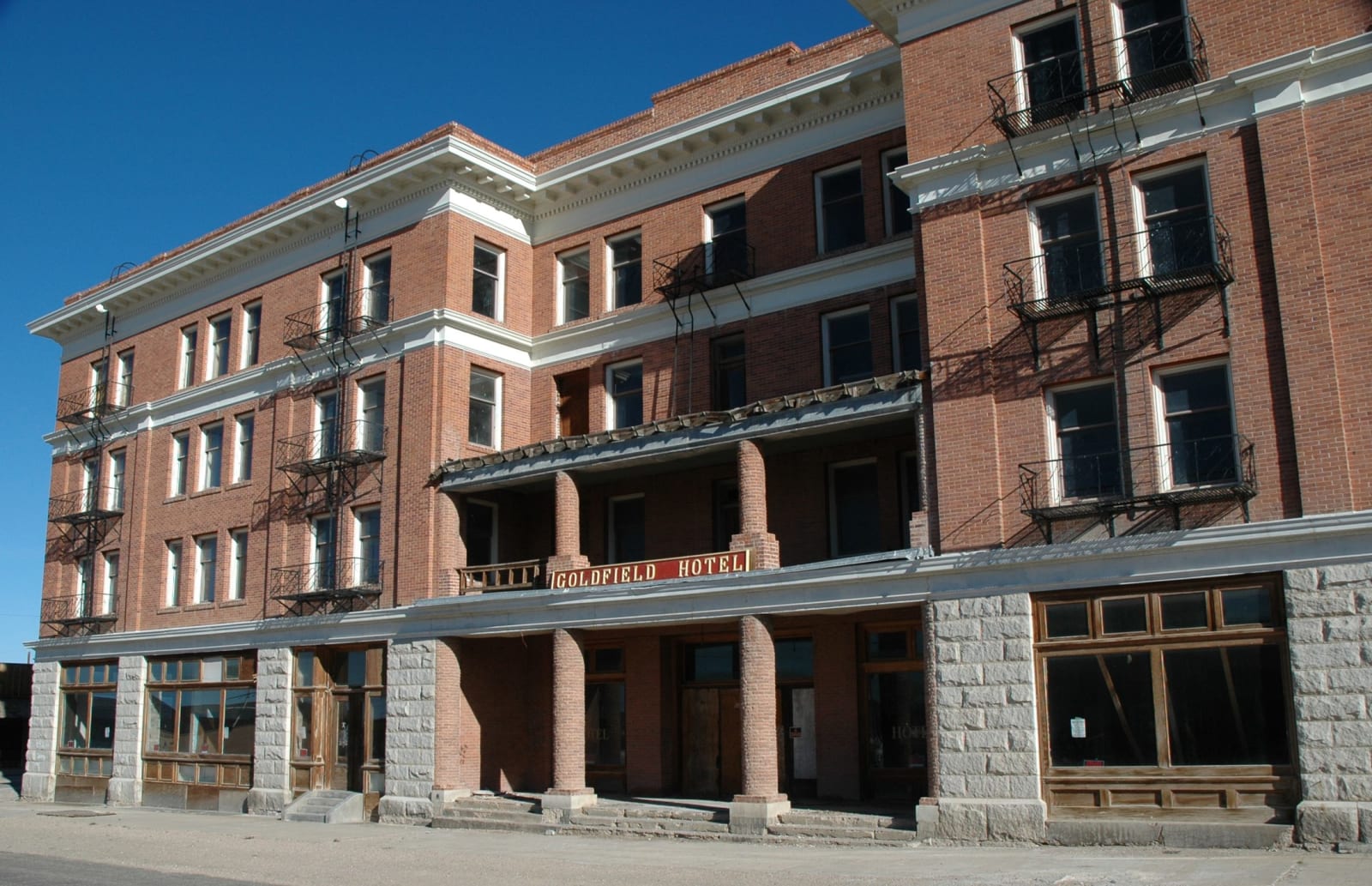
 Vivaverdi / CC BY 3.0
The Story
Twenty-six miles south of Tonopah, Goldfield is the purest boom-and-bust story in the West, and the most spectacular ruin of one. Gold turned up here in 1902, and within four years this patch of empty desert had become the largest city in Nevada — twenty thousand people, some say thirty, with five banks, three newspapers, a stock exchange, a red-light district, and a saloon so long it took eighty bartenders to work it. It was the last great gold rush in the West, and for a few years around 1906 Goldfield was the richest, rowdiest, most self-important place in the state. Today about two hundred and fifty people live here. The distance between those two numbers is the whole story.
The gold was found, by most honest accounts, by a Western Shoshone prospector named Tom Fisherman, whose lead two Tonopah men followed to stake the first claims in late 1902. What they first called Grandpa became Goldfield, and the strike proved deep and rich enough to draw the whole country across the desert — by the new automobile as much as by rail. Money built the town fast and built it to last: not the clapboard of an old silver camp but brick and native stone, electric light and telephone lines, a courthouse fit for a city ten times the size.
Nothing captures the boomtown's swagger like the prizefight. In 1906 the saloon-keeper and promoter Tex Rickard, wanting to put Goldfield on the national map, threw up an eight-thousand-seat arena in the desert and staged the Gans-Nelson Lightweight Championship of the World on Labor Day. Joe Gans — the first African American world boxing champion — beat Battling Nelson when Nelson was disqualified for a low blow in the forty-second round, a gloved-title-fight length that still stands in the record books. The stunt worked: the fight made national headlines, and Goldfield with it. Rickard took his winnings and his gift for spectacle east, where he went on to build the original Madison Square Garden.
Behind the boosterism was hard money and harder politics. George Wingfield, a poker player turned mining magnate, merged the richest mines into the Goldfield Consolidated and built a near-monopoly — the foundation of a political machine that would run Nevada for the next forty years. When the miners' unions, the Western Federation and the radical Wobblies of the IWW, pushed back, the fight turned bitter; in 1907 the governor talked President Theodore Roosevelt into sending federal troops to Goldfield, who broke the unions for the owners. It was one of the ugliest labor episodes in Western mining, and it happened at the very height of the town's wealth.
The fall was as fast as the rise. The ore pinched out, pumping water from the diggings turned unprofitable, the biggest company pulled out by 1919; a flash flood took the town in 1913, and a fire — set off, fittingly, by an exploding moonshine still — burned most of it in 1923. What survived stands today in a strange, half-empty grandeur. The 1907 Esmeralda County Courthouse, native sandstone and castle-turreted, is still in use, its original Tiffany lamps still lit; across town the Goldfield Hotel, the most luxurious in Nevada when it opened in 1908, has stood dark and shuttered since the Second World War, reputed one of the most haunted buildings in the country. The Santa Fe Saloon has poured without a break since 1905.
What's here now is a living ghost town that takes its own history seriously — a few hundred residents, still the seat of Esmeralda County, keeping the courthouse open and the worst of the ruins from falling down. Walk the wide quiet streets and the scale of what's missing does the talking. Then drive a mile out to the International Car Forest of the Last Church, where dozens of cars, trucks, and buses stand planted on end and stacked in the sage, repainted endlessly by visiting artists — a junkyard cathedral that is somehow the perfect monument to a town that once had everything and bet it all. Goldfield is what a boom looks like a century after it ends: not erased, just emptied, and strangely magnificent.
Visitor Info
On the Map
Stories featuring this place
Go deeper into the history and character of this stop
Nearby
The closest stops worth working into your route
Historical markers nearby
Roadside plaques and monuments within a short detour