 Famartin / CC BY-SA 4.0
The Story
Virginia City is a town that sits directly on top of its own reason for existing. Beneath the wooden boardwalks and brick storefronts of C Street runs the Comstock Lode, a two-and-a-half-mile body of silver and gold that, after its discovery in 1859, turned a bare slope of Mount Davidson into one of the largest cities between Chicago and San Francisco. At its height in the mid-1870s, Virginia City and its downhill twin Gold Hill held around twenty-five thousand people, more than a hundred saloons, four banks, a stock exchange, churches, schools, and an opera house grand enough to draw performers on world tours. The silver under the street paid for all of it.
The boom ran hot and strange. The first prospectors had come for gold and cursed the heavy blue-gray clay that clogged their rockers, throwing it aside until an assay revealed it was nearly solid silver—the discovery that named the lode. What followed was less a gold rush than an industrial campaign: the ore lay deep and scalding, and reaching it took engineering the frontier had never seen. Miners worked levels thousands of feet down, in heat that forced them to rest in ice-cooled chambers, the tunnels held open by a lattice of square-set timbering invented here on the Comstock and later copied in deep mines around the world. The deeper the shafts went, the richer the ore, and the wealth they pulled up remade everything above ground.
That wealth bought more than machinery. A young failed prospector named Sam Clemens took a reporting job at the Territorial Enterprise, then the most powerful paper in the West, and in 1863 first signed a story "Mark Twain"; the name went around the world while the town that gave it to him stayed put. The Enterprise printed, the opera house filled, the mansions rose. Then, early on a windy October morning in 1875, a tipped lamp set off the Great Fire, which ran up the mountain and leveled three-quarters of the town in a matter of hours. Virginia City simply rebuilt—most of the brick you pass on C Street today dates from the months right after the fire, a town reconstructed at the very peak of its fortunes.
Those fortunes faded fast. By the late 1870s the richest ore was gone, the mines flooded and closed, and the people drained away as quickly as they had gathered. What saved Virginia City from vanishing, as so many Nevada camps did, is that it had been built in brick and stone for permanence—and that the whole town is, in effect, one enormous artifact of the silver age.
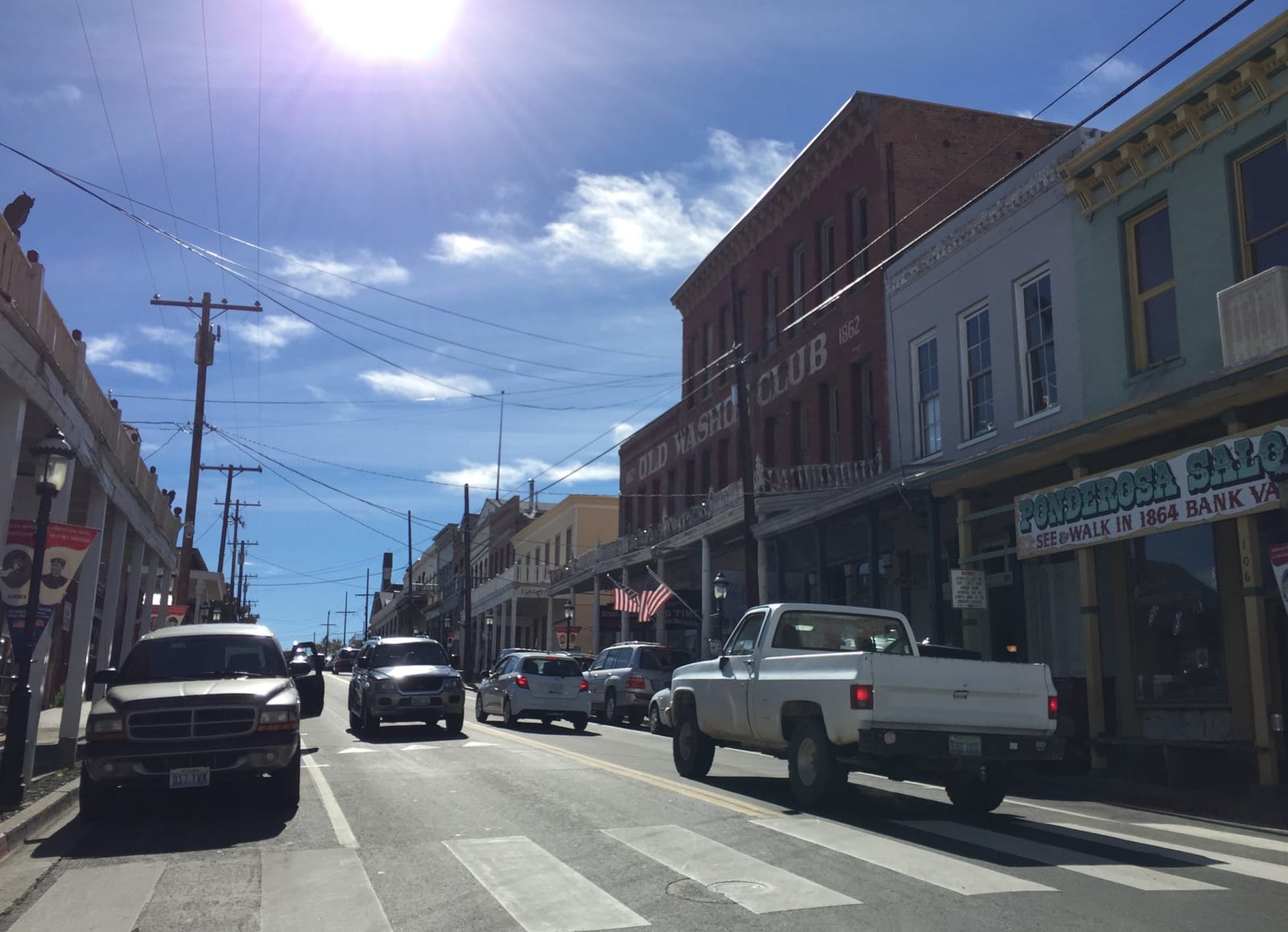
What's here now is a National Historic Landmark District of fewer than a thousand residents, lived-in rather than roped off. C Street still runs along the hillside under its wooden awnings, lined with saloons, museums, and shops and closed to chain businesses. Two mines are open to walk into: the Chollar, where the tour reaches a stope braced with the original square-set timbers, and the Best & Belcher, entered through the back of the Ponderosa Saloon. Piper's Opera House—the third on its site, rebuilt in 1885 after two fires—still has its raked stage, painted scenery, and the box seats where the bonanza kings once sat; self-guided tours run spring through fall. The Mark Twain Museum occupies the old Territorial Enterprise building, the 1876 Fourth Ward School holds a museum of the Comstock, and St. Mary in the Mountains has stood over the rooftops since 1877. From Memorial Day into October the Virginia & Truckee Railroad—once the richest short line in the country, running as many as forty-five trains a day—carries passengers on a thirty-five-minute run down toward Gold Hill, the same grade that once hauled bullion out and timber in.
The drive up is part of it: the Geiger Grade climbs the steep face from the Truckee Meadows, the modern road having replaced the original 1862 toll grade in 1936—the same steep climb refugees fled up the night the town burned. Reno is about forty minutes down one side; Carson City and the Mint that coined the lode's silver sit half an hour down the other. Stand on C Street and the whole region's story is under your boots—the strike that built a state, and the town that has spent a century and a half outliving it.
Visitor Info
On the Map
Stories featuring this place
Go deeper into the history and character of this stop
Nearby
The closest stops worth working into your route
Historical markers nearby
Roadside plaques and monuments within a short detour