 Famartin / CC BY-SA 4.0
The Story
US-50 does not skirt Austin; it climbs straight into it. The highway bends up Pony Canyon onto the west face of the Toiyabe Range and runs right down the main street of a town stacked on the grade at sixty-six hundred feet — stone storefronts, three church spires, a strange granite tower on the bluff above. Austin is a silver boomtown that swelled past ten thousand people in the 1860s and has since fallen to fewer than two hundred, and yet it never quite died. It is the classic Nevada living ghost town: too storied to abandon, too small to bustle, holding on in the high lonely middle of the loneliest road.
The whole thing started with a kicked rock. In May 1862 a former Pony Express rider named William Talcott was hauling wood out of Pony Canyon when he turned up a vein of silver-rich quartz — and the version everyone prefers is that his horse kicked the telltale stone loose. The assay came back rich, word ran, and the Rush to Reese was on. Thousands poured into the canyon through 1863; a promoter named David Buel laid out a townsite on the slope and named it for his partner, Alvah Austin. Within a year and a half this raw camp had a mayor, a police force, and the county seat — a city conjured out of sagebrush by the sheer speed of money.
At its height Austin was astonishing for its remoteness. The Reese River district pulled some twenty million dollars in silver from these hills, and the town spent it building itself into a real city — gas-lit streets, a courthouse, schools, and the Reese River Reveille, a newspaper founded in 1863 that would run for a hundred and thirty years and whose frontier wit got it compared to Mark Twain. Virginia City, briefly down on its luck, sold Austin its grand International Hotel, which was taken apart and freighted a hundred and seventy miles over the mountains. So many churches went up that Austin called itself the City of Churches; the Catholic, Methodist, and Episcopal spires that earned the name still stand, along with the 1863 bank that is now the town library.
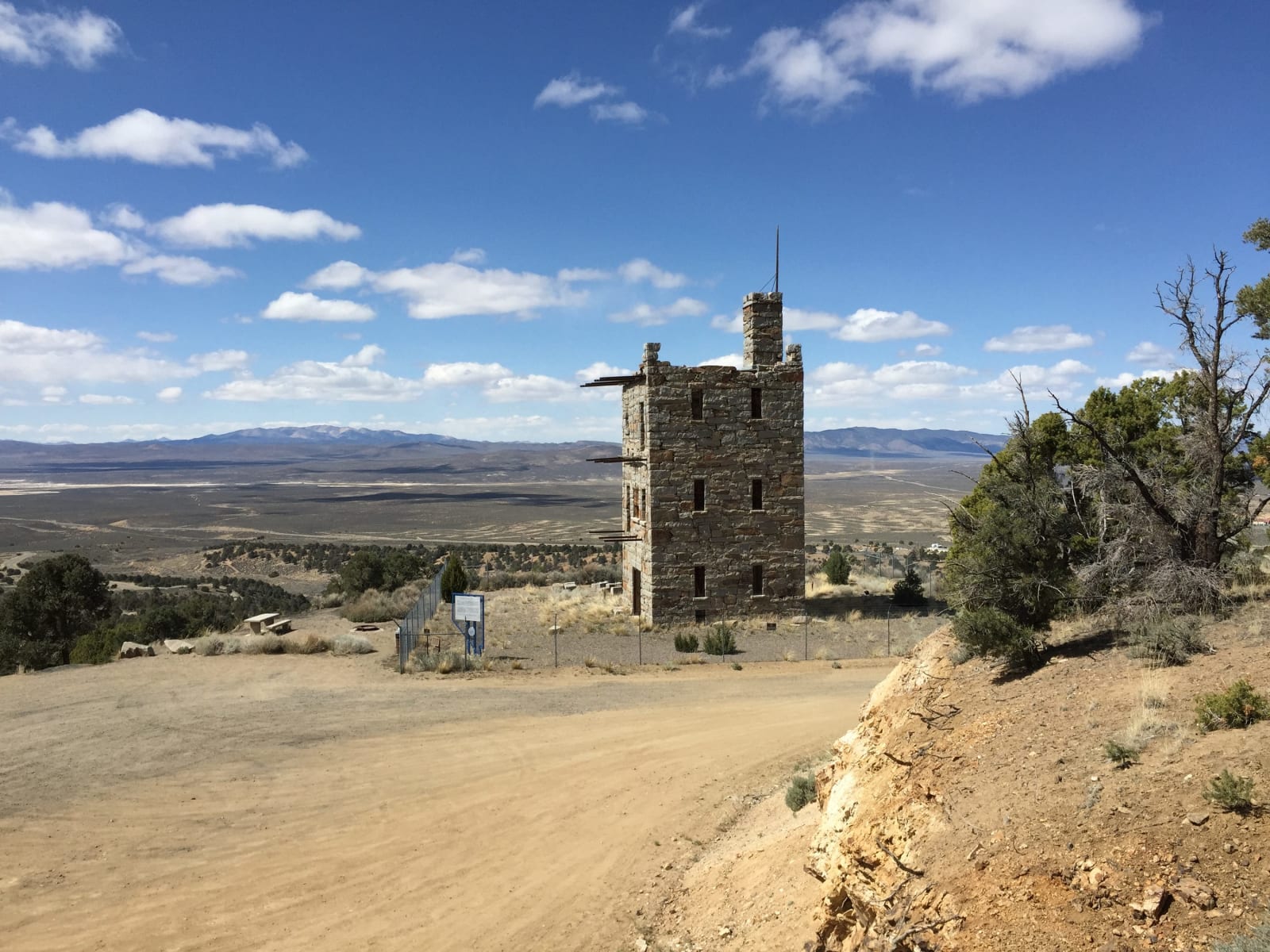
The strangest monument to all that money stands alone on a bluff at the west edge of town: Stokes Castle, a three-story tower of rough native granite that looks like it was airlifted out of Tuscany. The eastern capitalist Anson Phelps Stokes built it in 1897 as a summer retreat for his sons, modeling it on a medieval tower he had admired on the Roman campagna, the huge stones winched up by hand and set with clay mortar. The family used it for about a month, sold their Austin interests the next year, and never came back. It has stood empty ever since, open to the wind, and today you can drive the dirt spur up to it for free and look out over the Reese River Valley exactly as the Stokeses did for their single summer.
The boom did not last. The richest ore was gone by the late 1880s, the Nevada Central Railroad arrived in 1880 a little too late to save anything, and the town began its long slide — losing the county seat to Battle Mountain only in 1979, more than a century after the silver peaked. What kept Austin alive was its position: a trade and supply point on the one road across central Nevada, and later a way station for travelers on US-50. The result is a town that feels paused rather than dead — real residents, a working café and bar, a small historical museum in the old buildings, and just enough open doors to make a stop feel welcomed rather than intrusive.
Austin is also a doorway to country most of the highway's drivers never see. The Toiyabe Range rises straight above town toward Arc Dome, its high summit, and the Reese River runs cold out of those peaks past ranches in the valley below. Above the main street, Pony Canyon still holds the shafts and tailings of the strike that started everything, walkable on the old mining road. Within easy reach are Spencer Hot Springs out on the valley floor, a scatter of true ghost towns, and some of the best gravel and mountain-bike riding in the state. Twenty-four miles east the road climbs to the rock art at Hickison; Austin makes the natural base for all of it.
For a town this size it asks for real time. Drive up Pony Canyon for the view back over the rooftops, walk out to Stokes Castle at sunset, look in on the churches and the museum, and eat where the locals do — the International, a café and bar descended from that hotel dragged over the mountains in 1863. There is gas and food and a bed here, which on this stretch of road is not nothing. Most of US-50 is the space between towns; Austin is one of the few places the loneliest road stops being lonely, climbs a mountain, and becomes a town again.
Visitor Info
On the Map
Stories featuring this place
Go deeper into the history and character of this stop
Nearby
The closest stops worth working into your route
Historical markers nearby
Roadside plaques and monuments within a short detour