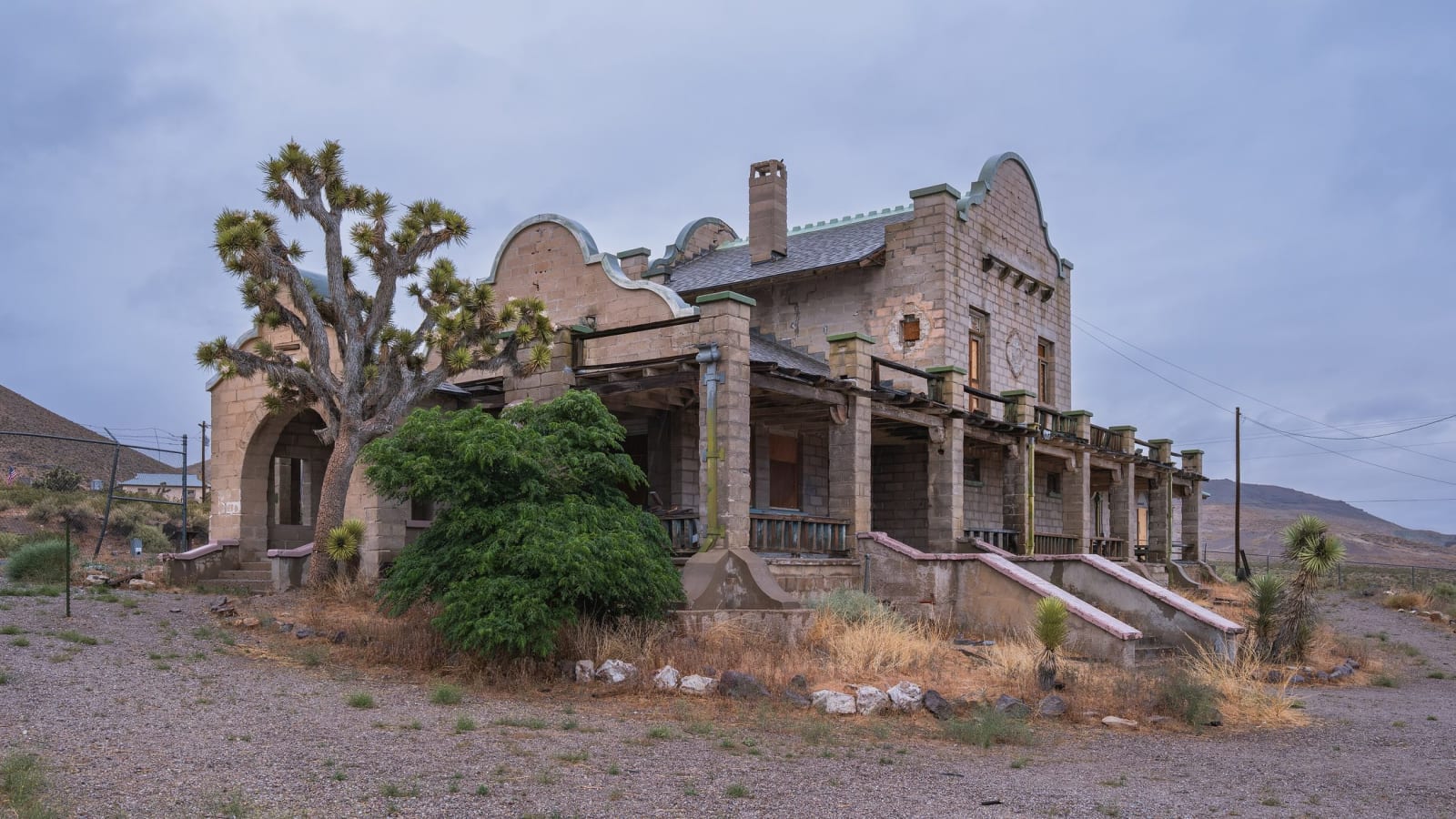
 Christian David / CC BY-SA 4.0
The Story
Where Tonopah survived and Goldfield half-survived, Rhyolite went all the way to ghost. It is the most complete boom-and-bust arc in Nevada — sagebrush to stone city to sagebrush in about eleven years — and the most photographed ruin in the state. The gold that built it was found on August 4, 1904, when two prospectors, Frank "Shorty" Harris and Ed Cross, struck rich ore in the Bullfrog Hills near the edge of what is now Death Valley. They named the claim Bullfrog for the green-tinged rock, the news ran north to the bigger camps, and the rush was on.
Rhyolite grew faster than almost any camp in the West. A two-man tent camp in January 1905 was a town of more than a thousand within two weeks and twenty-five hundred by that summer, with fifty saloons and its own daily paper. Then the steel magnate Charles Schwab bought the district's biggest mine, the Montgomery-Shoshone, in 1906 and poured in real money — piped water, electric lines, three competing railroads. By 1907 a town that had been bare desert thirty months earlier had concrete sidewalks and electric streetlights, telephones, a hospital and a school, an opera house, and a stock exchange.
That was the thing about Rhyolite: it was built to last, in stone and concrete, by men who were sure the gold would never quit. The three-story John S. Cook Bank, with its marble stairs and mahogany, was the showpiece; the train depot, finished in 1905, served three competing railroads at once. And because lumber was scarce in the desert and bottles were not, a miner named Tom Kelly built a house out of some fifty thousand beer and medicine bottles and raffled it off — a piece of desert ingenuity that, restored once by a Hollywood film crew, still stands.
It quit anyway, and fast. The 1906 San Francisco earthquake and the financial Panic of 1907 cut off the capital a speculative mining town runs on; the Montgomery-Shoshone closed in 1911. The numbers tell it plainly: more than five thousand people at the peak, six hundred and seventy-five by 1910, fourteen by the 1920 census. The post office closed in 1913, the last train pulled out in 1914, and in 1916 the power company shut off the lights and rolled up its wire. The last resident died in 1924. Much of the town did not crumble so much as move — whole buildings were hauled four miles to Beatty, where the Miners' Union Hall became the town hall and Rhyolite's lumber became a schoolhouse.
What is left is a BLM historic site, free and open year-round, and one of the most haunting places in the West to walk at dusk: the skeletal Cook Bank, the fenced depot, the old jail, the bottle house, scattered stone walls going pink in the low sun. Just below the townsite sits the Goldwell Open Air Museum, where in 1984 the Belgian artist Albert Szukalski draped live models in wet plaster to cast a ghostly, full-size Last Supper that has stood in the open desert ever since, joined now by a giant cinder-block miner and a few other surreal figures. The combination — a dead stone city and a field of pale ghosts — is stranger and better than either alone.
Rhyolite sits four miles west of Beatty off State Route 374, on the Nevada doorstep of Death Valley, under some of the darkest night sky in the Lower 48: the ruins by day, the Milky Way by night. Come between October and April, because the summer heat here is genuinely dangerous. Of all the ghost towns in this stretch of Nevada, this is the one that earns the word completely — a town that had everything, built it in stone, and was gone inside a decade.
Visitor Info
On the Map
Stories featuring this place
Go deeper into the history and character of this stop
Nearby
The closest stops worth working into your route
Historical markers nearby
Roadside plaques and monuments within a short detour