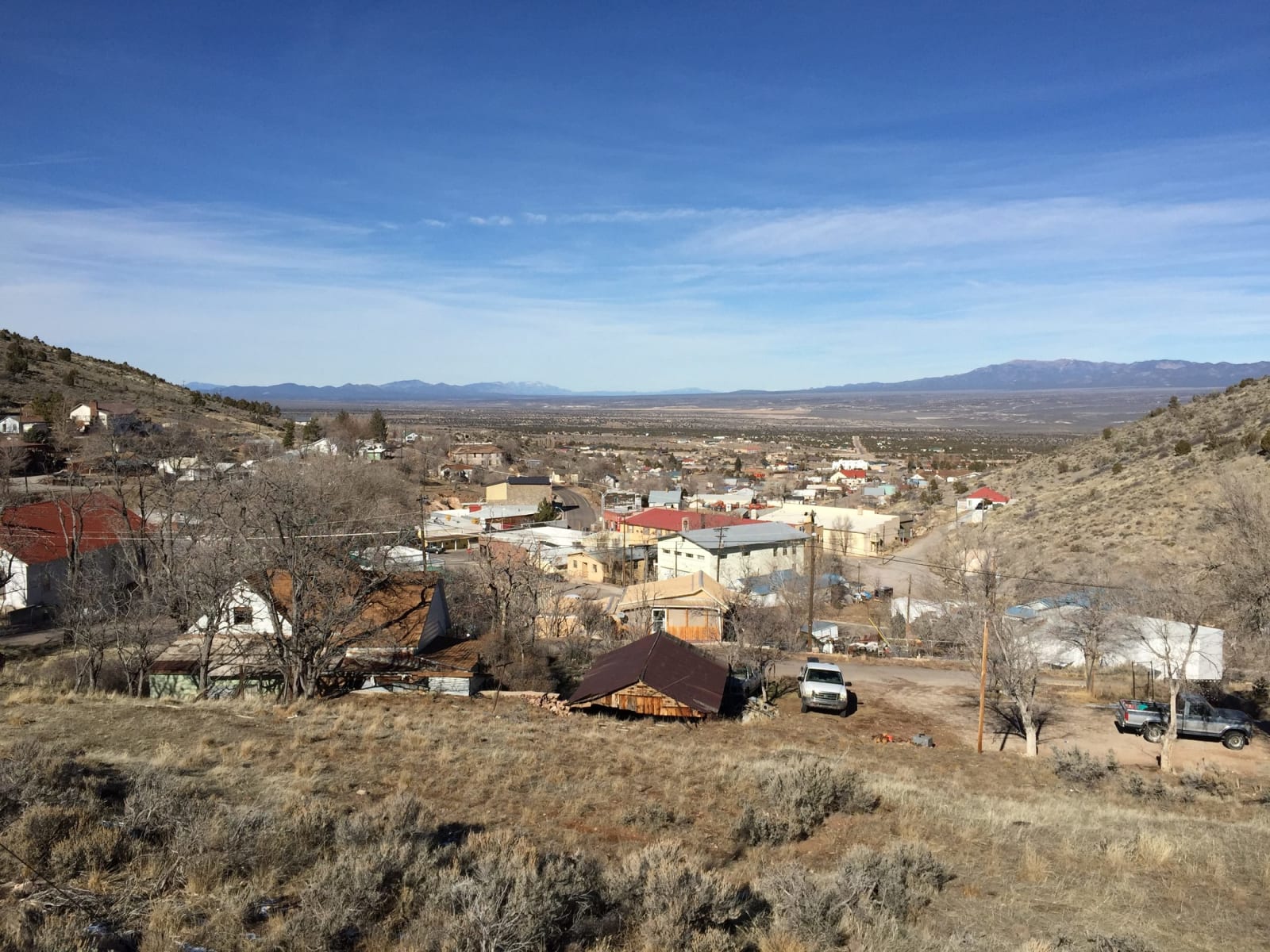
 Famartin / CC BY-SA 4.0
The Story
Pioche is the wild card of the Silver Trails — the silver camp that, by legend, out-killed the entire Old West. High in the Lincoln County hills at six thousand feet, a dozen miles up US-93 from Cathedral Gorge, it grew so rich and sat so far from any court that violence simply became the way business got settled. The town's favorite boast, repeated on signs all over Main Street, is that seventy-two men were buried up on Boot Hill — killed "with their boots on" — before anyone in Pioche died a natural death. The number is legend, not ledger. But the reputation behind it was real.
The silver was Southern Paiute country first. For a thousand years the semi-nomadic Paiute moved with the seasons through these desert hills, and it was a Paiute man who, in 1863, showed a Mormon scout the ore in the ledges above Meadow Valley. The rush that followed was delayed for years — by the remoteness, by the lack of any way to smelt the ore, and by Paiute resistance to the taking of their land — until the San Francisco financier François Pioche bought up the claims in 1869 and brought in the money and machinery to mine at scale. Within two years the camp that bore his name held seven thousand people and had become the mining capital of southern Nevada.
What made Pioche lethal was the same thing that made it rich: ore worth millions, claims drawn carelessly, and the nearest law two hundred and fifty miles away. When two companies claimed the same vein, they did not go to court — or they went to a court so easily bribed it amounted to the same thing. Instead they hired gunmen, at twenty dollars a day, to hold the ground by force. The better-documented truth beneath the boots-on legend is grim enough: in 1871 and 1872, well over half of all the killings in the entire state of Nevada happened in and around this one town. The local paper took to congratulating Pioche whenever it managed sixty days without a murder. This was an older, rawer frontier violence than the corporate labor wars that would later convulse Goldfield — gunmen and claim-jumpers, not troops and unions.
The town's other great monument to excess still stands on the hill: the Million-Dollar Courthouse. Begun in 1871 on a budget of well under thirty thousand dollars, it ran over from the start, and rather than pay the debt, the county refinanced it — issuing bonds to cover bonds, compounding interest on interest, decade after decade. By the time the thing was finally paid off in the late 1930s, the bill had ballooned toward a million dollars, and the building had already been condemned and abandoned for a newer courthouse down the street. It is hard to imagine a more fitting civic emblem for a boomtown: a courthouse that cost a fortune, delivered little, and outlived its own usefulness before the debt was clear.
Pioche should have died like the rest, and nearly did — by 1900 it was almost a ghost. What saved it was its title: as the seat of Lincoln County, it had a reason to exist beyond silver, and it hung on as a government and supply center through the lean years until lead and zinc brought a second mining era in the early twentieth century. The most striking relic of that revival still hangs over the town — an aerial tramway, built in the 1920s, that once carried ore buckets on cables from the mines on Treasure Hill down to the mill in the valley, running mostly on gravity. The cables and a few rusting buckets are still strung above the rooftops, the strangest skyline in eastern Nevada.
What's here now is a genuine living Old West town of about a thousand people — not a restored attraction but the real, weathered thing. You can tour the courthouse and its jail, climb to Boot Hill to read the markers at dusk, walk a Main Street of 1870s saloons and storefronts, and stay over the bar at the still-running Overland Hotel. Pioche sits under some of the darkest skies in the state, an easy basecamp for the cluster of parks around it — Cathedral Gorge is fifteen minutes south. It is the rawest chapter of the Silver Trails and, improbably, one of the few silver towns rough enough to survive its own legend.
Visitor Info
On the Map
A story featuring this place
Go deeper into the history and character of this stop
Nearby
The closest stops worth working into your route
Historical markers nearby
Roadside plaques and monuments within a short detour