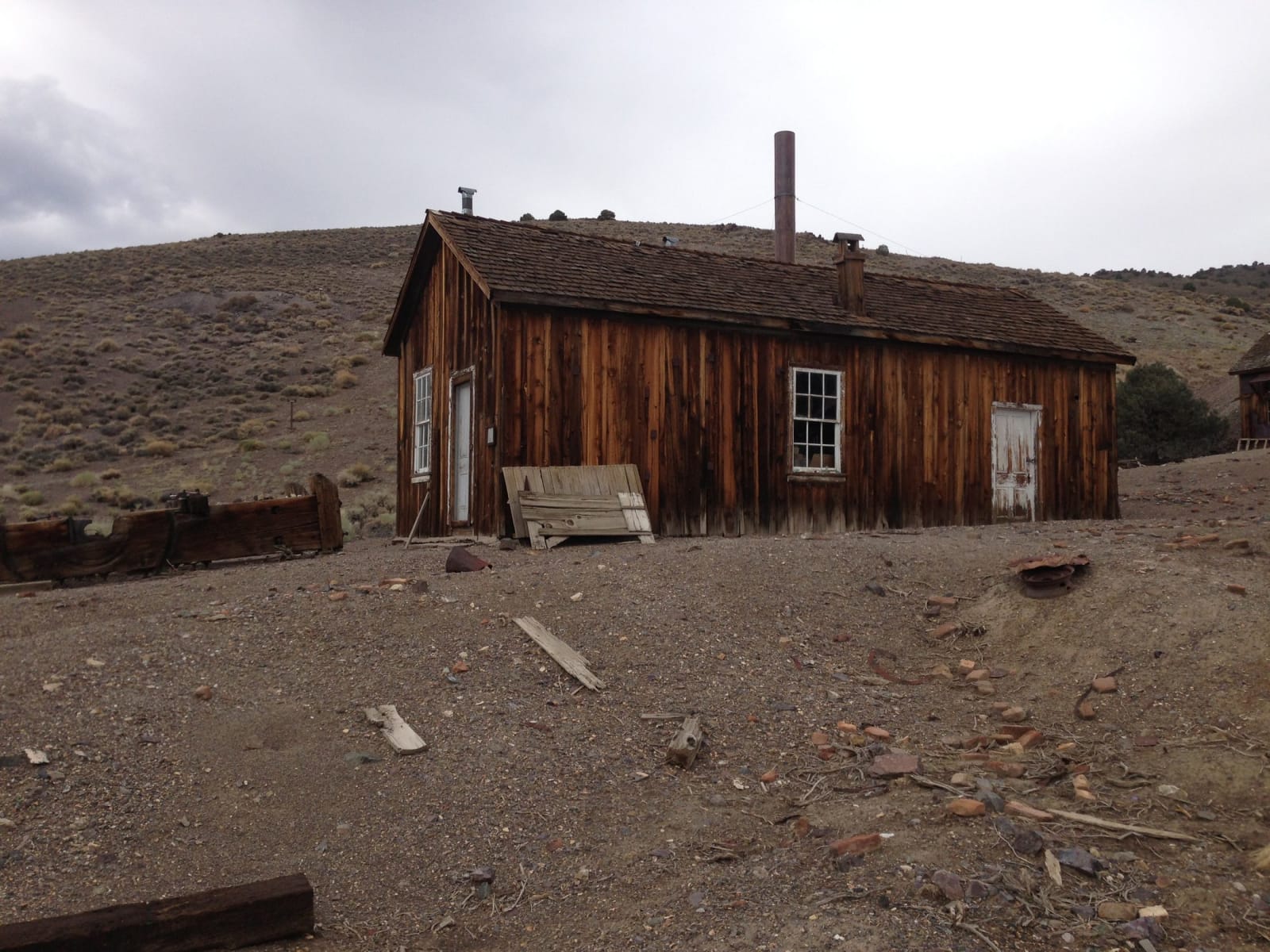
 Famartin / CC BY-SA 4.0
The Story
The Silver Trails end where they run out of both road and time. At the very end of State Route 844, high in the Shoshone Mountains of northwestern Nye County, a single quiet canyon holds two dead things side by side: a gold-mining town abandoned in 1911 and left almost exactly as it stood, and a graveyard of fifty-foot sea monsters that died here two hundred and twenty-five million years before anyone thought to dig for gold. Berlin-Ichthyosaur State Park is the region's deep-time bookend — the place that quietly reminds you the whole boom-and-bust story you have been touring is the thinnest, newest layer over a Nevada that used to be an ocean.
Berlin itself is one of the truest ghost towns in the state, precisely because so little was done to it. Gold drew a camp here in the 1890s; the Nevada Company developed the Berlin Mine, ran three miles of tunnels, and built a thirty-stamp mill, and at its peak around 1908 perhaps three hundred people lived in the canyon. When the ore stopped paying in 1911, they simply left, carrying what they could and abandoning the rest. The mining company kept the buildings standing for decades, and in 1970 the state of Nevada took over and froze the town in what the parks call "arrested decay" — not restored, not collapsed, but held in place mid-weather.
The result is eerie and wonderful. You walk a townsite of bleached wood and rusted nails — the mill with its stamps and mercury tables, the assay office, the blacksmith and machine shops, the stagecoach barn, the homes — stepping into some and peering through the windows of others at the furniture and tools left behind, like peepholes into a morning in 1911. More than eighty interpretive signs tell who lived where; much of their text was written by a man named Firmin Bruner, who grew up in Berlin as a boy and came back in his old age to give tours. A small cemetery holds some of the people who never left.
Two miles up a gravel road from the town, the timescale drops off a cliff. Here, in rock laid down on a Triassic seabed, lie the fossilized remains of dozens of ichthyosaurs — giant, fish-shaped marine reptiles that cruised a warm ocean over this spot when central Nevada lay underwater. The species found here, Shonisaurus popularis, named for the Shoshone Mountains, grew up to fifty feet long, hunted with a toothy snout, and bore its young live like a whale; for decades it was the largest ichthyosaur known to science, and it is Nevada's official state fossil. Around forty individuals have been uncovered in one short stretch of ground — the densest concentration of big ichthyosaurs anywhere in North America.
What makes the site extraordinary is what the excavators chose not to do. When Dr. Charles Camp's Berkeley team dug the skeletons out in the 1950s and '60s, they left them in place, embedded in the stone exactly where they died, and the park built a roofed Fossil House over the main quarry to shelter them. Stand at the railing and you are looking at the animals as the rock holds them, not as a museum arranged them. Why so many giants died together here is still debated; the newest and loveliest idea, supported by the bones of embryos and newborns in the stone, is that this was a birthing ground the ichthyosaurs returned to for ages — a nursery, now a graveyard.
What is here now is gloriously remote: a fourteen-site campground in the sagebrush, some of the darkest skies in Nevada, ranger tours of the Diana Mine and the Fossil House in the warm months, and almost no one else. Come prepared — the nearest fuel and food are twenty miles off in Gabbs, the last miles are gravel, and winter can close the road. Where Rhyolite is the Silver Trails' perfect modern ruin and Cathedral Gorge its sculpted clay, Berlin-Ichthyosaur is the region's long exhale into deep time. It is the right place to end the drive: a dead town and a pod of dead leviathans sharing one silent canyon, reminding you that in this desert, everything is only ever passing through — the miners, the sea dragons, and us.
Visitor Info
On the Map
A story featuring this place
Go deeper into the history and character of this stop
Nearby
The closest stops worth working into your route
Historical markers nearby
Roadside plaques and monuments within a short detour