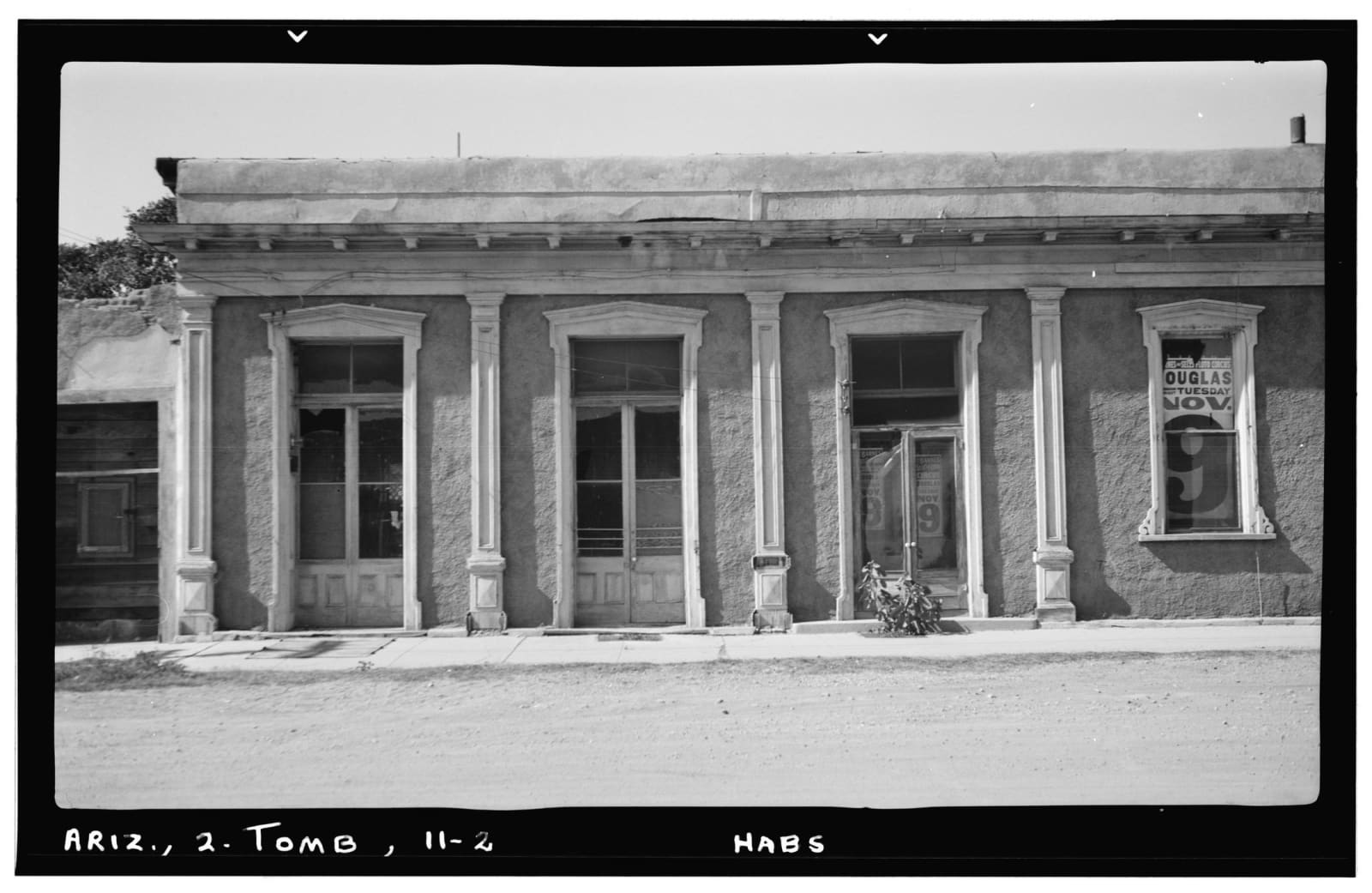
 Historic American Buildings Survey (Library of Congress), public domain via Wikimedia Commons
The Story
In 1877 a prospector named Ed Schieffelin was combing the hills of southeastern Arizona — Chiricahua Apache country, dangerous ground in the middle of the Apache Wars — when soldiers at a nearby camp told him the only thing he'd find out there was his own tombstone. He found one of the richest silver veins in the West instead, and named his claim, and the town that swarmed up around it, Tombstone, in defiance of the joke. By 1881 it held over five thousand people, a courthouse, an opera house, newspapers, and enough saloons and gambling halls to earn the boom its reputation.
That reputation crystallized on October 26, 1881, in a vacant lot on Fremont Street — near, but not actually in, the O.K. Corral. There the town marshal Virgil Earp, his brothers Wyatt and Morgan, and Doc Holliday faced the Clantons and McLaurys, a loose faction called the Cowboys, in a confrontation that had been building for months over cattle-rustling and politics. It lasted about thirty seconds; three men died; and it has been refought in books and films ever since, most of them getting the location, and much else, wrong.
The silver ran out the hard way — the mines flooded when they hit the water table, and the 1893 collapse in silver prices finished the job — and Tombstone should have died with a hundred other Arizona camps. It didn't. It hung on, kept the courthouse until the county seat moved to Bisbee, and reinvented itself as the town that sells its own legend, billing itself, accurately enough, as too tough to die. The 1881 Bird Cage Theatre, the Crystal Palace saloon, and the 1882 county courthouse still stand along its old streets. It sits in Cochise County, named for the Chiricahua leader whose people held this ground first; the Chiricahua mountains he used as a fortress stand to the northeast.
Visitor Info
On the Map
Nearby
The closest stops worth working into your route
Historical markers nearby
Roadside plaques and monuments within a short detour