 Garrett / CC BY 2.0
The Story
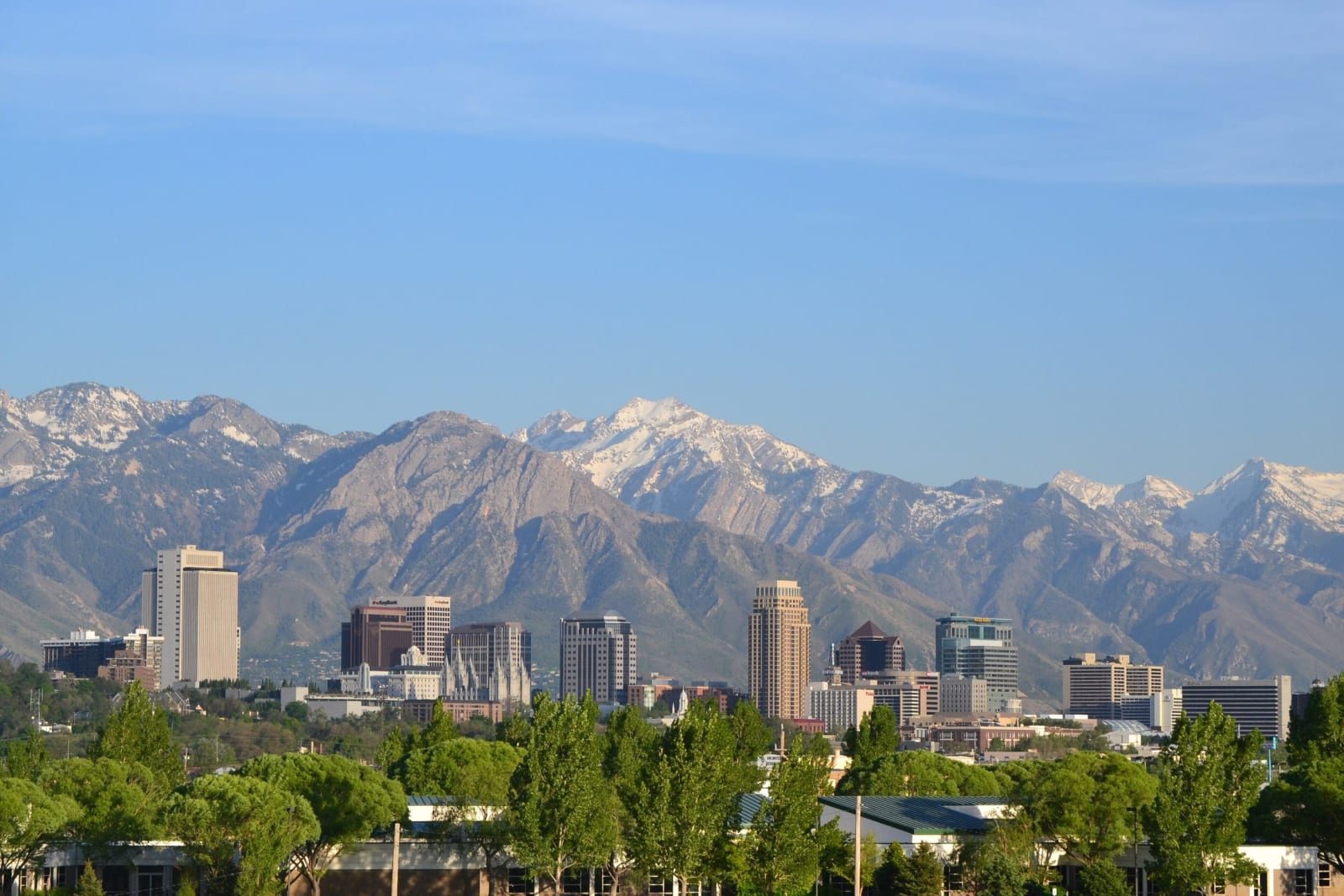
Salt Lake City is built on a contradiction that defines it more clearly than any other American capital — a city founded as a religious refuge that has become one of the West's most cosmopolitan small metros, a Mormon settlement that now hosts a thriving secular culture, a desert outpost that lives at the foot of an alpine range. The city of about 200,000 sits in a broad valley between the Wasatch Range to the east and the Oquirrh Mountains to the west, with the Great Salt Lake spreading shallow and strange to the northwest. In any direction the geography is dramatic. In every direction the history is improbable.
How the city got here
In July 1847, a wagon party of Mormon pioneers led by Brigham Young crested Big Mountain at the head of Emigration Canyon and looked down on a valley that nobody had wanted. The Shoshone and Ute peoples passed through it but did not settle the valley floor in numbers. The Mexican government had nominally owned it for a few decades. The trappers who knew the region considered the lake undrinkable and the soil too alkaline for crops. Young is reported to have said "this is the place" — a phrase now memorialized at This Is The Place Heritage Park — and the pioneers descended into the valley to build a city that nobody else thought could be built.
The street grid they laid out is the bones of the city you walk today. Brigham Young centered the plan on what would become Temple Square, divided the surrounding land into ten-acre blocks oriented to the cardinal directions, and gave every street a numbered address counted from the temple's southeast corner — which is why a Salt Lake City address like "500 South 1200 East" tells you exactly how far you are from the temple and in which direction. The system is jarring on first encounter and brilliant once you understand it. It is the most legible street grid in any major American city, and it is also a daily reminder that the city was designed as a sacred geography.
The temple itself took 40 years to build, finished in 1893, hewn from granite quarried in Little Cottonwood Canyon and hauled to the construction site by ox wagon before the arrival of the railroad. The craftsmanship is extraordinary regardless of one's relationship with the faith that built it.
The geography that explains everything
Salt Lake City sits at about 4,300 feet of elevation, which surprises visitors who expect a flat desert metropolis. The valley floor slopes gently westward from the foothills, and the city's east bench — the neighborhoods that climb the lower Wasatch slopes — is several hundred feet higher than the airport on the valley's west side. The temperature can vary by ten degrees across the city in summer, and the air quality often varies even more in winter.
The Wasatch Range rises directly behind the city, a wall of 10,000- and 11,000-foot peaks just minutes from downtown by car. Seven world-class ski resorts sit within an hour's drive — Alta, Snowbird, Brighton, Solitude, Park City, Deer Valley, and Snowbasin — and the "greatest snow on earth" slogan on Utah's license plates is, by most measures, not hyperbole. The same canyons that deliver the snow also feed the city's water supply, which is why dogs are prohibited in the Wasatch watershed canyons and motorized recreation is sharply limited.
To the west, the Great Salt Lake is the largest saltwater lake in the Western Hemisphere — a remnant of the much larger Pleistocene-era Lake Bonneville, whose ancient shoreline is still visible as a horizontal terrace cut into the mountains above the city. The lake is too salty for fish, which gives the brine flies and brine shrimp ecological dominance, which in turn supports millions of migratory birds. The lake is also shrinking, with implications for air quality and ecology that the state is only beginning to reckon with.
The valley's geography produces a meteorological quirk that defines winter in the city: temperature inversions, where cold air settles in the valley and traps pollution underneath a layer of warmer air above. For weeks at a time the air at the airport can be measurably worse than the air in Beijing, while the air at 7,000 feet in the canyons is among the cleanest in the country. The locals call this "going up to find the sun." It is one of the most striking environmental contrasts in any American city.
The modern city
The Salt Lake City that exists in the 2020s is not the city most outsiders imagine. The state legislature is conservative, the demographics are shifting, and the cultural life of the metropolitan area looks much more like Denver or Portland than the Mormon theocracy of popular imagination. Roughly half the residents of Salt Lake County identify with the LDS Church; within the city limits the share is well under half. The mayor's office has been held by Democrats for decades, the city has a thriving LGBTQ community, and the food scene has quietly become one of the most interesting in the Mountain West.
The neighborhoods worth knowing are walkable and distinct. Downtown anchors around Temple Square and the City Creek shopping district. The Avenues, north of downtown, is a Victorian-era residential neighborhood of brick bungalows and shaded streets — among the oldest intact neighborhoods in the western United States. Sugar House, southeast of downtown, has the dense bookstores-coffee-shops-vintage-stores energy of an older streetcar suburb. Liberty-Wells and Central Ninth are the city's grittier creative neighborhoods, full of breweries, taquerias, and music venues. The 9th-and-9th and 15th-and-15th districts are small, tree-lined commercial pockets that feel like Brooklyn dropped into the desert.
The food has gotten genuinely good — Red Iguana for Mexican, Pago and HSL for new American, Takashi for sushi, Pretty Bird for hot chicken — and the city's Vietnamese pho scene in the West Valley suburbs is its best-kept culinary secret. The coffee culture is real and rivals anywhere west of the Mississippi.
Liberty Park is the city's central green space, the International Peace Gardens gather 28 nations' worth of horticulture along the Jordan River on the west side, Red Butte Garden is its botanical showpiece, and the Natural History Museum of Utah — perched on the foothills above the University of Utah campus — is one of the finest natural history museums in the country. The Gilgal Sculpture Garden hides a baffling collection of religious folk art in a residential backyard near downtown. Ensign Peak, a 20-minute walk above the Avenues, delivers the entire valley in a single panoramic view.
Practical info for a visit
Salt Lake City International Airport (SLC) sits about ten minutes by car from downtown — one of the shortest airport-to-downtown commutes of any major American city. Delta Air Lines maintains a hub here, which means direct flights to most US cities and a growing number of international destinations. The light rail system, TRAX, connects the airport to downtown for $2.50.
Most visitors stay either downtown (close to Temple Square, restaurants, and the convention center) or near the University of Utah on the east bench (closer to the canyons and the museums). Hotels in the airport area are cheap but inconvenient.
Liquor laws in Utah are genuinely different from other states, though far less restrictive than tourism cliches suggest. Bars and restaurants serve full drinks, though restaurants are required to keep mixed drinks below a certain alcohol content unless food is also ordered. Grocery stores sell beer; wine and spirits are sold only in state-run liquor stores, which are closed on Sundays.
Salt Lake City is best visited in late spring, early fall, or any clear week of winter when the inversion lifts. Summer is hot in the valley but the canyons stay cool — locals retreat to Big Cottonwood and Little Cottonwood Canyons every weekend from June through September. Winter offers some of the best skiing on earth, weather permitting; the city itself is at its prettiest under fresh snow.
Visitor Info
On the Map
A story featuring this place
Go deeper into the history and character of this stop
Nearby
The closest stops worth working into your route
Historical markers nearby
Roadside plaques and monuments within a short detour