 Pollardjosephd / CC BY-SA 4.0
The Story
Liberty Park is Salt Lake City's backyard — 80 acres of grass, trees, ponds, and paths in the center of the city that has been serving the same essential function since 1882: giving people a place to breathe. The park sits between 500 and 700 East and 900 and 1300 South, surrounded on all sides by neighborhoods that range from historic bungalows to modern apartments, and its boundaries contain enough variety — an aviary, a playground, a swimming pool, tennis courts, a pond with ducks, and miles of walking paths — to accommodate every possible definition of outdoor recreation short of mountain climbing.
The Tracy Aviary is the park's most distinctive feature and one of only two freestanding aviaries in the United States. The aviary houses over 400 birds from more than 130 species, displayed in a mix of indoor exhibits and outdoor habitats that range from wetland enclosures to raptor flight areas. The collection includes flamingos, bald eagles, Andean condors, hornbills, and dozens of species that most visitors have never encountered outside of a nature documentary. The aviary has evolved from a traditional zoo-style display into a conservation-focused institution that participates in breeding programs for endangered species and runs education programs that connect urban audiences with bird biology and habitat preservation.
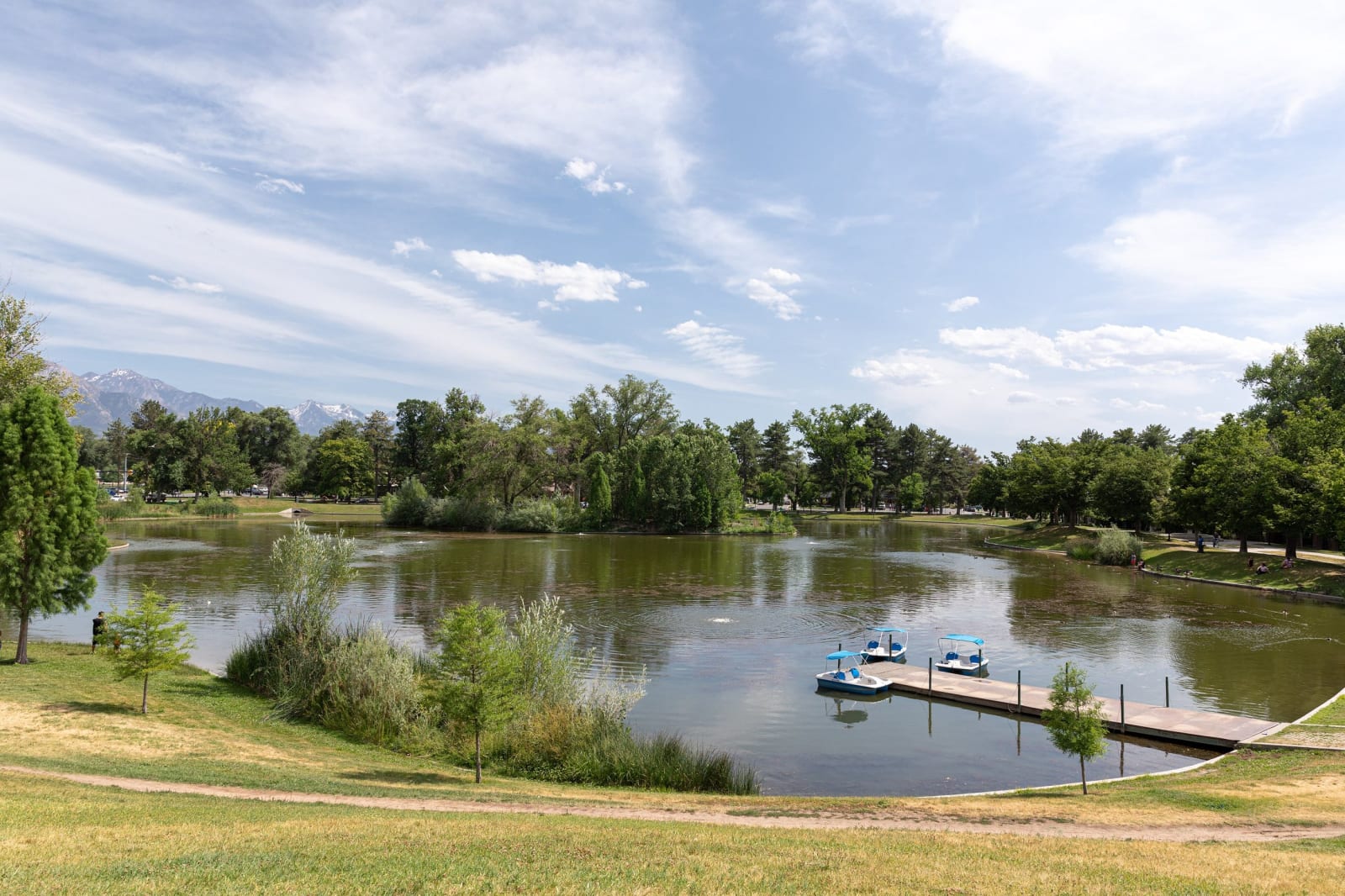
The park's pond — a small, irregularly shaped body of water near the center of the grounds — is home to a population of ducks and geese that have become the park's unofficial welcoming committee. Children feed them, joggers run past them, and the ducks regard both activities with the serene indifference of animals that have been the center of attention for over a century. The pond is fed by the city's irrigation canal system, and the water circulates through the park in a network of channels and streams that add a gentle soundtrack of moving water to the ambient noise of the surrounding city.
The historic carousel, dating to 1902, operates seasonally near the park's center and has been carrying children in circles for over 120 years. The hand-carved horses have been restored multiple times, and riding them is a direct connection to an era when public amusement meant a painted horse on a spinning platform and that was enough. The carousel is modest by modern amusement standards, which is precisely its appeal — it operates at a pace and a scale that matches the unhurried atmosphere of the park itself.
The park functions as the city's primary gathering space for events, protests, festivals, and the spontaneous socializing that defines urban public life. The annual Pride Festival fills the grounds every June. Cultural festivals representing Salt Lake City's growing diversity — Pacific Islander, Latin American, Asian American — use the park regularly. And on any given weekend, the paths and lawns accommodate an informal census of the city's population — families with strollers, teenagers with skateboards, elderly couples on benches, runners on the perimeter path, and dogs of every conceivable breed and mix socializing with the enthusiastic democracy that only dogs can manage.
The perimeter path, roughly 1.5 miles around, is the park's cardiovascular backbone. Runners, walkers, cyclists, and inline skaters share the paved loop in a traffic pattern that is negotiated through eye contact and mutual goodwill rather than posted rules. The path is flat, shaded by mature trees for much of its length, and busy enough at most hours that exercising alone never feels lonely and always feels safe.
The park's mature tree canopy is one of its greatest assets. Elms, oaks, maples, and cottonwoods planted over the past century have grown into a forest canopy that provides shade in summer, color in autumn, and the sense of being in a natural environment even though downtown Salt Lake City is visible through the branches. The trees also support a population of songbirds, squirrels, and the occasional great horned owl that adds a wildlife dimension to the urban landscape.
The playground area has been updated in recent years with modern equipment that accommodates a wider range of ages and abilities than the previous installation. The swimming pool operates during summer months and provides affordable recreation for families in the surrounding neighborhoods. Tennis courts, horseshoe pits, and open lawn areas round out the recreational options.
Liberty Park is not a tourist destination in the traditional sense. It does not appear in most Utah travel guides, and visitors focused on the national parks and red rock country would have no reason to seek it out. But for anyone spending time in Salt Lake City — waiting for a flight, attending a conference, visiting the University of Utah, or simply passing through — Liberty Park provides the same service it has provided for over 140 years: a green, quiet, welcoming space in the middle of a city that is sometimes too busy, too hot, or too concrete to feel comfortable. The park does not solve these problems. It provides a place to sit with them, under a tree, beside a pond, while the ducks go about their business and the carousel turns slowly in the shade.
Visitor Info
On the Map
Nearby
The closest stops worth working into your route
Historical markers nearby
Roadside plaques and monuments within a short detour