The Story
The International Peace Gardens are hidden in plain sight — tucked into Jordan Park on the west side of Salt Lake City, surrounded by residential neighborhoods and light industry, in a location so unassuming that many lifelong Salt Lake residents have never visited. The gardens occupy roughly 11 acres along the Jordan River, divided into 28 sections, each designed and maintained to represent a different country's culture, landscape, and horticultural traditions. The result is a quiet, eccentric, deeply personal collection of gardens that reflects the immigrant communities who built them and the post-war idealism that inspired their creation.
The gardens were founded in 1947, two years after the end of World War II, as a gesture of international goodwill and cultural celebration. The idea was simple and ambitious: invite Salt Lake City's immigrant communities to each design and maintain a garden section representing their home country, creating a place where the world's cultures could coexist in a shared landscape. The participating communities — representing nations from Scandinavia to Southeast Asia, from the British Isles to the Pacific Islands — took the invitation seriously, and the gardens they created range from formal European designs with clipped hedges and classical sculpture to more informal arrangements reflecting tropical, arid, and East Asian horticultural traditions.
Each garden section is maintained by members of the community it represents, which gives the International Peace Gardens a quality that professionally maintained botanical gardens cannot replicate. The gardens are personal. The plants are chosen because they mean something to the people who planted them — a particular flower from a grandmother's village, a tree species that grows in the homeland, a layout that echoes a garden remembered from childhood. The quality of maintenance varies — some sections are meticulously tended, others show the wear of volunteer organizations stretched thin — and that variation is part of the character. These are community gardens in the truest sense, reflecting the capacity and commitment of the communities behind them.
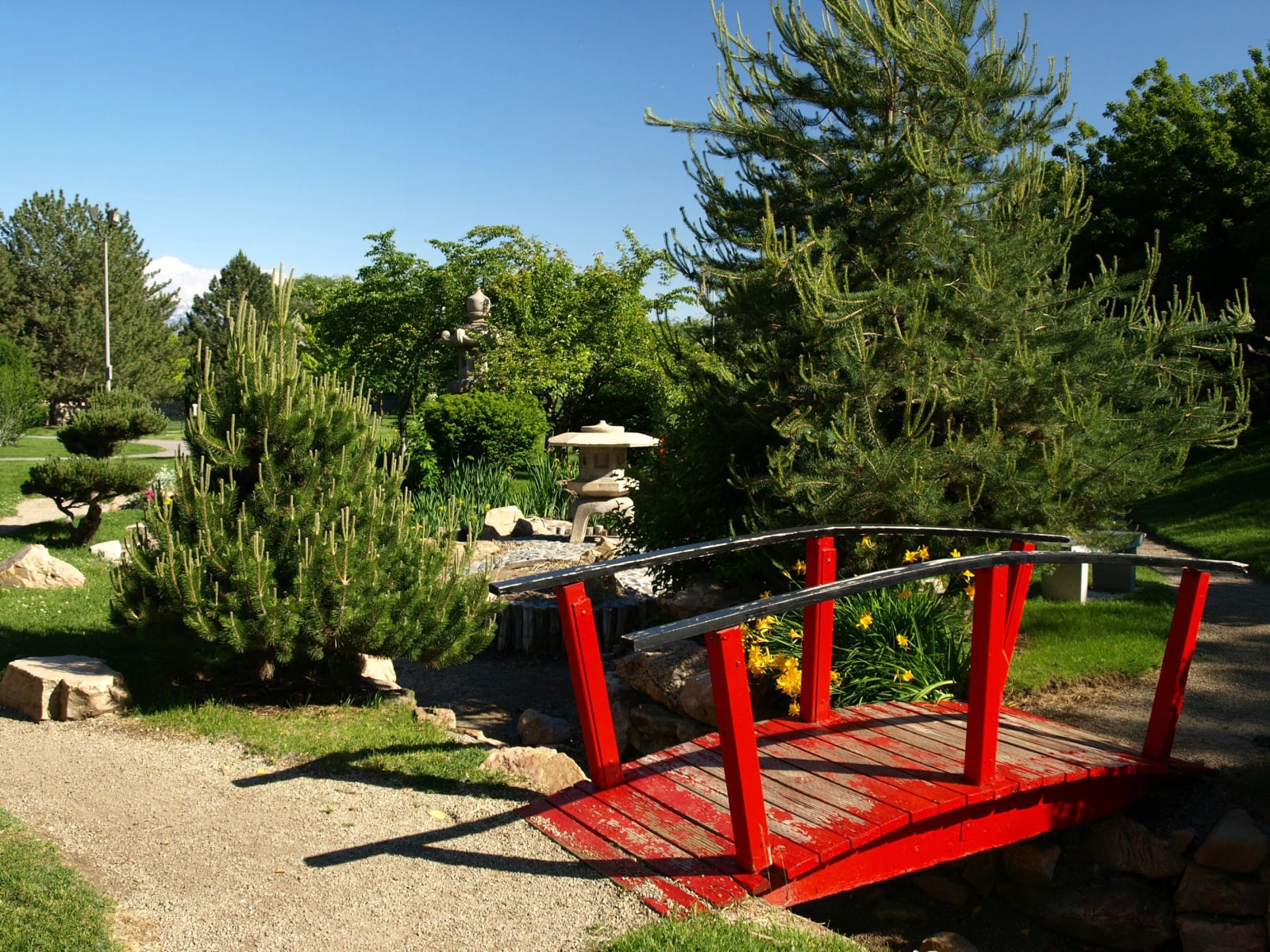
The gardens are arranged along paths that wind through the park, and walking from one section to the next creates a gentle cultural tourism — you pass from Japan to Greece to Sweden to Mexico in the space of a few hundred yards, each transition marked by a change in plants, materials, and design philosophy. The Japanese garden features a traditional stone lantern and carefully pruned trees. The Greek section includes classical columns and Mediterranean plants. The Swedish garden is clean-lined and understated. The Mexican section is colorful and exuberant. The juxtaposition of these different approaches to landscape and beauty — all sharing the same soil, the same climate, the same irrigation water — makes the gardens a living metaphor for the multicultural city they inhabit.
The gardens are free and open during daylight hours, which removes every barrier to entry and makes them accessible to the surrounding neighborhoods — communities that are among the most ethnically diverse in Utah. Families use the paths for walks. Children play on the lawns between garden sections. The Jordan River, which borders the gardens to the west, adds a riparian corridor of cottonwood trees and native vegetation that frames the cultivated gardens with a strip of wildness.
The Peace Gardens are not a major tourist attraction and do not aspire to be. There is no admission fee, no gift shop, no audio tour, and no marketing campaign. There is a parking lot, a path, and 28 gardens built by 28 communities as an act of cultural expression and international solidarity. The gardens exist because people who had come to Utah from around the world wanted to bring a piece of home with them and share it with their neighbors. That impulse — generous, nostalgic, optimistic — is visible in every planted bed and every hand-placed stone.
The gardens have faced challenges over the decades. Funding for maintenance is always limited. Vandalism has damaged some sections. The volunteer communities that maintain individual gardens have aged, and recruiting the next generation of gardeners is an ongoing concern. Several sections have been renovated or redesigned as communities have evolved, and the gardens today look different from the gardens of the 1950s and 1960s, just as the city around them looks different.
The International Peace Gardens are best visited in late spring through early fall, when the plantings are at their peak. A slow walk through all 28 sections takes about an hour, and the experience is contemplative rather than exciting — this is a place for noticing details, reading dedication plaques, and appreciating the quiet determination of immigrant communities who expressed their identities through the universal language of plants and soil. The gardens will not change your life. But they might change your afternoon, and in a city that sometimes feels defined by its religious homogeneity, they are a gentle, blooming reminder that Salt Lake City has always been more diverse than its reputation suggests.
Visitor Info
On the Map
Nearby
The closest stops worth working into your route
Historical markers nearby
Roadside plaques and monuments within a short detour