The Story
Gilgal Sculpture Garden is the strangest place in Salt Lake City, and Salt Lake City knows it. Hidden in a residential neighborhood between 500 and 600 East, surrounded on all sides by ordinary houses and apartment buildings, this small walled garden contains a collection of stone sculptures and engraved rocks so eccentric, so personal, and so resistant to easy interpretation that visitors routinely leave shaking their heads — not in disapproval but in genuine bewilderment at what they have just seen.
The garden was created over 18 years by Thomas Battersby Child Jr., a local businessman who worked as a mason and contractor by day and spent his evenings and weekends carving massive stone sculptures in his backyard. Child was a devout member of The Church of Jesus Christ of Latter-day Saints, and his sculptures draw heavily on Mormon theology, the Bible, and the Book of Mormon — but filtered through a sensibility so idiosyncratic that the results would puzzle most churchgoers as much as they puzzle secular visitors.
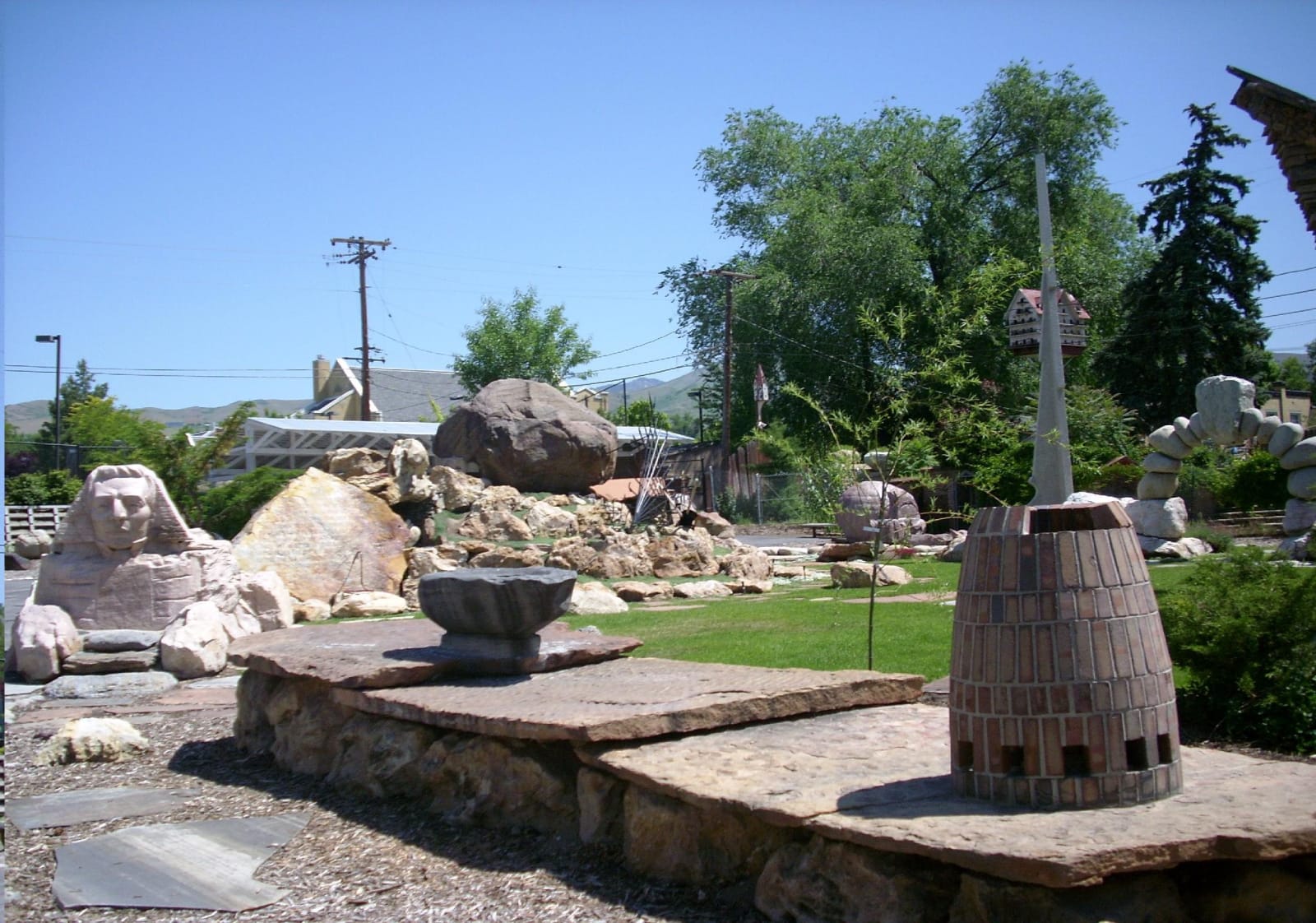
The centerpiece is a sphinx with the face of Joseph Smith, the founder of the LDS Church. The figure has the body of a traditional Egyptian sphinx but wears a distinctly nineteenth-century expression, and the juxtaposition is jarring and fascinating. The sculpture sits on a pedestal inscribed with text, and the combination of sacred and surreal — a sphinx in a backyard in Salt Lake City, with the face of a religious prophet — sets the tone for everything else in the garden. This is not institutional religious art. This is one man's deeply personal, slightly obsessive attempt to express his faith through stone.
Other sculptures include a figure in distress being consumed by his own brick pants — a reference to a scripture about wearing the whole armor of God — and a large stone monument covered in engraved passages from the Bible, the Book of Mormon, and other texts that were meaningful to Child. The engravings are dense and sometimes cryptic, mixing scriptural quotations with personal commentary in a way that feels more like marginalia in a private journal than public inscription. Reading them requires patience and a willingness to sit with ambiguity.
The garden contains 12 original sculptures and over 70 stones engraved with scriptures, poems, and philosophical texts. The craftsmanship varies — some pieces are rough and almost primitive, while others show considerable skill and attention to detail. The inconsistency is part of the charm. Child was not a trained artist. He was a mason who felt compelled to create, and the sculptures have the quality of folk art at its most authentic — made by hand, driven by conviction, unconcerned with critical reception or commercial value.
Child worked on the garden from 1947 until his death in 1963, and for decades afterward it remained a private curiosity — technically on private property, known mainly to neighbors and the occasional curious visitor who heard about it through word of mouth. The property changed hands several times, and there were periods when the garden was inaccessible and at risk of demolition. In 2000, the Salt Lake City government purchased the property and turned it into a public park, preserving the sculptures and opening the garden to visitors. It was a wise decision. Gilgal is irreplaceable — there is nothing else like it in Utah or anywhere else.
The garden is small — you can walk through the entire space in fifteen minutes — but it rewards slower exploration. Sit on one of the benches and read the inscriptions. Walk around the sphinx and notice how the expression changes with the angle. Look at the way the sculptures interact with the garden plants that have grown up around them over the decades — vines climbing the stones, flowers blooming at the feet of figures, the organic and the carved merging into something that feels both intentional and accidental.
Gilgal occupies an interesting position in Salt Lake City's cultural landscape. The city has a complicated relationship with its religious heritage — proud of the pioneer accomplishment, sometimes uneasy with the theological specificity. Gilgal threads that needle in an unexpected way. The sculptures are deeply, unapologetically religious, but their strangeness gives them a universality that transcends denomination. You do not need to be Mormon to find a sphinx with Joseph Smith's face compelling. You do not need to believe in scripture to appreciate a man who spent 18 years carving his beliefs into stone in his backyard. What you need is curiosity, and Gilgal rewards every ounce of it.
The garden is free, open during daylight hours, and has no staff or guided tours. There is a small interpretive sign near the entrance, but most of the meaning-making is left to the visitor. Bring water, bring patience, and bring a willingness to be confused. Gilgal does not explain itself. It never did, even when its creator was alive. That refusal to simplify is what makes it art.
Visitor Info
On the Map
Nearby
The closest stops worth working into your route
Historical markers nearby
Roadside plaques and monuments within a short detour