 An Errant Knight / CC BY-SA 4.0
The Story
This Is The Place Heritage Park sits at the mouth of Emigration Canyon, marking the exact spot where Brigham Young reportedly looked out over the Salt Lake Valley on July 24, 1847, and declared that the exhausting, dangerous, 1,300-mile journey from Winter Quarters, Nebraska was over. The valley below was sagebrush and silence. The Great Salt Lake shimmered in the distance. The Wasatch Mountains rose behind them. And Young, sick with Rocky Mountain spotted fever and riding in the back of a wagon, saw something in that empty basin that convinced him this was the right place to build a civilization. The park exists to tell that story, and it tells it with a physicality that books and films cannot match. Four days after the declaration remembered here, Young walked down to the valley floor and drove his cane into the ground to mark the site of the temple — the founding gesture that fixed Temple Square as the point from which the entire city was surveyed and laid out. Four days after the declaration remembered here, Young walked down to the valley floor and drove his cane into the ground to mark the site of the temple — the founding gesture that fixed Temple Square as the point from which the entire city was surveyed and laid out.
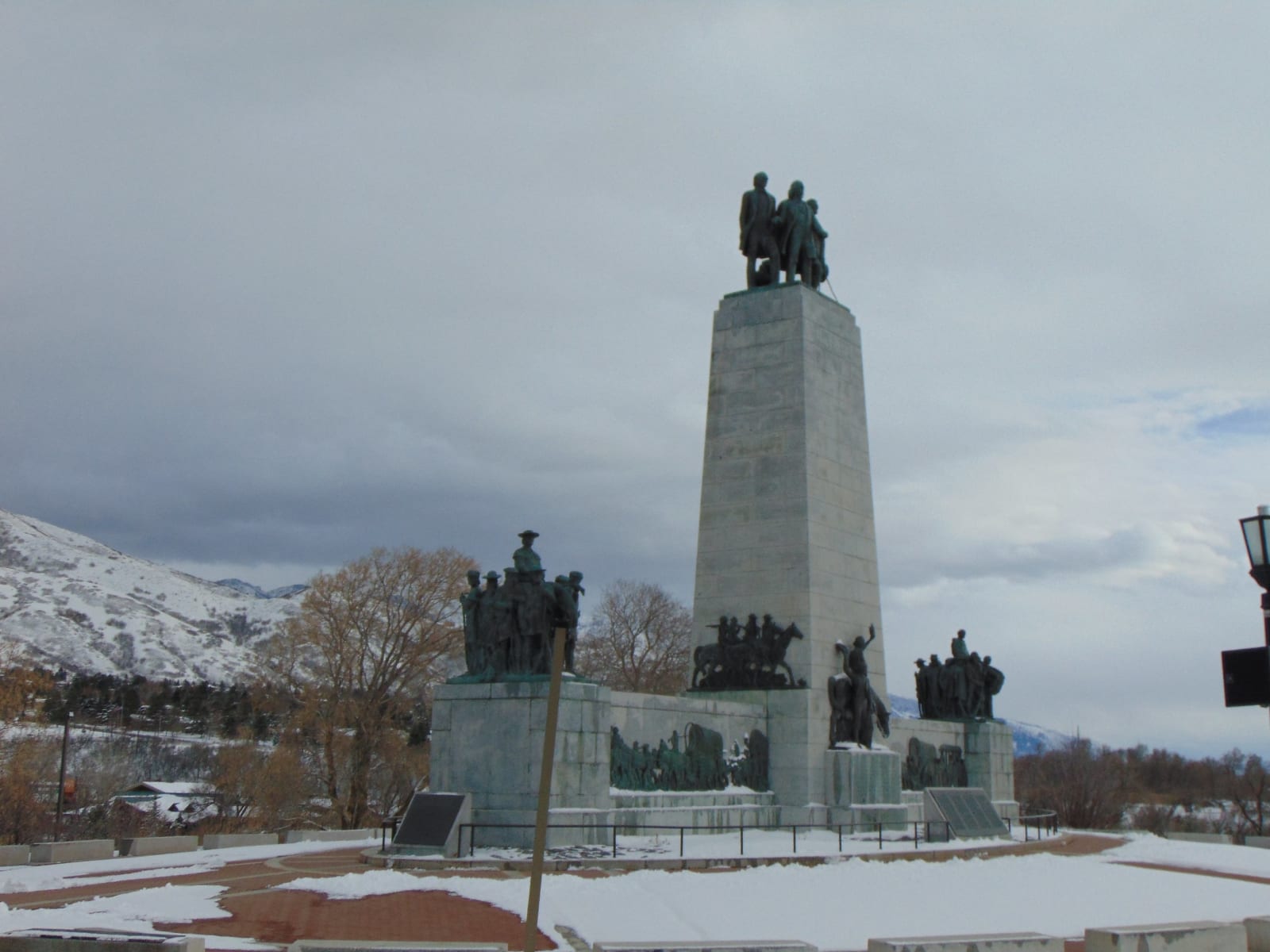
The monument at the park entrance is the visual landmark — a 60-foot granite and bronze pillar topped with statues of Brigham Young, Heber C. Kimball, and Wilford Woodruff, with additional figures representing the trappers, explorers, missionaries, and indigenous peoples who preceded the Mormon pioneers in the region. The monument was dedicated in 1947 on the centennial of the pioneers' arrival, and its prominent position at the canyon mouth makes it visible from miles across the valley. The scale is deliberate — the monument is large enough to register as a landmark from the highways below, a permanent marker on the landscape saying something important happened here.
The heritage village behind the monument is where the park comes alive. Over 40 historical buildings — some original structures relocated from sites across Utah, others faithful reproductions — have been assembled into a living history village that recreates pioneer-era life with a level of detail and immersion that surprises visitors expecting a quick monument photo. Costumed interpreters demonstrate blacksmithing, candle-making, spinning, weaving, and other trades in period-appropriate workshops. The Brigham Young farmhouse, a modest structure reflecting the practical rather than grand lifestyle of the early settlement, is furnished with period items and staffed by interpreters who answer questions in character.
The village includes a Native American section that represents the indigenous peoples who lived in the Salt Lake Valley before the pioneers arrived — the Shoshone, Ute, and Goshute nations whose relationship with the arriving settlers was complex, often difficult, and inadequately documented in the traditional pioneer narrative. The park has made efforts in recent years to expand this section and present a more complete picture of the valley's history, acknowledging that the pioneer arrival was not a beginning but a disruption of communities that had been here for centuries.
The park operates a narrow-gauge train that circles the village, a hit with children and a pleasant way to get an overview of the grounds before exploring on foot. Pony rides, a panning-for-gold station, and seasonal events — including a large Pioneer Day celebration on July 24th, Utah's biggest state holiday — round out the family-oriented programming. The events calendar is extensive, with holiday-themed activities, evening programs, and special demonstrations throughout the operating season.
The setting at the canyon mouth provides natural context that no indoor museum could replicate. Standing at the monument and looking west, you see the same valley the pioneers saw — expanded now with a city of over a million people, but the mountains are unchanged, the lake is still visible on clear days, and the geography that shaped the settlement decision is legible in the landscape. The Wasatch Range rises immediately behind the park, and the mouth of Emigration Canyon frames the eastern horizon. The pioneers walked out of that canyon and into this valley, and standing at the transition point you feel the narrative weight of the moment.
The park is located at 2601 Sunnyside Avenue in Salt Lake City, easily accessible from the foothills neighborhoods east of the university. Admission is charged, with discounts for children and seniors, and the village is open seasonally from spring through fall, with limited winter hours for special events. The monument and grounds are accessible year-round.
This Is The Place Heritage Park is not a subtle experience. It is a monument, a village, and a celebration of a specific historical moment, presented with the earnestness and conviction that characterize Utah's relationship with its pioneer heritage. The history it tells is real — people did cross the continent on foot, they did arrive in this valley with almost nothing, and they did build a society from the ground up in a place that offered no guarantees. Whether you view that story as inspiring, complicated, or both — and it is genuinely both — the park provides the physical space to engage with it on its own terms, at the exact spot where it began.
Visitor Info
On the Map
Nearby
The closest stops worth working into your route
Historical markers nearby
Roadside plaques and monuments within a short detour