 A. E. Crane, U.S. Department of Transportation / public domain via Wikimedia Commons
The Story
Logan Canyon is the drive that northern Utah locals keep to themselves, and every autumn they regret that they ever told anyone about it. The canyon road — Highway 89 — climbs 28 miles from the Cache Valley floor at 4,500 feet to the Bear Lake summit at 7,800 feet, winding through a corridor of limestone cliffs, alpine forest, and river-carved narrows that is officially designated a National Scenic Byway and unofficially designated one of the most beautiful drives in the American West.
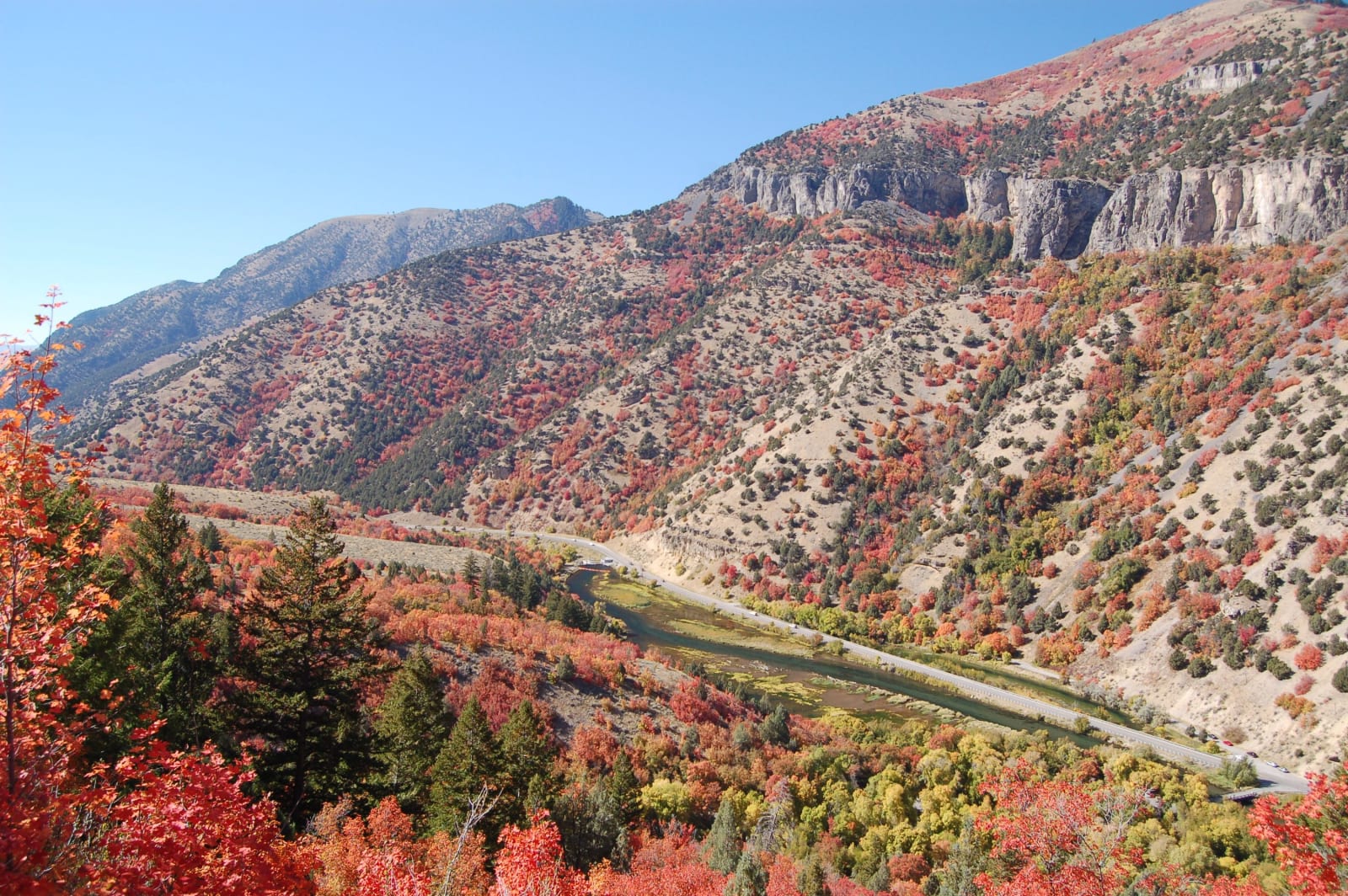
In October, the canyon catches fire. Not literally — though the visual effect is close. The bigtooth maples that line the lower canyon turn a red so intense, so saturated, so impossibly vivid that the canyon walls appear to glow from within. The color is not the gentle gold of aspen or the muted russet of oak. It is a pure, screaming crimson that photographs cannot capture and memory cannot exaggerate. Utahns drive from across the state to see it, and the canyon road fills with slow-moving cars whose occupants are trying to drive and stare simultaneously, which is a poor combination on a winding mountain road but an understandable one.
The geology is different from southern Utah's sandstone country. Logan Canyon is carved through the Bear River Range, a northern extension of the Wasatch Mountains composed primarily of Paleozoic-era limestone and dolomite — rocks deposited in ancient seas 300 to 500 million years ago. The canyon walls are gray, cream, and pale blue rather than red, and the formations tend toward vertical cliffs and overhanging ledges rather than the rounded domes and fins of the sandstone country. The change in rock type creates a completely different aesthetic — cooler, more alpine, more reminiscent of the northern Rockies than the Colorado Plateau.
The Logan River runs the length of the canyon, a clear, cold stream that supports one of the best trout fisheries in the state. Brown and cutthroat trout hold in the pools and riffles, and fly fishermen work the water with the focused concentration of people who have discovered a resource worth protecting. The river is catch-and-release in several sections, and the combination of clean water, healthy fish populations, and spectacular scenery makes it a destination fishery that rivals better-known rivers in Montana and Idaho.
The canyon offers more than driving and fishing. The Riverside Nature Trail follows the river through the lower canyon on a paved path suitable for families and casual walkers. The Crimson Trail climbs steeply to a ridge with panoramic views of the canyon and the valley beyond. The Wind Cave Trail — a short, steep hike to a triple-arched limestone cave overlooking the canyon — is one of the best short hikes in northern Utah. And the Jardine Juniper trail leads to one of the oldest living trees in the world, a Rocky Mountain juniper estimated at over 1,500 years old, standing gnarled and wind-twisted at 9,000 feet elevation. Higher up, a paved spur climbs to Tony Grove Lake, a glacial tarn rimmed by some of the best wildflower meadows in the range at around 8,000 feet, and one of the most popular high-country stops on the drive.
The canyon is also a rock climbing destination of increasing reputation. The limestone walls offer routes ranging from moderate sport climbs to challenging traditional lines on vertical and overhanging faces. The China Cave area, about midway up the canyon, has become particularly popular, with a concentration of bolted routes on high-quality limestone that draws climbers from across the region.
At the top of the canyon, the road crests the Bear Lake summit and the landscape transforms from forest to open meadow and sagebrush. A pullout near the summit offers a sweeping view of Bear Lake far below — the turquoise water visible through a frame of evergreen forest — and the descent to the lake shore drops through rolling ranchland and wildflower meadows. The transition from canyon to lake, from vertical limestone to horizontal water, is one of the most satisfying geographic progressions in Utah.
Winter transforms Logan Canyon into a different kind of destination. Beaver Mountain Ski Area, a family-owned ski hill about 27 miles up the canyon, has been operated by the Seeholzer family since 1939, making it the longest continuously family-run ski resort in the United States. The skiing is modest compared to the mega-resorts of the Wasatch — a few lifts, a few hundred acres, no heated pools or celebrity sightings — but the snow is deep, the lift lines are short, and the family atmosphere is genuine. Cross-country skiing and snowshoeing are available throughout the canyon, and the snow-draped limestone cliffs take on a monochrome beauty that is entirely different from the autumn color show.
Logan Canyon connects two of northern Utah's most appealing destinations — the college town of Logan at the western end and Bear Lake at the eastern end — and the drive between them is one of those rare journeys where the road itself is the destination. The canyon has been here for millions of years, the river for thousands, the maples for centuries. The road is the newest addition, and it has the good sense to follow the canyon's lead rather than imposing its own agenda. Drive it slowly. Stop often. And if you come in October, bring a camera with a battery that is fully charged, because you are going to use it.
Visitor Info
On the Map
Stories featuring this place
Go deeper into the history and character of this stop
Nearby
The closest stops worth working into your route
Historical markers nearby
Roadside plaques and monuments within a short detour