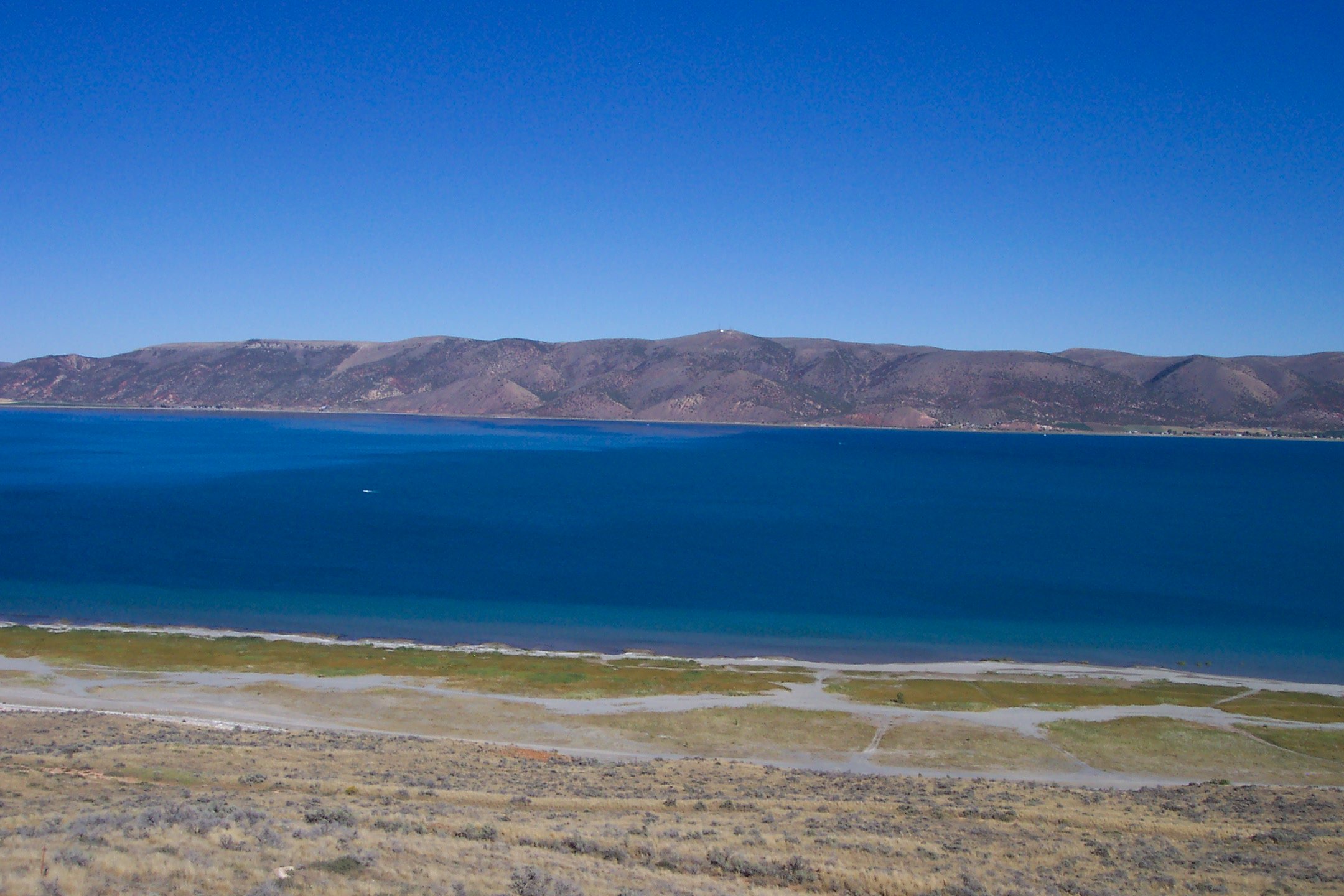
Everyone arrives in Utah looking for the red. The arches and the hoodoos, the cliffs of Zion, the buttes of Monument Valley — the whole iconography of the state is sandstone the color of rust, and it is concentrated in the south, on the high tableland of the Colorado Plateau. Drive north for long enough, though, and the red runs out. Somewhere up past the cities the rock changes color and changes age, and by the time you reach the far northeast corner — Cache Valley, the Bear River Range, the turquoise improbability of Bear Lake — Utah has gone gray. The stone here is limestone, far older than anything holding up an arch, and once you understand that one fact, the whole strange corner falls into place.
An older sea
The red rock of southern Utah is young, as these things go — Mesozoic sandstone, the petrified dunes and riverbeds of the age of dinosaurs, stained by a thin rind of iron oxide. The gray rock of the north is older by a wide margin and made of something else entirely. The Bear River Range, the long high wall that Logan Canyon cuts through on its way east, is built of more than three thousand feet of limestone and dolomite laid down between roughly three hundred and five hundred million years ago, when this part of the continent sat near the equator under warm, shallow seas. Limestone is not sand. It is the floor of an ocean — the compacted lime mud and broken shells and reef debris of uncountable marine animals, pressed into stone. Crack a fresh slab of it almost anywhere in the canyon and the proof is right there — the little stacked poker-chip disks of crinoid stems, the fans of brachiopod shells, the honeycomb of old coral, the bodies of the sea creatures that became the rock. The red country is fossilized desert. The gray country is fossilized sea, and a far older one — the limestone of the north runs roughly twice the age of the sandstone that made the state famous.
A rock that dissolves
Limestone has a defining habit that sandstone does not: it dissolves. Rainwater, turned faintly acidic by the carbon dioxide it picks up from the air and the soil, eats slowly into limestone along every crack and seam, and across the eons it hollows the rock from the inside. Geologists call the resulting landscape karst, and the Bear River Range is a textbook of it. The whole range leaks — snowmelt disappears into the fractured limestone up high and runs underground until it bursts back out lower down as springs, like Ricks Spring, which pours from a grotto in the rock wall a few feet off Highway 89. The plumbing is real and has been mapped: dye tipped into the Logan River upstream has come back out of Ricks Spring, the surface stream quietly leaking down into the limestone and resurfacing as if from nowhere. The moving water carves caves as it goes; the triple-arched window of Wind Cave, some eight hundred feet above the canyon floor, is one of them, dissolved out of the canyon's Paleozoic limestone and then widened by frost. Higher still, the glacier-scooped basin that holds Tony Grove Lake rests on dolomite so riddled with sinkholes and solution channels that meltwater drains away through the floor of the bowl. The mountain is, very slowly, dissolving itself.
The lake is the canyon
All of that dissolved rock has to go somewhere, and a great deal of it ends up in Bear Lake. The water that drains the Bear River Range arrives carrying the range in solution — calcium and carbonate, the disassembled limestone — and the lake is so saturated with it that it cannot keep it all dissolved. The excess precipitates back out as calcium carbonate, in crystals too fine to sink, and those microscopic particles hang suspended through the whole water column and scatter the sunlight that falls into them. That scattering is the famous color. Bear Lake's startling turquoise, the shade so out of place against the sagebrush that the brochures call it the Caribbean of the Rockies, is not depth and not clarity and nothing tropical at all — it is limestone. It is the gray cliffs of Logan Canyon, dissolved, carried downhill, and reassembled as powder hanging in the water. The lake is the canyon, in another state. And it has been doing this for at least a quarter of a million years — long enough to be one of the oldest bodies of water in North America, and long enough to have grown four kinds of fish that live in its particular chemistry and nowhere else on Earth.
What the rock starves
The limestone shapes the living things on top of it as surely as it colors the lake. Nearly five miles up a trail above Logan Canyon stands the Jardine Juniper, a Rocky Mountain juniper that has been alive for something like fifteen hundred years — already a seedling as Rome was coming apart. It did not last that long because its perch is kind. It lasted because the limestone ledge it clings to is the opposite of kind: poor, thin, well-drained, and stingy, the sort of ground that starves out every faster, greedier tree that might otherwise have crowded or shaded or burned it. The rock's miserliness is the whole reason the tree is ancient. Limestone gives grudgingly; what grows on it grows slowly, and what grows slowly here has lasted.
The older half
The red rock gets the postcards, and it has earned them — there is nothing wrong with the south. But the gray country in the north is the older and in some ways the stranger half of the state: a corner built from the floor of a vanished tropical ocean, out of a stone so soluble that it is never quite finished, forever dissolving and traveling and settling back out in some new shape. The cliff, the cave, the cold spring, the turquoise lake, the tree that will outlive everyone reading this — all of it is the same limestone, the same drowned Paleozoic sea, caught at different moments of coming apart. Drive north until the red gives out. What begins where it ends is made of water and time and the bottom of an ocean, and it does not look like the rest of Utah because it is much, much older than the rest of Utah.