 A. E. Crane, U.S. Department of Transportation / public domain via Wikimedia Commons
The Story
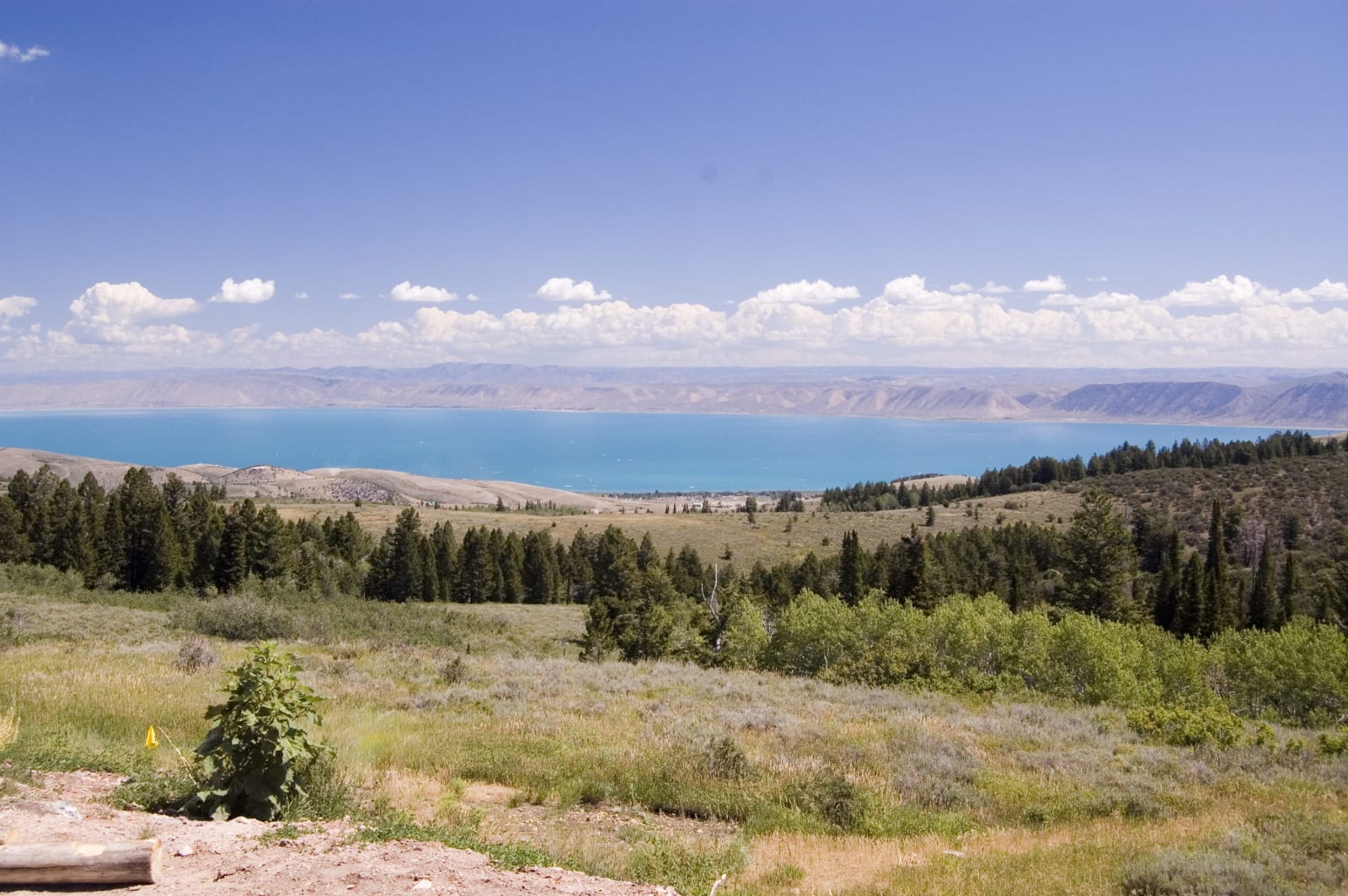
The first time you see Bear Lake, you will think someone is playing a trick on you. You are driving through the mountains of northern Utah, through ranch country and pine forest, and then you crest a ridge and there it is — a lake so turquoise it looks tropical, stretching 20 miles across a high valley at 5,900 feet elevation, framed by brown and green hills that could not look less Caribbean if they tried. The color is so unexpected, so out of place, that locals have called it the Caribbean of the Rockies for generations, and for once the marketing nickname is not an exaggeration.
The turquoise comes from calcium carbonate — microscopic limestone particles suspended in the water column that scatter sunlight and produce the distinctive blue-green hue. The particles are too fine to settle, so the color is present year-round, though it intensifies in summer when the sun is high and the water is calm. The effect is different from the blue of a typical mountain lake, which usually comes from depth and clarity. Bear Lake's color comes from what is in the water, not what is absent from it, and the result is a shade of turquoise that looks almost artificial against the sagebrush and rangeland surrounding it.
The lake straddles the Utah-Idaho border, with roughly half in each state, and it is genuinely ancient. Bear Lake has existed as an independent body of water for at least 250,000 years, making it one of the oldest lakes in North America. That age has had biological consequences. Four species of fish — the Bonneville cisco, the Bonneville whitefish, the Bear Lake whitefish, and the Bear Lake sculpin — are found here and nowhere else on Earth. They evolved in isolation over tens of thousands of years, adapting to the specific chemistry and temperature of the lake. The Bonneville cisco, a small silvery fish that spawns in January along the eastern shore, draws ice fishermen who dip-net them by the thousands during the brief spawning run — a tradition that has been going on for as long as anyone can remember.
The western shore, anchored by the small town of Garden City, is the social center of Bear Lake. In summer the beaches fill with families from the Wasatch Front — Bear Lake has been a traditional vacation destination for northern Utah and southern Idaho families for generations, and many of the cabins and homes along the shore have been in the same families for decades. The lake is warm enough for swimming by mid-June, deep enough for sailing and waterskiing, and clear enough that you can see your feet in chest-deep water.
But the real cultural institution of Bear Lake is the raspberry shake. Garden City sits at the center of a microclimate uniquely suited to growing a particular variety of raspberry — a plump, intensely flavored berry that thrives in the valley's combination of cold winters, warm summers, and rich volcanic soil. Roadside shake stands line the highway through town, each serving their own version of the Bear Lake raspberry shake — thick, sweet, and so packed with berries that the straw stands up on its own. Stopping for a shake is not optional. It is the law of the road, enforced by generations of tradition and the irresistible smell of fresh raspberries drifting across the highway.
The eastern shore is quieter and wilder, with fewer developments and longer stretches of undeveloped shoreline. Cisco Beach, on the northeastern end, offers some of the best swimming access and the most vivid turquoise color, especially on calm mornings when the surface reflects the sky and the limestone particles glow in the shallow water. Rendezvous Beach, on the southern end, is a state park with a campground and wide sandy beach that fills up on summer weekends but empties out beautifully on weekday afternoons.
Bear Lake is also the jumping-off point for Logan Canyon, one of the most beautiful mountain drives in Utah. The canyon road climbs from the lakeshore through limestone cliffs, alpine meadows, and forests that turn spectacular shades of red and gold in autumn. The combination of a Bear Lake afternoon and a Logan Canyon drive is one of the finest day trips in northern Utah.
Winter transforms the lake into something entirely different. The turquoise water turns steel gray under overcast skies. Snow blankets the surrounding hills. The raspberry stands close for the season. And the cisco spawn begins, drawing hardy locals onto the frozen or near-frozen shoreline with dip nets and headlamps. It is a colder, quieter, more austere version of the same lake, and some locals prefer it to the summer crowds.
Bear Lake is not on most tourists' itinerary — it sits in the far northeast corner of Utah, well off the national park circuit — and that is part of its charm. This is a locals' lake, a family lake, a place where the traditions run as deep as the water and the raspberry shakes taste like summer itself.
Visitor Info
On the Map
A story featuring this place
Go deeper into the history and character of this stop
Nearby
The closest stops worth working into your route
Historical markers nearby
Roadside plaques and monuments within a short detour