The Story
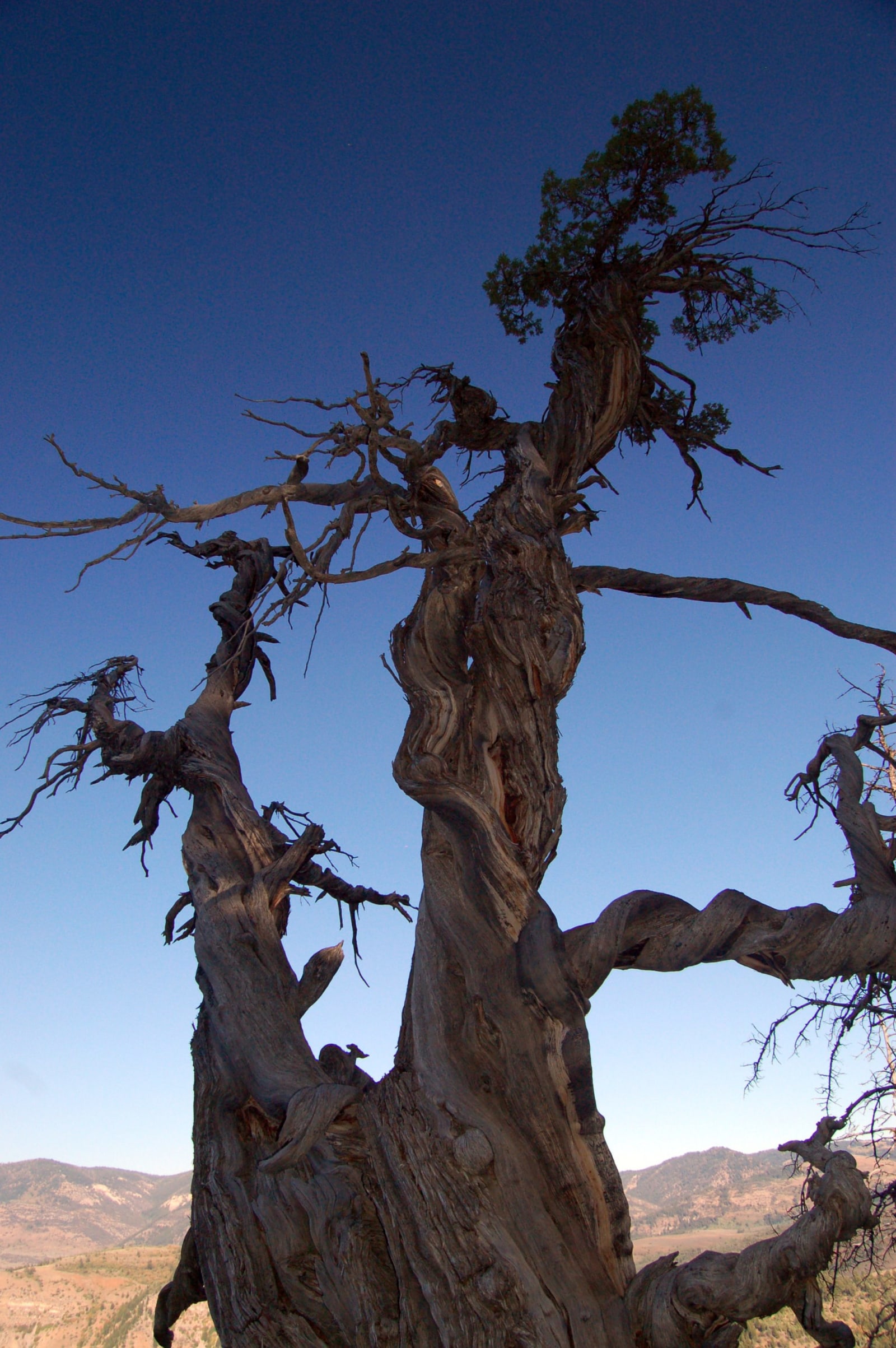
The Jardine Juniper has been alive for over 1,500 years, and it looks every day of it. The trunk is massive — over seven feet in diameter — twisted and furrowed by centuries of wind, frost, and sun into a shape that looks less like a tree and more like a monument to endurance. Strips of dead wood spiral around sections of living bark, and the branches that still carry green needles extend from a trunk that is mostly hollow and weathered to the color of old bone. It is not a pretty tree. It is a magnificent one.
The tree stands at roughly 9,000 feet elevation on the slopes above Logan Canyon, reached by a 4.8-mile trail that climbs about 1,800 feet from the Wood Camp trailhead. The hike is moderate — steady uphill through aspen groves, conifer forest, and open meadows — and the trail is well-maintained and well-marked. The final approach crosses a rocky slope and emerges at a fenced overlook where the juniper stands alone on a limestone ledge, silhouetted against the sky with the canyon dropping away below.
The age estimates vary. Early studies using core samples suggested the tree was roughly 3,200 years old, which would have made it one of the oldest non-clonal organisms on Earth. More recent analysis has revised that estimate downward to roughly 1,500 years, which is still extraordinary — this tree was a seedling around the time the Roman Empire was collapsing and the early Middle Ages were beginning in Europe. It was already centuries old when the Fremont people were carving petroglyphs in the canyons below. It was approaching its millennium when the first Mormon pioneers entered Cache Valley.
Rocky Mountain junipers are not typically known for extreme longevity — most live a few hundred years at best. The Jardine Juniper's survival is likely due to its specific location. The rocky, exposed site limits competition from other trees, which reduces the risk of fire and disease. The elevation provides adequate moisture from snowmelt. And the limestone bedrock, while nutrient-poor, is stable and well-drained, preventing root rot. The tree has essentially found a niche where the conditions are harsh enough to discourage competitors but mild enough to sustain slow, steady growth over centuries.
The tree is named after William Jardine, a former U.S. Secretary of Agriculture who visited the site in the early twentieth century and helped bring attention to its significance. The name stuck, and the tree has been a regional landmark ever since. The Forest Service installed a fence around the base to prevent soil compaction and root damage from visitors, and interpretive signs at the site explain the tree's biology and history.
The hike to the Jardine Juniper is one of the most rewarding half-day outings in northern Utah. The trail passes through a succession of ecosystems — riparian meadow at the bottom, dense aspen and fir forest on the middle slopes, and open rocky terrain near the summit — and the wildflower displays in July and August are excellent. Views of Logan Canyon and the Bear River Range open up as you gain elevation, and the final approach to the tree has a quality of pilgrimage — you have walked nearly five miles uphill to see a single tree, and the tree justifies every step.
The experience of standing next to the Jardine Juniper is different from standing next to a young, healthy tree. There is no lush canopy, no shade to speak of, no sense of biological exuberance. What you feel instead is persistence. This tree has survived drought, fire, lightning, wind, ice storms, and fifteen centuries of mountain weather through sheer stubbornness, growing so slowly that its rings are sometimes too narrow to count with the naked eye. It adds wood the way glaciers move — imperceptibly, relentlessly, on a timeline that makes human lifespans feel like brief interruptions.
The trailhead is located along Highway 89 in Logan Canyon, about 10 miles east of Logan. Parking is limited but usually available on weekdays. The trail is typically accessible from late May through October, depending on snowpack. Bring water, sun protection, and a layer for the higher elevation, where temperatures can be significantly cooler than the canyon floor. And bring a willingness to stand quietly in front of something very old and very patient, because that is what the Jardine Juniper asks of you, and it is the least you can offer a tree that has been here since before your civilization began.
Visitor Info
On the Map
A story featuring this place
Go deeper into the history and character of this stop
Nearby
The closest stops worth working into your route
Historical markers nearby
Roadside plaques and monuments within a short detour