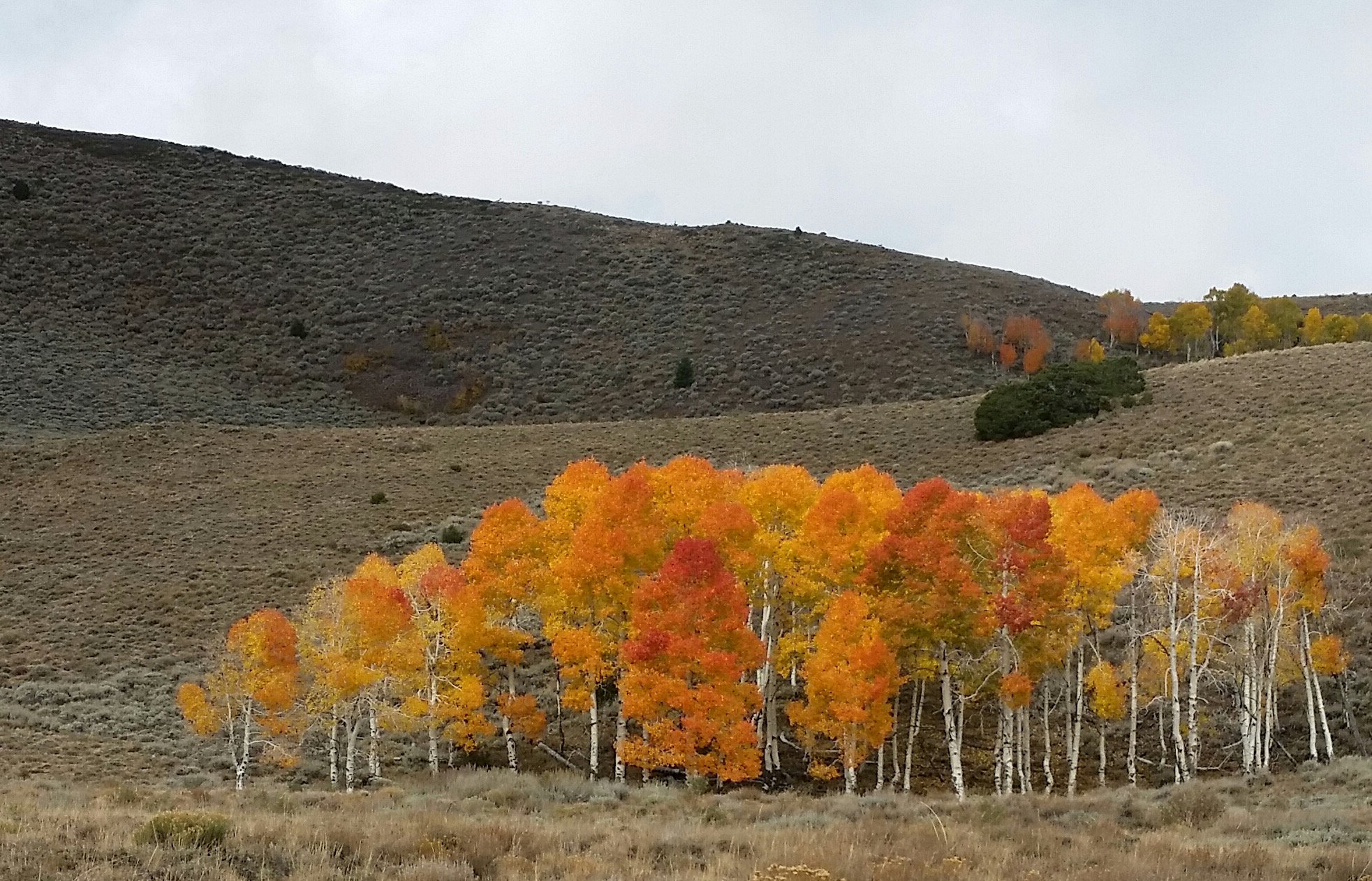
Stand on a Utah mountain road in the last week of September and look across at the far slope. One patch of aspen is blazing gold. The patch beside it is still deep green. A third, higher up, has already gone bare and gray. It looks like a forest of trees turning at their own individual pace, the way maples do back east — a little randomness, a little luck, leaf by leaf.
It is nothing of the kind. What you are looking at is a map. Each block of single-colored aspen is one living thing, and the seams between the colors are the borders between individuals. A stand of aspen is not a crowd of trees. It is, more often than not, a single tree wearing a few thousand trunks — and autumn is the season it shows you its outline.
A grove is one tree
Aspen barely bother with seeds. Where most trees scatter offspring and let them fend for themselves, a quaking aspen mostly clones — it sends up new trunks as suckers from a spreading underground root system, each one a genetically identical shoot of the same organism. Every white trunk you can count in a stand is not a separate tree but a stem of one shared individual, the way blades of grass run off a single set of roots. Botanists call the whole connected being a clone, and a clone can be enormous.
The individual trunks are not long-lived; an aspen stem rarely passes 100 to 150 years before it dies. But the root system underneath is effectively immortal. When a stem dies, or a fire kills a whole stand, the roots simply push up a fresh generation, and the cycle starts again. A clone can do this for thousands of years, which means the organism is far older and far larger than any single trunk suggests. The most extreme case anyone has measured is right here in Utah — Pando, a single aspen near Fish Lake that covers more than a hundred acres and is counted as the largest, heaviest living thing on Earth. But Pando is not a freak of nature. It is only the biggest example of the thing every aspen slope in the state is quietly doing.
How to read the gold
Here is where autumn earns its reputation. Because each clone is a separate individual with its own genes, it keeps its own calendar and wears its own exact shade. One clone runs pure butter-gold; the clone touching it leans orange; a third is still green when its neighbors have dropped. The color of an aspen's leaves is inherited the way hair color is, and every stem in a clone shares that inheritance, so a clone leafs out together in spring and turns together in fall, all at once, like a single body deciding it is time. North-facing slopes generally go first.
The practical upshot is that you can stand at a pullout and read the genetics off the hillside. Foresters delineate aspen clones exactly this way — by watching where one block of synchronized color stops and the next begins. That patchwork of golds and ambers and lingering greens you photograph every October is not decoration. It is a property map of giant organisms, drawn in pigment, legible for about two weeks a year.
Once you know the seams are there, the famous drives change character. The gold corridors of Logan Canyon, the cirque basin at Tony Grove Lake, the slopes above Aspen Grove on the Alpine Loop, the basins along the Nebo Loop past Payson Lakes, the high stands around Ruth Lake in the Uintas — every one of them is not a forest of thousands of trees but a mosaic of a few dozen individuals, each painting its own panel. You cannot unsee it after the first time.
The most alive thing on the mountain
It is worth knowing what these organisms are before talking about losing them, because an aspen stand is not just prettier than the dark conifer forest around it — it is dramatically more alive. The open, ever-shifting canopy lets light reach the ground, and the ground answers with an understory of grasses, wildflowers, and shrubs that a closed stand of fir or spruce simply cannot support. Acre for acre, aspen grow many times the forage of the conifers beside them and shelter a far richer roster of birds, insects, and mammals; ecologists treat them as one of the biodiversity strongholds of the interior West. They handle water differently too, holding the snowpack longer and yielding cleaner, steadier streamflow than the evergreen forest that tends to replace them. When a gold slope converts to dark green, the mountain does not just lose a color in October — it loses its richest neighborhood.
The oldest things on the mountain are vanishing
There is a harder fact folded into the gold. A great many of these organisms are failing, and from the road you would never know.
Aspen are a disturbance species: they evolved to depend on something knocking the forest back — fire, mostly, but also avalanche or flood — which triggers the roots to flood the cleared ground with new suckers. Take the disturbance away and the system stalls. A century of aggressive fire suppression let slower conifers creep up into the aspen and shade out the young stems, converting gold slopes to dark green a tree at a time. Then, in the droughts of the early 2000s, whole stands began dying back outright across southern Utah, southwestern Colorado, and northern Arizona — a fast collapse that scientists named Sudden Aspen Decline. And underneath both problems sits a steady one: deer and elk graze the tender new suckers down to nothing, so even when the roots try to send up a replacement generation, it gets eaten before it can grow tall enough to escape.
The diagnostic is simple enough that you can run it yourself from the trail. A healthy clone has all its ages at once — old trunks, middle-aged saplings, and a thicket of knee-high sprouts coming up underneath. If you can see clean through an aspen grove, with nothing but mature trunks and grass below them, the sprout and sapling layers are missing, and the organism is quietly going out of business. The root can outlast almost any fire. What it cannot outlast is a steady diet of its own children. Even Pando, the largest of them all, is thinning for exactly these reasons — the biggest organism on the continent, undone by deer.
Next September the gold will come back, and from a distance nothing will look wrong. But there is a little less of it each decade, and what is thinning is not really trees. It is individuals, some of them older than the first people who ever walked into these mountains, dimming one panel at a time. Read the gold while it is still a full map.