The Story
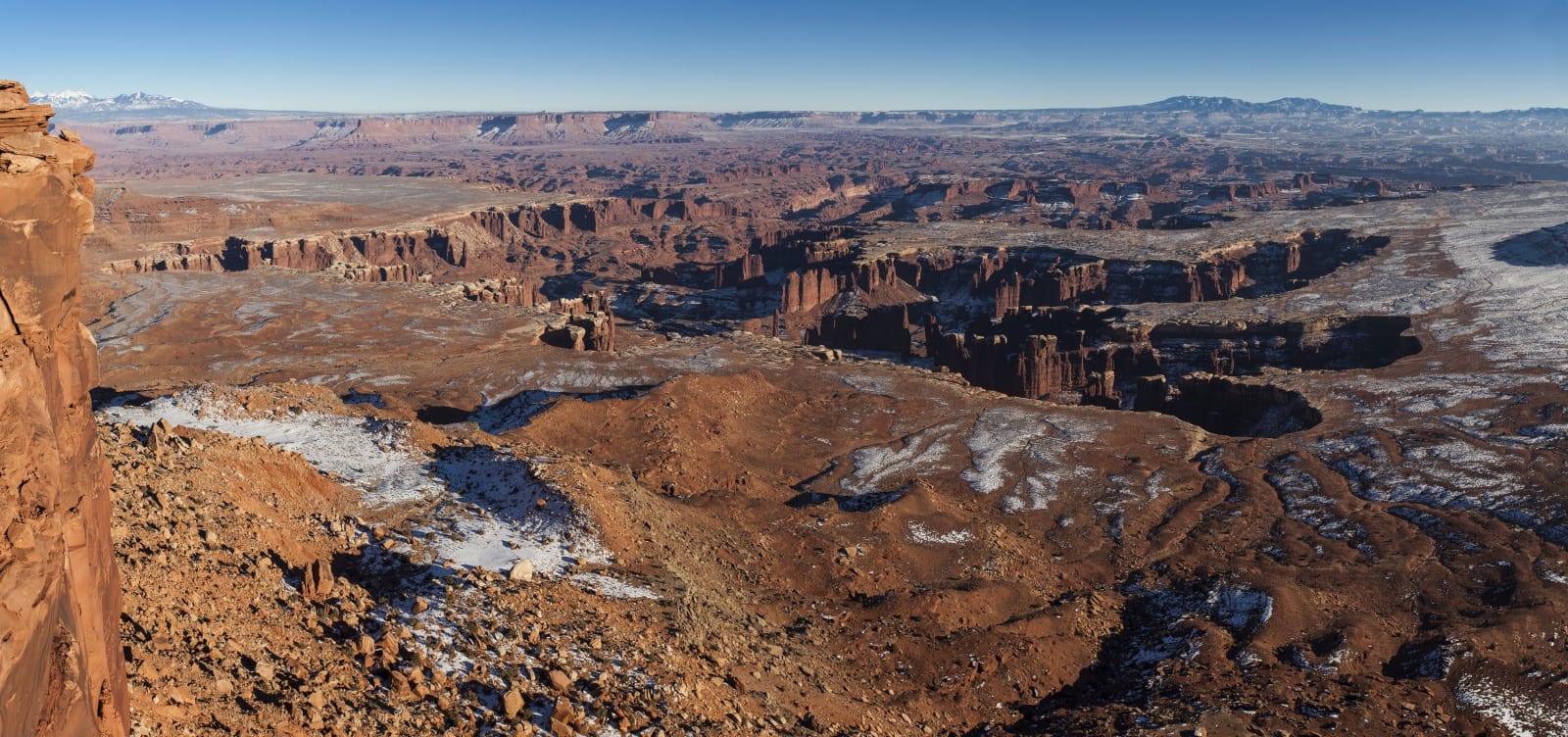
Island in the Sky is a flat-topped mesa standing 1,000 feet above the surrounding landscape, and the views from its edges are the kind that rearrange your understanding of distance. At Grand View Point, you can see over 100 miles in every direction — a staggering panorama of canyons, mesas, buttes, and the snow-capped peaks of the La Sal and Henry Mountains on the horizon. There are no trees, no buildings, no cell towers interrupting the view. Just layer after layer of carved stone stretching to the curve of the Earth.
Island in the Sky is the most accessible of Canyonlands National Park's four districts, and it is the one most visitors see. The paved approach on UT-313 also leads to Dead Horse Point State Park, whose overlook of a goosenecked bend in the Colorado River 2,000 feet below is one of the most photographed views in the state, and the two are almost always visited on the same trip. The mesa sits between the Green and Colorado Rivers, which converge at the Confluence roughly 2,000 feet below. A single paved road runs the length of the mesa, ending at Grand View Point, with spur roads to additional overlooks and trailheads. You can drive the entire thing in an hour, but you should not. Every pullout reveals a different angle on the labyrinth below, and the scale demands that you slow down.
The mesa top is high desert — sparse juniper, cryptobiotic soil crust, and wind — but the real landscape is the one you look down into. The White Rim, a broad bench of White Rim Sandstone roughly 1,200 feet below the mesa top, forms a second tier of the canyon system. Below that, the rivers have cut another 1,000 feet to the canyon floor. The total depth from mesa top to river is roughly 2,000 feet, and the rock layers exposed in those walls span over 300 million years of geological history.
Mesa Arch is the park's most photographed feature, and for good reason. This modest pothole arch sits right at the edge of the mesa rim, and at sunrise the underside of the arch catches the reflected light from the canyon below, glowing an intense, almost supernatural orange. Behind it, the Washerwoman Spire and Buck Canyon drop away into a thousand feet of nothing. The hike is only a half-mile round trip, and at dawn in the shoulder seasons you might have it to yourself.
The Upheaval Dome trail leads to one of the most debated geological features in Utah. From the rim overlook, you look down into a circular crater nearly a mile across. For decades geologists argued whether it was a collapsed salt dome or a meteorite impact crater. The current consensus leans toward impact — a meteor roughly a third of a mile in diameter striking the Earth 60 million years ago — but the debate is not fully settled, and standing at the rim you can see why. The structure is bizarre and unlike anything else in the park.
The White Rim Road is a 100-mile unpaved loop that traces the White Rim bench, and it is one of the great adventure drives in the American West. Most people do it over three to four days by four-wheel-drive vehicle or mountain bike, camping at designated sites along the way. Permits are required and competitive, but the experience — sleeping under the stars in complete silence, waking up at the edge of a 1,000-foot cliff — is unmatched.
Canyonlands is often compared to the Grand Canyon, and the comparison is fair but misleading. The Grand Canyon is a single enormous chasm with one river at the bottom. Canyonlands is a maze — a tangle of canyons, mesas, grabens, needles, and standing rocks carved by two rivers and their tributaries over tens of millions of years. It is wilder, less developed, and far less crowded. The park's other districts are quieter still — the Needles, to the south, is reached on UT-211 past the Newspaper Rock petroglyph panel, one of the densest rock-art sites in the Southwest. There is no lodge, no shuttle bus, no gift shop at the bottom. There is just rock, sky, silence, and the slow patient work of water.
That patience is what you feel most strongly at Island in the Sky. Standing at any of the overlooks, watching the shadows lengthen and the colors shift as the sun moves across the canyon walls, you are watching the same process that carved everything you see. The rivers are still cutting. The cliffs are still falling. The mesa you are standing on is a little smaller today than it was yesterday, and a little bigger than it will be tomorrow. You are standing on a temporary platform above a permanent process, and the humility that produces is the real gift of this place.
Visitor Info
On the Map
Stories featuring this place
Go deeper into the history and character of this stop
Nearby
The closest stops worth working into your route
Historical markers nearby
Roadside plaques and monuments within a short detour