 James St. John / CC BY 2.0
The Story
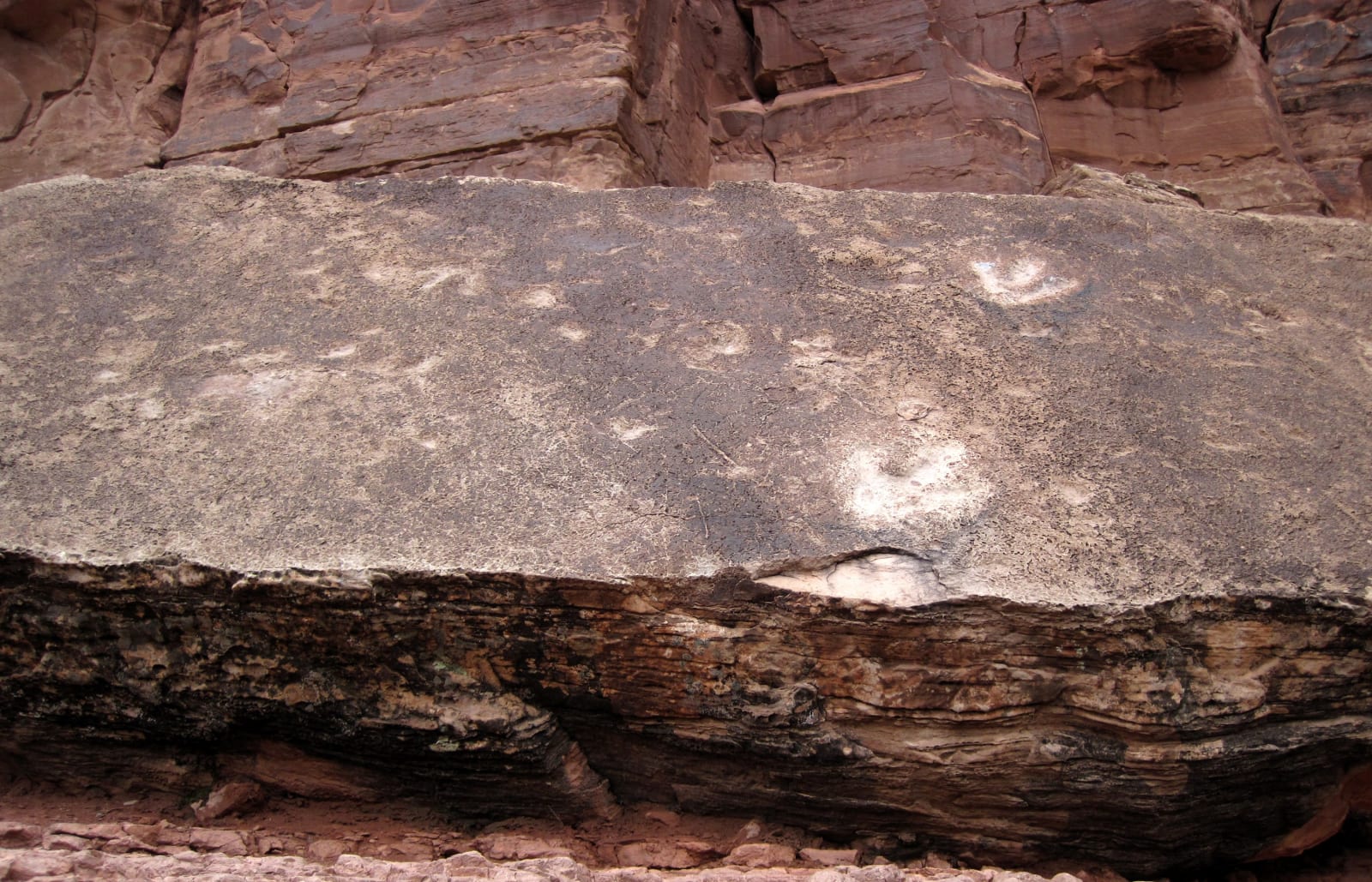
The Potash Road dinosaur tracks are embedded in a cliff face along the Colorado River, and finding them requires nothing more than a short walk from a pullout on one of the most scenic roads in the Moab area. The three-toed footprints were left by theropod dinosaurs roughly 150 million years ago, pressed into the soft sediment of a Jurassic riverbank that has since been turned to stone, tilted by tectonic forces, and exposed on a vertical cliff face where they are visible from a short trail below. You stand at the base of the cliff, tilt your head back, and look at footprints left by an animal that was walking on flat ground 150 million years ago — ground that is now a wall.
The tracks are preserved in the Kayenta Formation, a reddish-brown layer of sandstone and siltstone deposited by rivers and streams during the early Jurassic period. The formation is visible throughout the Moab area as a ledgy, chocolate-colored band of rock that sits between the massive Wingate Sandstone cliffs below and the rounded Navajo Sandstone domes above. The Kayenta was a floodplain environment — rivers meandered across a broad, flat landscape, and the soft mud along their banks recorded the footprints of every animal that walked across it. Most of those impressions were erased by the next flood or the next footstep. A few, buried rapidly by fresh sediment and protected from erosion, survived long enough to be lithified — turned to stone — and preserved as trace fossils.
The tracks at this site include several clear three-toed prints attributed to medium-sized theropod dinosaurs, likely similar to Dilophosaurus or related species. The prints are roughly 10 to 15 inches long, with well-defined toe impressions and in some cases visible claw marks at the tips. The vertical orientation of the rock face — the result of the tectonic tilting that rotated the originally horizontal layers — presents the tracks in profile, which can be disorienting at first. Your brain expects footprints to be on the ground, and seeing them on a cliff wall requires a moment of mental rotation to understand what you are looking at.
The pullout and trailhead are located along Potash Road, officially Highway 279, which follows the Colorado River northwest from its junction with Highway 191 about 3 miles north of Moab. The road itself is one of the most scenic drives in the area — a narrow corridor between towering Wingate Sandstone cliffs and the green ribbon of the Colorado River, passing rock art panels, rock climbing areas, and several other geological points of interest before reaching the potash evaporation ponds that give the road its name.
The dinosaur track site is marked with a small sign that is easy to miss if you are distracted by the scenery — which you will be, because the scenery along Potash Road is relentlessly spectacular. The walk from the pullout to the cliff face takes about five minutes on an informal trail, and interpretive signs at the base of the cliff help identify the individual tracks and explain their geological context. Binoculars or a camera with a telephoto lens are helpful for studying the tracks in detail, as the best-preserved prints are 10 to 15 feet above ground level.
The site is free to visit and managed by the Bureau of Land Management. There are no facilities — no restrooms, no water, no shade. The exposure is full desert sun, and summer temperatures along the river corridor can exceed 100 degrees. Early morning or late afternoon visits are more comfortable and produce better lighting conditions for photographing the tracks.
Potash Road is also home to several panels of ancient rock art — petroglyphs pecked into the desert varnish on the cliff faces by Fremont and Ancestral Puebloan peoples roughly 1,000 to 2,000 years ago. The combination of dinosaur tracks and human rock art along the same road creates a timeline that spans from the Jurassic to the recent past, with the Colorado River as the constant thread connecting both eras. The dinosaurs walked along a Jurassic river. The Fremont people carved images along a modern river. Both left their marks on the same canyon walls, separated by 148 million years.
The Potash Road dinosaur tracks are a ten-minute detour on a road that most Moab visitors drive for its scenery alone. The tracks add a paleontological dimension to the drive that transforms a scenic road into a geological time machine. You are driving through a landscape built from the same sediments that recorded these footprints, and the connection between the tracks on the cliff and the formations around you is direct and physical. The animals that made these prints walked on the ground that became the rock that became the cliffs that frame the road you are driving. Everything is connected. The tracks are the proof.
Visitor Info
On the Map
Nearby
The closest stops worth working into your route
Historical markers nearby
Roadside plaques and monuments within a short detour