The Story
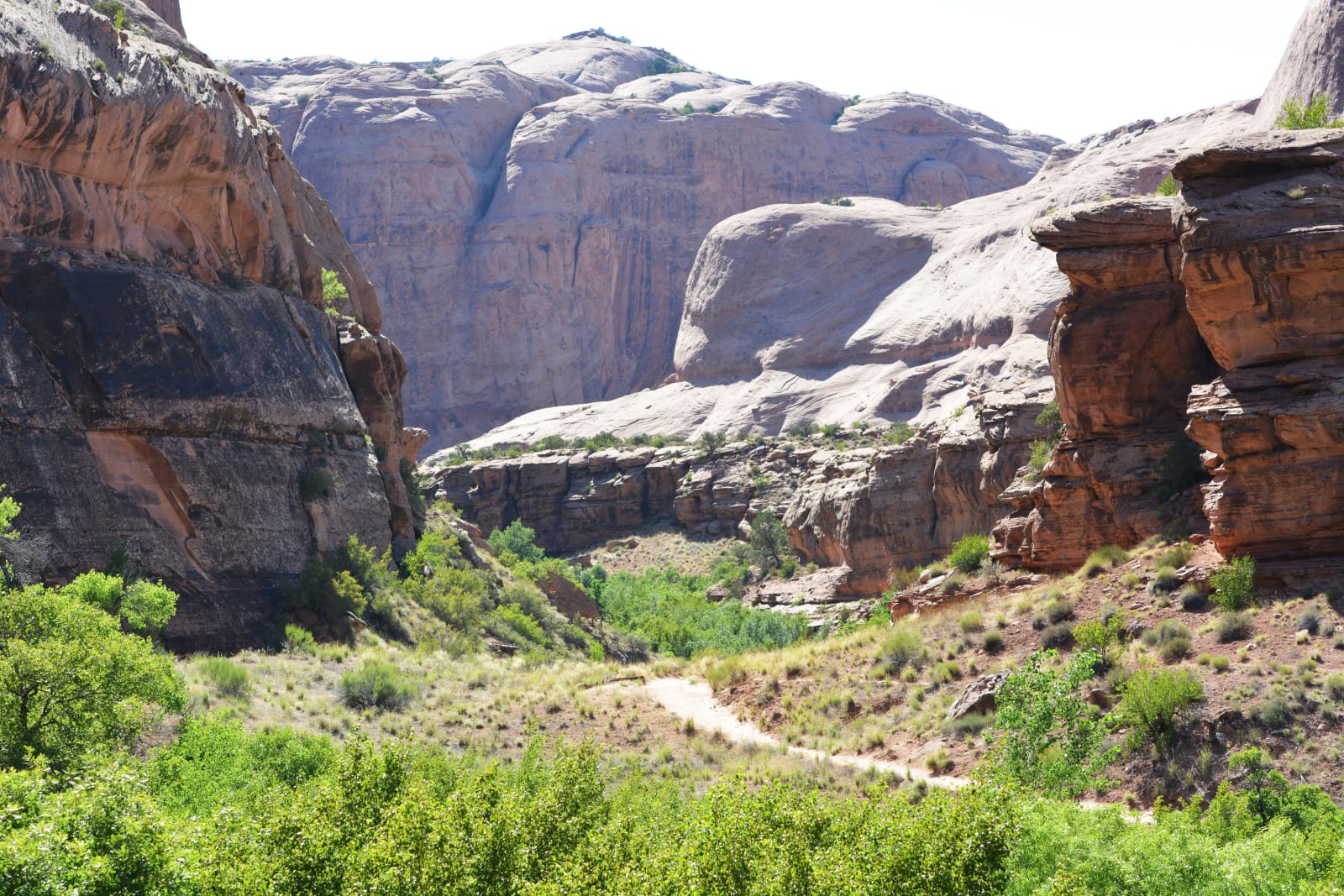
Most of the trail up Grandstaff Canyon runs along the bottom of a sandstone slot a few hundred feet deep, beside a stream that does not quit even in August, and that combination — running water, high red walls, near-constant shade — makes it one of the few hikes near Moab you can do in the heat of summer without paying for it. The path crosses the creek again and again, so your feet are going to get wet, and that is half the appeal: in July the water is the reason to come, and in winter the walls hold the cold long enough that microspikes are not a bad idea.
The walk is about four and a half miles round trip with only three hundred feet of climbing, which is gentle by the standard of nearly anything else in this country, and it ends at Morning Glory Natural Bridge. The span is 243 feet across, the sixth-longest natural rock span in the United States, and it is strange even by southern Utah's standards: instead of arching over the canyon the way a bridge ought to, it runs parallel to the cliff a mere fifteen feet off the wall, eroded out of a sandstone fin by the same patient water that carved the formations in nearby Arches National Park. Because a stream cut it rather than ordinary weathering, geologists call it a bridge and not an arch. A spring seeps at its base into a shaded pool, and a small waterfall runs at the southern end when the canyon is wet — and that same dampness feeds a thick crop of poison ivy, so the cool green tangle beneath the span is best admired without wading into it.
The canyon carries a name that took a long time to get right. It honors William Grandstaff, a frontiersman of African American and Creole descent who was among the first settlers to put down roots near Moab in the late 1870s and who ran cattle up this drainage long enough that the place came to bear his name. For most of the twentieth century the canyon was labeled with a cruder, racially loaded version of it; in 2017 the name was formally changed to Grandstaff, restoring the man rather than the slur, and the campground at the trailhead carries his name as well. The Bureau of Land Management looks after the canyon, charges nothing to walk it, and designated the route a National Recreation Trail in 2020 — formal recognition for a trail locals have always treated as one of the best easy days in the area. It pairs naturally with Fisher Towers and the old Dewey Bridge farther up UT-128 if you are working your way along the river.
Visitor Info
On the Map
Nearby
The closest stops worth working into your route
Historical markers nearby
Roadside plaques and monuments within a short detour