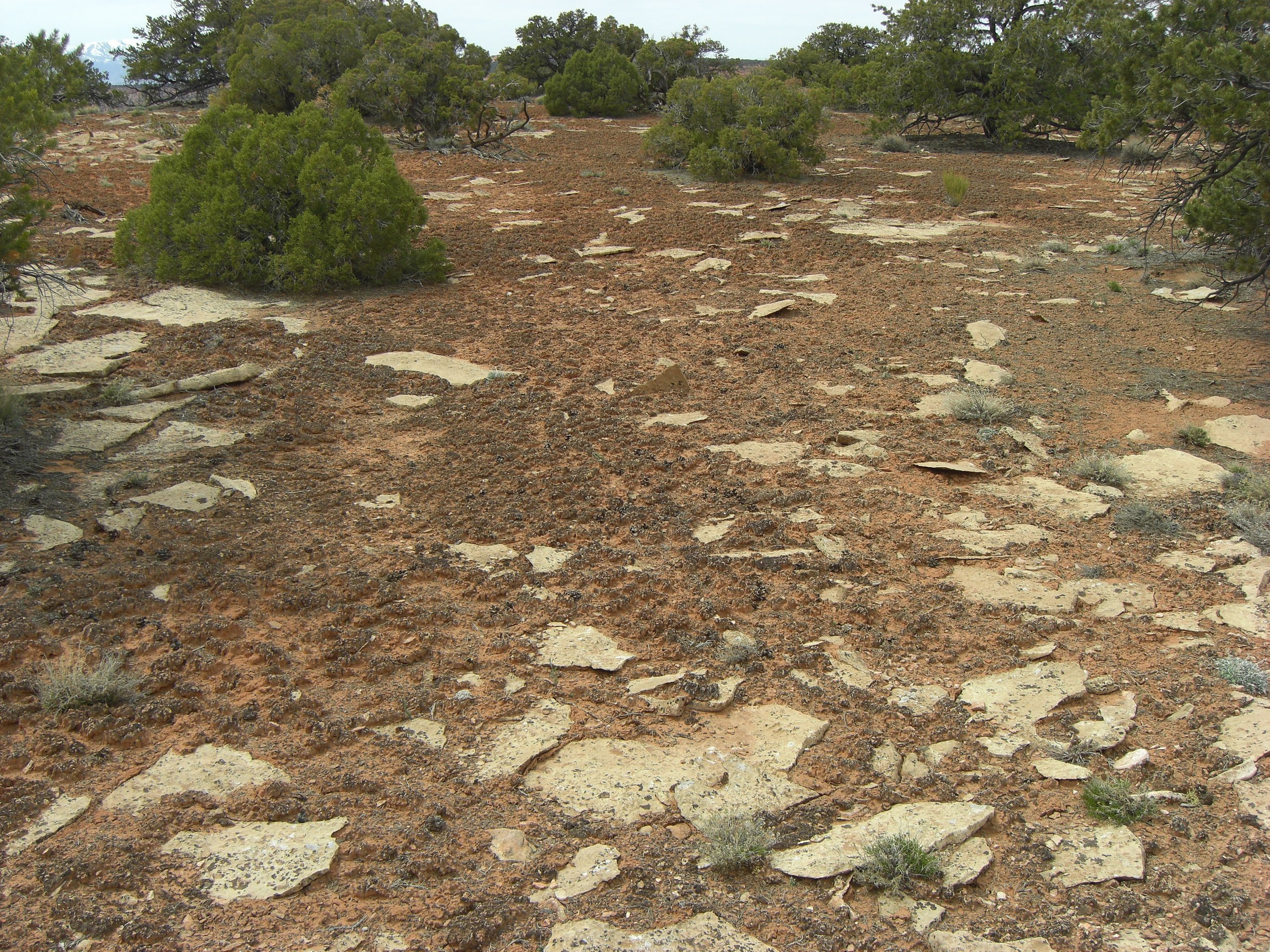
You have seen it without seeing it. The lumpy black ground between the sagebrush and the slickrock all across southern Utah, dark and knobby, as though the desert floor grew a rind or a low crust of cooled lava set up overnight. Most people walk straight over it on the way to the view. The one-line version is on a sign at Dead Horse Point: a living crust that takes decades to grow and seconds to destroy. That is true, and it is a vast understatement. That black rind is one of the oldest and most consequential living things in Utah — and out in the open ground between the plants, it is not something lying on the desert. It is the desert's skin.
A skin of glue and sunscreen
The formal name is biological soil crust, or cryptobiotic soil, and it is not a thing but a community — cyanobacteria, lichens, mosses, fungi, and algae, all woven together through the top few millimeters of dirt. The pioneer, the organism that starts it, is a cyanobacterium finer than a thread. When rain comes, it wakes and crawls through the sand, trailing a sticky sheath of sugars behind it; lift a flake of mature crust and you can see the filaments hanging underneath, sand grains glued along their length like beads on a string. That glue is the entire trick. Billions of sticky threads lace through loose sand and bind it into a tough, continuous mat.
The black color is not dirt. It is sunscreen — a dark pigment the cyanobacteria manufacture to survive the desert's punishing ultraviolet light. Look closely at a healthy crust and you find it is not black at all but mottled: rust and chartreuse and pink and charcoal, each color a different species of lichen or moss, a dozen of them crowded into a square foot of ground. The whole community spends most of its life dormant and brittle under the sun, then turns visibly green within minutes of a rain shower and goes back to sleep as it dries. Its lineage is almost beyond comprehension: cyanobacteria much like these were binding the world's soils more than a billion years ago, before anything had crawled out of the sea to walk on them.
What the crust is doing for you
This unassuming mat is the connective tissue of the entire landscape. In undisturbed country on the Colorado Plateau, biological crust can make up seventy to eighty percent of the living ground cover — which is to say that in the wide gaps between the junipers and the shrubs, the living thing covering the soil is almost always the crust. And it earns that real estate by doing the jobs nothing else in a place this dry will do.
It holds the ground down. The sticky mat clamps loose sand and silt in place so that wind cannot strip it and flash floods cannot carry it off; without the crust, much of the red-rock desert is simply sand waiting for a reason to move. It feeds the ground, too: the cyanobacteria pull nitrogen straight out of the air and fix it into the soil in a form plants can use, and in these starved sands the crust is the main natural fertilizer, a quiet reason the wildflowers and bunchgrasses can grow here at all. It manages the water, its rough and porous surface soaking up scarce rain and holding it near the top of the soil where seeds and shallow roots can reach it, rather than letting it sheet off bare sand and vanish. And its bumpy surface catches blowing seeds and nutrient-rich dust, assembling the next generation of soil one gust at a time. The cottonwoods and the junipers and the showy spring flowers are tenants. The crust is the landlord.
A lifetime to build, a second to break
Here is the cruel part. A thing built to outlast a billion years of sun and drought and radiation has almost no defense against the one force it never evolved to meet: weight. A single footstep, a bike tire, a cow's hoof crushes the filaments and shears the mat, and the spot you came down on is dead at once. Where dark, living crust used to be, a pale scar of loose sand opens up — and that color change is the whole story at a glance, because mature crust is dark and pinnacled while disturbed crust goes light, slumping back into something that looks like the bare sand it has become.
The timescale is what turns carelessness into damage. A thin cyanobacterial veneer might creep back across a scar in five to ten years, if the spot is left strictly alone and the rains are kind. But the full community — the lichens, the mosses, the built structure, the stored nitrogen — takes decades, and frequently centuries, and on the driest, coarsest ground some scars never truly heal at all. Tank-training tracks pressed into desert soils in the 1940s are still legible today; so are the tire scars of a single ill-judged drive across the flats. You can erase in one thoughtless step something that took longer than the United States has existed to assemble.
And the wound does not stay local. Where the crust is broken, the sand it was holding begins to travel, and the dust it lifts does not merely haze the desert — it can ride the wind for hundreds of miles and settle onto mountain snowpack, where the darkened snow absorbs more sun and melts off weeks early, shortchanging the rivers that distant cities are counting on through the summer. The skin of the desert turns out to be quietly tied to the water in the mountains.
Where it is, and how not to kill it
Once you know to look, you will see it everywhere on the Colorado Plateau: the mesa tops of Canyonlands, the flats between the fins at Arches, the benches of Capitol Reef, the open desert of the San Rafael Swell, the Cedar Mesa country around Natural Bridges. Fittingly, the world's center of crust research is Moab itself, where government scientists have spent decades working out exactly what the crust does, how slowly it heals, and how much harder that healing becomes as the climate warms.
The rule that follows is simple, and worth taking seriously even when no one is watching. Stay on the trail, the slickrock, or the sandy bottom of a wash; never shortcut across the black knobby ground, however sturdy it looks underfoot. The signs that ask you not to bust the crust are not being precious. They are asking you not to kill, in one careless second, something that was already alive when the rock around it was still being buried — and that the whole desert, silently, is standing on.