The Story
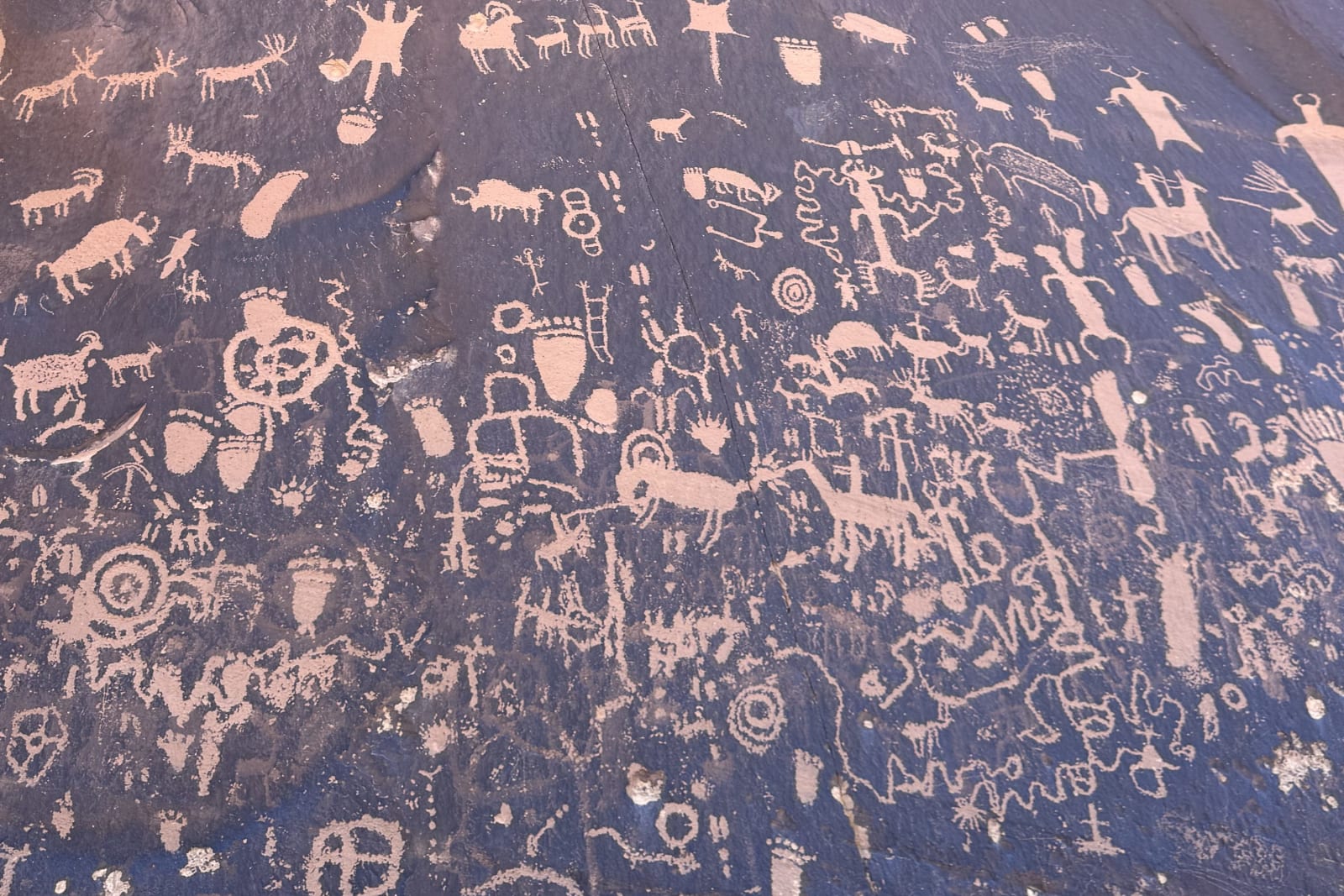
Newspaper Rock is one of those places where the distance between you and the ancient world collapses to the width of a pane of glass. A single massive panel of dark desert-varnished sandstone, roughly 200 square feet, is covered with over 650 petroglyphs spanning at least 2,000 years of human history. Figures of bighorn sheep, deer, riders on horseback, human handprints, spirals, geometric patterns, and scenes of hunting and ceremony crowd the surface in a dense, layered palimpsest of meaning. Some images are clearly older than others — the desert varnish has re-darkened over the older carvings while newer ones remain bright against the dark rock. The result is a timeline you can read with your eyes, scratched into stone by people whose names we will never know.
The rock sits in a small canyon along Indian Creek, about 12 miles west of the Needles District of Canyonlands National Park on Highway 211. The setting is modest — a pullout, a short paved path, a viewing railing, and the rock itself. There is no visitor center, no gift shop, no audiovisual presentation. Just the panel, the canyon, and the carvings. The simplicity is appropriate. The rock speaks for itself.
The petroglyphs were created by pecking through the dark layer of desert varnish — a thin coating of iron and manganese oxides deposited on exposed rock surfaces over centuries by wind-borne clay particles and bacterial action — to reveal the lighter sandstone beneath. The contrast between the dark varnish and the pale rock makes the images remarkably legible, even from the viewing railing several feet away. A pair of binoculars or a camera with a zoom lens reveals even more detail — tiny figures, subtle designs, and overlapping images that are invisible to the casual glance.
The artists span multiple cultures and time periods. The oldest images are attributed to Archaic-period hunter-gatherers who lived in this region over 2,000 years ago. Later additions were made by Ancestral Puebloan and Fremont peoples between roughly AD 200 and 1300. Ute people added images after that, and some of the most recent petroglyphs — including figures on horseback — date to the period after Spanish contact in the 1600s. Each culture had its own iconography, its own style, and its own reasons for carving on this particular rock. The cumulative effect is a document of human presence in this landscape that stretches back to a time when the world looked and felt fundamentally different.
The meaning of most petroglyphs is unknown, and anyone who tells you otherwise is guessing. Some images are clearly representational — a bighorn sheep is a bighorn sheep, a human figure is a human figure. But the spirals, concentric circles, abstract patterns, and enigmatic composite figures resist easy interpretation. They may be astronomical markers, clan symbols, ceremonial records, territorial boundaries, or something entirely outside modern Western categories of meaning. The temptation to impose narrative on the images is strong, but the honest answer is that we do not know what most of them mean, and that mystery is part of what makes them compelling.
What we do know is that this rock was important to many different peoples over a very long time. The concentration of images on a single panel suggests that the location itself held significance — perhaps as a landmark on a travel route, a gathering place, a ceremonial site, or simply a smooth, dark, inviting surface that accumulated carvings the way a community bulletin board accumulates notices. The Indian Creek corridor has been a natural travel route through the canyonlands for millennia, and Newspaper Rock sits at a point where the canyon widens and water is reliably available. It is easy to imagine travelers stopping here, resting, and adding their marks to a surface that was already ancient.
The rock is protected behind a railing, and visitors are asked to stay on the path and refrain from touching the surface. Desert varnish is fragile, and the oils from human skin can damage both the varnish and the carvings. Photography is encouraged, and the best light for capturing the petroglyphs is in the morning, when the sun hits the panel directly and the contrast between the dark varnish and light carvings is strongest. Afternoon light casts shadows from the canyon wall that can obscure portions of the panel.
Newspaper Rock is a five-minute stop on the way to the Needles District of Canyonlands, and many visitors treat it as exactly that — a quick photo and back in the car. That is a missed opportunity. Spend twenty minutes at the railing. Study the layers. Notice how newer carvings overlap older ones. Find the riders on horseback and realize that those images represent the most recent chapter in a story that stretches back two millennia. Then look up at the canyon walls around you and wonder how many other panels are out there, in side canyons and on cliff faces, unseen and unrecorded, slowly accumulating varnish over images that no living person has ever seen.
Visitor Info
On the Map
Nearby
The closest stops worth working into your route
Historical markers nearby
Roadside plaques and monuments within a short detour