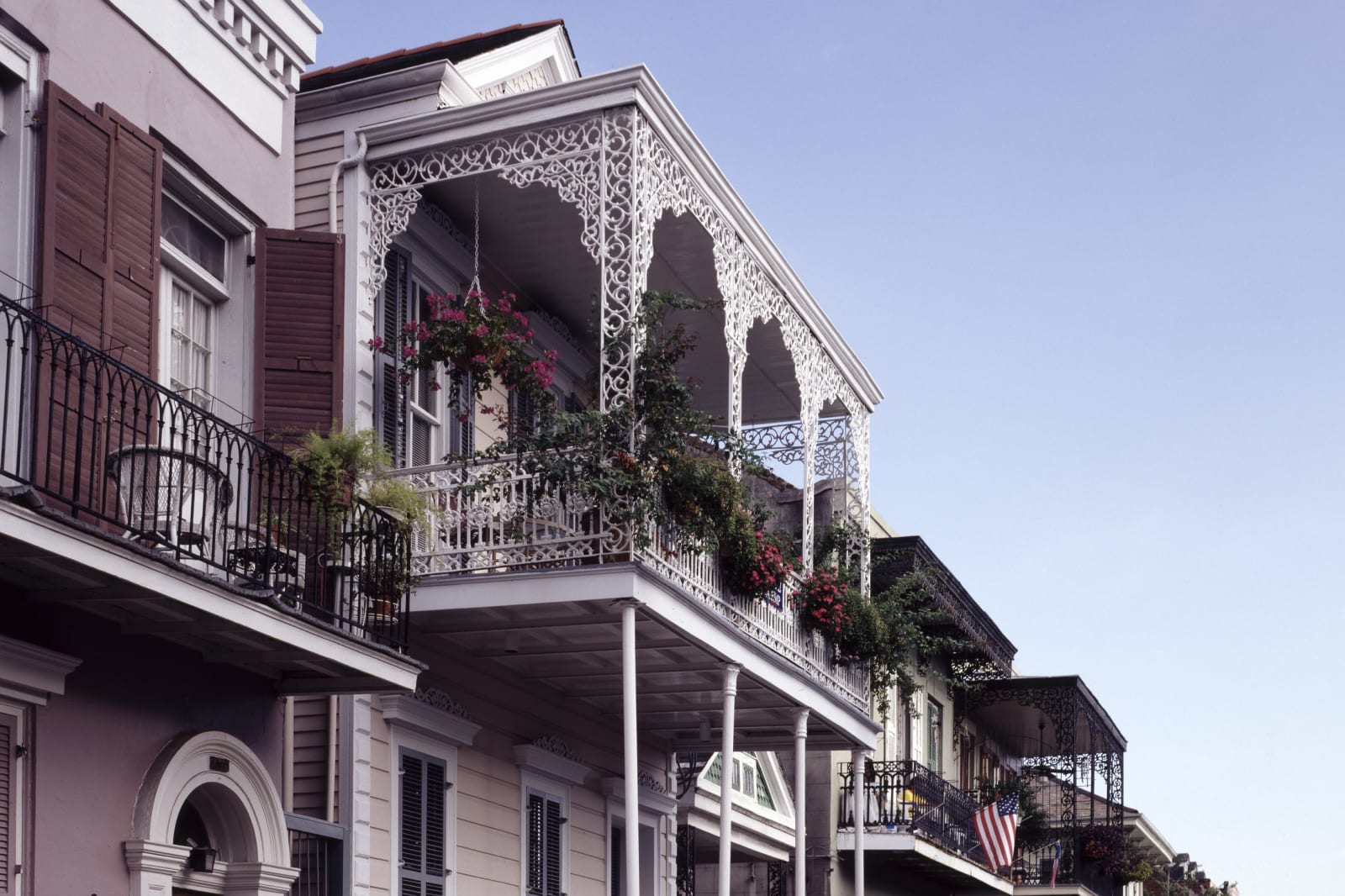
Carol M. Highsmith / public domain via the Library of Congress
A 6-Day Itinerary
New Orleans, the River Road, Baton Rouge, the Teche and Cane River in 6 Days
A one-way line across Louisiana from New Orleans: the Cabildo, Congo Square and the Historic New Orleans Collection, the River Road to Destrehan and Whitney, Baton Rouge's two capitols, the Atchafalaya Basin, Lake Martin and the Teche, Opelousas and Marksville, the Epps House and Kent House in Alexandria, and Colfax, Natchitoches and Cane River.
6 days · 432.8 miles · best in spring
New Orleans, LA → Natchitoches, LA
Most visitors see Louisiana from I-10 between New Orleans and Lafayette. This line takes six days and about 430 miles, and it runs one way from New Orleans up the Mississippi to Baton Rouge, west across the Atchafalaya Basin to the Teche, north through Opelousas and Marksville to Alexandria, and on to Natchitoches on Cane River. It ends in Natchitoches, so plan your way back.
The country belongs to older peoples. The Chitimacha are the earliest known settlers of the Bayou Chene region of the Atchafalaya, the Atakapa-Ishak and Opelousa peoples were among the first inhabitants at Vermilionville, the Tunica-Biloxi Tribe succeeded the Tunica, Biloxi, Ofo and Avoyel peoples, and Natchitoches takes its name from a Caddo people. The trip also names slavery plainly where it passes it: the domestic slave market of New Orleans, the 1811 German Coast uprising and its executions, the plantation houses where enslaved people built the walls, the Colfax massacre of 1873, and the freedom some people took by leaving with Union soldiers in 1864.
1
Day 1
New Orleans: the Cabildo, the Historic New Orleans Collection, Congo Square and Jazz Park
1.6 mi · about 0.1 hrs driving · overnight in New Orleans
Begin at The Cabildo, at 701 Chartres Street on Jackson Square. It was rebuilt between 1795 and 1799 and hosted the transfer ceremonies of the Louisiana Purchase late in 1803. The Louisiana Supreme Court sat in its council chamber until 1910 and heard Plessy v. Ferguson there. Homer Plessy challenged racially separated railroad cars, and the 1896 US Supreme Court decision that followed set the doctrine of separate but equal, which stood until Brown v. Board of Education in 1954. A short walk away, the Historic New Orleans Collection is free but needs a ticket. Its own page calls New Orleans the largest slave market in antebellum America and puts at about one million the people sold and shipped from the Upper South to the Lower South after the international trade ended in 1808. Then walk to Congo Square at 701 North Rampart Street. In 1724 the Code Noir made Sunday a day of rest in the colony, enslaved Africans included, and an 1817 city ordinance limited gatherings of enslaved people for dancing to this one site. The same ground was also used for slave sales and public executions. In 1864 more than twenty thousand people gathered here to celebrate the Emancipation Proclamation. The city renamed it Beauregard Square in 1893 for a Confederate general, and the City Council made the name Congo Square official in 2011. New Orleans Jazz National Historical Park has no admission fee, holds Perseverance Hall of 1819 and 1820 in Louis Armstrong Park, and keeps its visitor center at 419 Decatur Street. Spend the night in New Orleans.
2
Day 2
The River Road: Destrehan, Whitney and Baton Rouge
97.6 mi · about 2.2 hrs driving · overnight in Baton Rouge
Drive 23 miles and about half an hour up River Road to Destrehan Plantation at 13034 River Road, which lists hours of 9 to 5:30. The house was finished in 1790. In January 1811 enslaved people along the German Coast rose, beginning on the evening of January 8 at Manuel Andry's plantation upriver. Slaveholding judges tried the recaptured, and the busiest tribunal, five slaveholders, met at Destrehan; Jean Noel Destrehan himself sat on it. Of 21 captured people tried here, 18 were executed by firing squad, and Charles Deslondes, named as the revolt's leader, was seized from custody and killed without a trial. White residents put heads on poles along the levee for more than thirty miles. The Miller-Haydel Museum holds an exhibit on the 1811 uprising. Then drive 26 miles and about 40 minutes to Whitney Plantation at 5099 Louisiana Highway 18, a museum about slavery. It is open from 9:30 to 4:30 with last entry at 3, and it is closed on Tuesdays, so this day is a Wednesday. Guided tours run hourly and include the upstairs of the Big House. The museum names the people: Anna, who was bought at a New Orleans auction house and was sexually assaulted in 1835 by Antoine Haydel, and her son Victor, who after the Civil War bought nearby land with his wife Celeste. Granite walls record the names of 107,000 people enslaved in Louisiana before 1820, the Field of Angels remembers 2,200 enslaved children who died in St. John the Baptist Parish between 1823 and 1863, and a memorial recalls the 1811 uprising. Then drive 49 miles and about an hour to Baton Rouge and spend the night there.
3
Day 3
Baton Rouge and the Atchafalaya Basin
69.2 mi · about 1.7 hrs driving · overnight in Lafayette
Start at the Old State Capitol at 100 North Boulevard, a Gothic castle by James H. Dakin that opened on January 28, 1850. Union troops occupied it on December 28, 1862, and a cooking fire destroyed the interior. Its Museum of Political History is free and open Tuesday, Thursday and Friday from 10 to 4 and Saturday from 9 to 3, so a Thursday works. A mile away is the Louisiana State Capitol, 450 feet and 34 floors, begun on December 16, 1930 and dedicated on May 16, 1932. Huey Long was shot there on September 8, 1935 by Dr. Carl Weiss and died two days later; he is buried on the front grounds. Admission is free, and the observation deck was listed as closed for renovation, so call before planning around the view. The Capitol Park Museum at 660 North Fourth Street is open Tuesday to Saturday from 9 to 4 and charges $13. Its exhibits cover the slave market, resistance and Jim Crow, including the Baton Rouge bus boycott of 1953. Then drive six miles to the LSU Rural Life Museum at 4560 Essen Lane, which keeps four slave cabins from Welham Plantation in St. James Parish, dating from the 1830s. It opens daily at 8, the historic structures close at 4:30, and admission is $12. Take I-10 west, 39 miles and about 50 minutes, to the Atchafalaya Welcome Center at 1908 Atchafalaya River Highway. The Basin covers about 1.4 million acres, and the Chitimacha are the earliest known settlers of the Bayou Chene region. Bayou Chene thrived from 1830 to 1953, and its site now lies under at least 12 feet of silt. Drive 22 miles, about half an hour, to Lafayette.
4
Day 4
Lafayette, Lake Martin and the Teche
46.8 mi · about 1.4 hrs driving · overnight in Lafayette
Begin at Vermilionville, 23 acres on Bayou Vermilion; a ticket is required. The Atakapa-Ishak, Choctaw, Chitimacha and Opelousa peoples were among the first inhabitants of the region, and a Native trading outpost called Pinsahuk, or Pinhook, stood here before the town. Sugar plantations here depended on enslaved Africans: in 1830 about 41 percent of Lafayette Parish was enslaved, and by 1860 about 49.6 percent. Drive eight miles to Cypress Island Preserve at Lake Martin at 1264 Prairie Highway. The preserve covers almost 10,000 acres, and thousands of birds nest in the flooded forest each spring. It lists no hours online, so call (337) 342-2475. Drive another eight miles to St. Martinville. St. Martin de Tours was founded in 1765 and is called the Mother Church of the Acadians; the 64 Parishes encyclopedia notes that historians call the expulsion that sent the Acadians here ethnic cleansing. Nearby, the African American Museum tells of the arrival of Africans in Southwest Louisiana in the mid-1700s, slavery and the community of free people of color; call (337) 394-2233 first. Longfellow-Evangeline State Historic Site at 1200 North Main Street is open daily and charges $6. A reproduction farmstead of about 1800 behind Maison Olivier includes slave quarters. Then drive ten miles to New Iberia and Shadows-on-the-Teche, open Thursday to Saturday, so this day is a Friday. Enslaved people owned by the Weeks family built it between 1831 and 1834, and by the Civil War the family had enslaved 1,112 people. An exhibit wall lists about 700 enslaved people identified by researchers, among them Charity Polk, who bore at least thirteen children. Advance tickets are recommended. Drive 19 miles back to Lafayette.
5
Day 5
Opelousas, Marksville and Alexandria: Solomon Northup's Louisiana
115.8 mi · about 2.7 hrs driving · overnight in Alexandria
Drive 25 miles north to Le Vieux Village in Opelousas, at 828 East Landry Street on US 190. The Venus House of about 1791 belonged to Marie Francois Venus, a free Creole woman of color, and Explore Louisiana calls it the oldest Creole home of its kind west of the Mississippi. Its visitor center holds a zydeco exhibit that names Clifton Chenier. Then drive 54 miles and about 75 minutes to the Tunica-Biloxi Museum just south of Marksville; admission is $5, and the museum asks you to call (318) 240-6421 before a long drive. The center of the collection is the Tunica Treasure, grave goods that the tribe says the Tunica left between 1731 and 1764. In 1968 a guard at the Louisiana State Penitentiary found the village and cemetery with a metal detector and dug for months, and the tribe regained possession in the late 1980s. The case helped lead to the Native American Graves Protection and Repatriation Act of 1990. In Marksville, the Avoyelles Parish Courthouse on North Main Street has a marker for Solomon Northup, a free man from New York who was kidnapped in 1841 and held by Edwin Epps for almost ten years. Northup was freed here on January 4, 1853. A bronze called Hope Out of Darkness, unveiled in January 2026, stands beside the marker. Drive 25 miles and 36 minutes to the Epps House at LSU Alexandria. Epps had the cottage built in 1852 on Bayou Boeuf, and Northup, enslaved by Epps from 1843 to 1853, helped build it. It is free and listed as open Thursday to Sunday from noon to 4, but it closed in 2021 for repairs, so call (318) 445-3672. Then drive 11 miles to Kent Plantation House, where tours leave the gift shop on the hour Monday through Saturday and cost $15. Historian Michael Wynne counts 80 to 82 enslaved people under Pierre Baillio and 120 to 122 under Robert Hynson by 1859. A 2023 memorial stone stands outside the quarters, and researcher Father Chad Partain could find only nine names. Spend the night in Alexandria.
6
Day 6
Colfax, Natchitoches and Cane River
101.8 mi · about 2.7 hrs driving · overnight in Natchitoches
This is a Sunday. Drive 27 miles and about 40 minutes to the Colfax Massacre Memorial, an outdoor monument off Eighth Street with no posted hours. On Easter Sunday, April 13, 1873, a force of 150 or more white men attacked Black men holding the Grant Parish courthouse, set it on fire, and executed many of the surviving prisoners that evening. 64 Parishes puts the dead at no fewer than sixty and perhaps as many as 150, nearly all African American. In 1876 the Supreme Court overturned the convictions in United States v. Cruikshank. The state's own marker called the killings a riot until it was taken down on May 15, 2021, and on April 13, 2023 a granite monument with 57 names was dedicated. Then drive 39 miles and 55 minutes to Natchitoches. Fort St. Jean Baptiste is open Wednesday to Sunday from 9 to 5 and charges $6; its replica palisade stands on Cane River Lake, and Louisiana State Parks says the Caddo depended almost entirely on French trade goods by the mid-18th century. The Natchitoches Historic District is free to walk, and the visitors bureau at 780 Front Street runs a free walking tour; call 318-356-5555 for times. Then drive nine miles to Cane River Creole National Historical Park, which is free and open Wednesday to Sunday from 9 to 3:30. The National Park Service counts nearly 160 enslaved people at Oakland by the Civil War and 235 at Magnolia, and in 1864 thirty-six enslaved people left Oakland with United States soldiers. Eight miles on, Melrose Plantation offers guided tours Thursday to Sunday; Marie Therese Coincoin was born enslaved in 1742 and freed in 1778, and the Metoyers who built Melrose were free people of color who also held enslaved people. St. Augustine Church on Isle Brevelle is a working parish, with Mass on Saturday at 5 and Sunday at 10:30, so visit outside Mass. Drive 16 miles to Natchitoches, where the trip ends.
The drives this trip follows
Each one is traced end to end on its own page, with every stop worth making along the way.