Home / Louisiana / Baton Rouge, the Northshore & Plantation Country / LSU Rural Life Museum
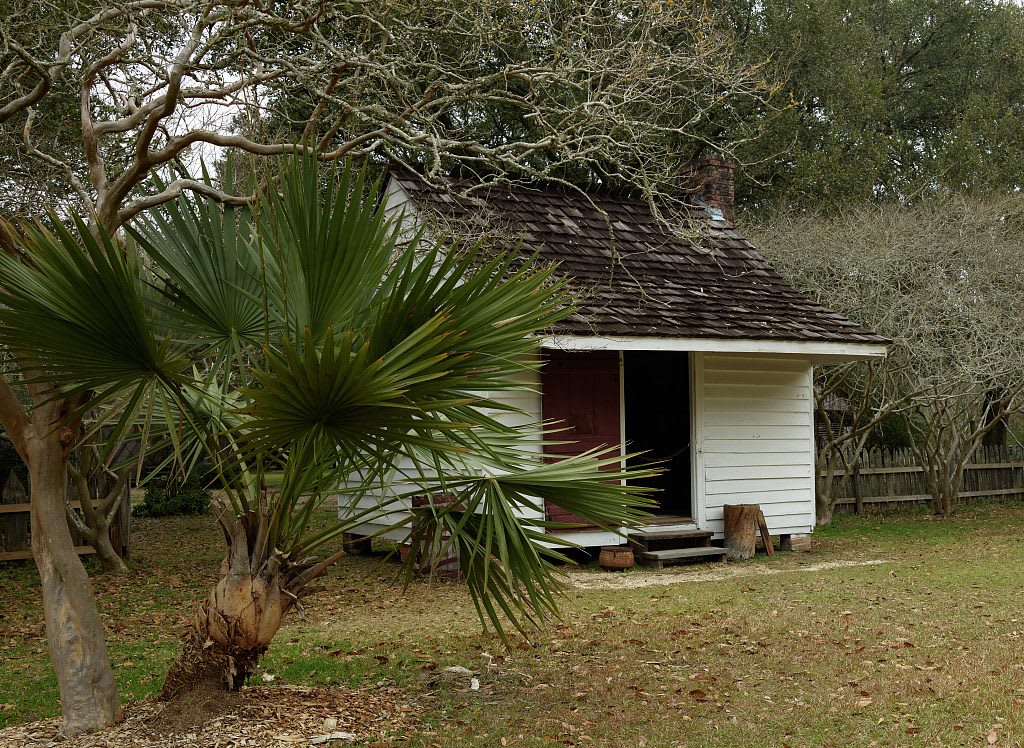
A small white-board cabin with a shingled roof and a brick chimney, its dark doorway open, seen past a sabal palm on a grassy lawn with oaks behind.Carol M. Highsmith / Public domain via Library of Congress
🎭Cultural

LSU Rural Life Museum

Part ofBaton Rouge, the Northshore & Plantation Country
On this driveThe Great River Road in Louisiana: New Orleans to Baton Rouge

Four slave cabins moved from Welham Plantation and a working-plantation row of more than twenty saved buildings, on land the Burden family held as Windrush plantation since the 1830s.

⏱
Duration
Two to three hours.
🎟
Admission
Adults 12 to 61 $12, seniors 62 and over $11, children 4 to 11 $10, under 3 free (as listed 2026).
📅
Best Season
Open daily from 8 a.m.; the visitor center and historic structures close at 4:30 p.m. and the grounds at 5 p.m. Closed New Year's Day, Easter Sunday, Thanksgiving, Christmas Eve and Christmas. Summer is hot; spring and fall are best.

The Story

The Rural Life Museum keeps four slave cabins from Welham Plantation in St. James Parish, dating from the 1830s, and puts them in a row with an overseer's house, a commissary and a smithy. That is the museum's working-plantation section, which also holds a post office, an open-hearth kitchen, a sick house, a sugar house, a blacksmith's shop and a schoolhouse. An exhibit barn covers the Plantation South, slavery, Creoles, yeoman farmers, the Civil War, Reconstruction and the Industrial Revolution, and a Highsmith photograph at the Library of Congress describes one cabin as a slave and later tenant-farmer dwelling of about 1840.

The ground itself has the same history. The land was the Burden family's Windrush plantation from the 1830s, and the family gave it to LSU in 1964: Steele Burden with his brother Pike and sister Ione. Steele Burden began moving buildings here in 1970, and the museum says it has saved more than twenty from demolition. A folk-architecture section adds a split-cypress barn, a country church, a shotgun house, a dogtrot house and a jail. Windrush Gardens, which Burden began planting in 1921, covers 25 acres.

The museum is at 4560 Essen Lane. It opens daily at 8 a.m.; the visitor center and historic structures close at 4:30 p.m. and the grounds at 5 p.m. Admission is $12 for adults and $11 for seniors, as listed in 2026. It is closed New Year's Day, Easter Sunday, Thanksgiving, Christmas Eve and Christmas.

Visitor Info

⏱
Time Needed
Two to three hours.
🎟
Admission
Adults 12 to 61 $12, seniors 62 and over $11, children 4 to 11 $10, under 3 free (as listed 2026).
📅
Best Season
Open daily from 8 a.m.; the visitor center and historic structures close at 4:30 p.m. and the grounds at 5 p.m. Closed New Year's Day, Easter Sunday, Thanksgiving, Christmas Eve and Christmas. Summer is hot; spring and fall are best.
🛣️
Highway
Essen Lane

On the Map

Nearby

The closest stops worth working into your route

architectural5 mi away
Old State Capitol
James Dakin's 1850 Gothic castle on the river bluff, gutted in the Civil War, nearly demolished in 1991 and reopened in 1994 as a free museum of political history.
cultural5.1 mi away
Capitol Park Museum
The Louisiana State Museum in Baton Rouge: a shrimp trawler and a Civil War submarine, galleries on the slave market, resistance and Jim Crow, and the music from Armstrong to Chenier.
architectural5.3 mi away
Louisiana State Capitol
A 450-foot Art Deco tower Huey Long pushed through in 1930, finished in 14 months, and the hallway where he was shot in 1935; free to enter and ringed by 27 acres of grounds.
historical22 mi away
Port Hudson State Historic Site
The 48-day siege of 1863 on the Mississippi bluffs, where the Louisiana Native Guards and Captain Andre Cailloux led the first assault; earthworks, a six-mile trail and a museum.
natural29 mi away
Tickfaw State Park
A floodplain park on the Tickfaw River, with cypress-tupelo swamp, bottomland hardwoods and about 4.75 miles of trails and boardwalks, plus a nature center with an 800-gallon river aquarium.
historical29 mi away
Audubon State Historic Site
Oakley House, where Audubon taught drawing and painted 32 birds in 1821, and the two cabins behind it where four Black families lived through slavery, Reconstruction and Jim Crow.

Historical markers nearby

Roadside plaques and monuments within a short detour

Marker3.5 mi away
U.S. Senator Russell Billiu Long
Baton Rouge
Marker4 mi away
Indian Mounds
Baton Rouge
Marker4.1 mi away
Baton Rouge National Cemetery
Baton Rouge
Marker4.2 mi away
Magnolia Cemetery
Baton Rouge
Marker4.6 mi away
Baton Rouge Pool Swim-In
Baton Rouge
Marker4.6 mi away
School for the Deaf
Baton Rouge