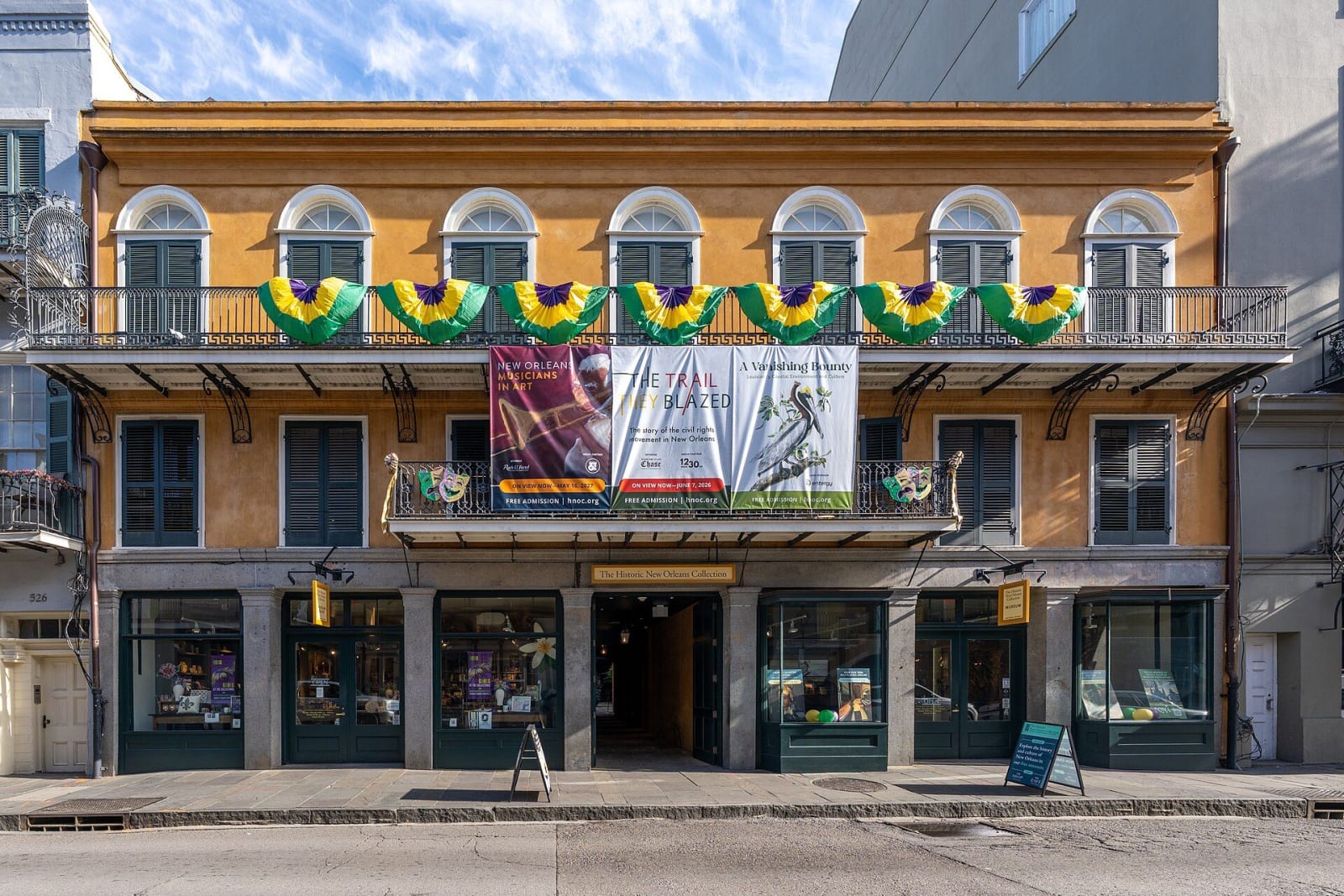
 ajay_suresh / CC BY 4.0 via Wikimedia Commons
The Story
The Historic New Orleans Collection began in 1966, when General and Mrs. L. Kemper Williams set up an institution to keep their Louisiana collection together and open to the public. Its museum is in the Merieult House on Royal Street, an eighteenth-century building listed on the National Register of Historic Places, with other buildings around it, among them the Williams Residence, an 1889 Italianate house museum that is closed for repairs. The Williams Research Center, at 410 Chartres Street, opened in January 1996 in a former criminal court and police station, and holds about 35,000 library items and roughly 350,000 photographs, prints, drawings and artifacts.
The center is where the Collection tackled slavery head on. Its exhibition Purchased Lives: New Orleans and the Domestic Slave Trade, 1808 to 1865, curated by Erin M. Greenwald, ran from March 17 to July 18, 2015. The Collection's page calls New Orleans the largest slave market in antebellum America and puts at about one million the people sold and shipped from the Upper South to the Lower South after the international trade ended in 1808.
The holdings also include Tennessee Williams materials acquired in 2001, the William Russell Jazz Collection and the William C. Cook War of 1812 collection. Admission is free but tickets are required, and guided tours, short talks and daily programs run alongside the exhibitions, which change; check the Collection's site for what is on view.
Visitor Info
On the Map
Nearby
The closest stops worth working into your route
Historical markers nearby
Roadside plaques and monuments within a short detour