The Bayou Teche Byway: Breaux Bridge to Franklin
About 52 miles of the Bayou Teche Byway, from Breaux Bridge by LA-31 and LA-182 through St. Martinville, New Iberia and Charenton to Franklin.
The Route at a Glance
The Bayou Teche Byway follows the bayou for 183 miles from Morgan City through Franklin, New Iberia, St. Martinville and Breaux Bridge to Arnaudville, and the Federal Highway Administration named it a National Scenic Byway in 2021. This drive takes 52 miles of it, about an hour and a half without stops, from Breaux Bridge south on LA-31 and LA-182 to Franklin, with a turn onto the Chitimacha Trail (LA-326) at Charenton. Lafayette & Cajun Country and Houma & the Bayou Coast cover the country. The bayou's Native peoples, the Acadians and the people enslaved along it all have stops here.
Cypress Island Preserve at Lake Martin lies about two miles west of the road on LA-353. The Nature Conservancy owns almost 10,000 acres of bottomland hardwood forest and cypress-tupelo swamp there, and each spring thousands of birds nest in the flooded forest, among them egrets, herons, ibises and roseate spoonbills.
St. Martinville carries the Acadian story and its other half. St. Martin de Tours was founded in 1765 and is called the Mother Church of the Acadians. The expulsion that sent them to Louisiana began in 1755, and the 64 Parishes encyclopedia notes that historians call it ethnic cleansing and that some estimate up to half of the roughly 15,000 exiles died. By the 1810s the Acadian community included wealthy planters who held enslaved people. At Longfellow-Evangeline State Historic Site, reproduction slave quarters stand behind Maison Olivier, a raised Creole cottage of about 1815, and the state's interpretation names Africans, enslaved people and free people of color among the people who shaped the Teche. The African American Museum covers the Africans who arrived in the mid-1700s, slavery, free people of color and Reconstruction.
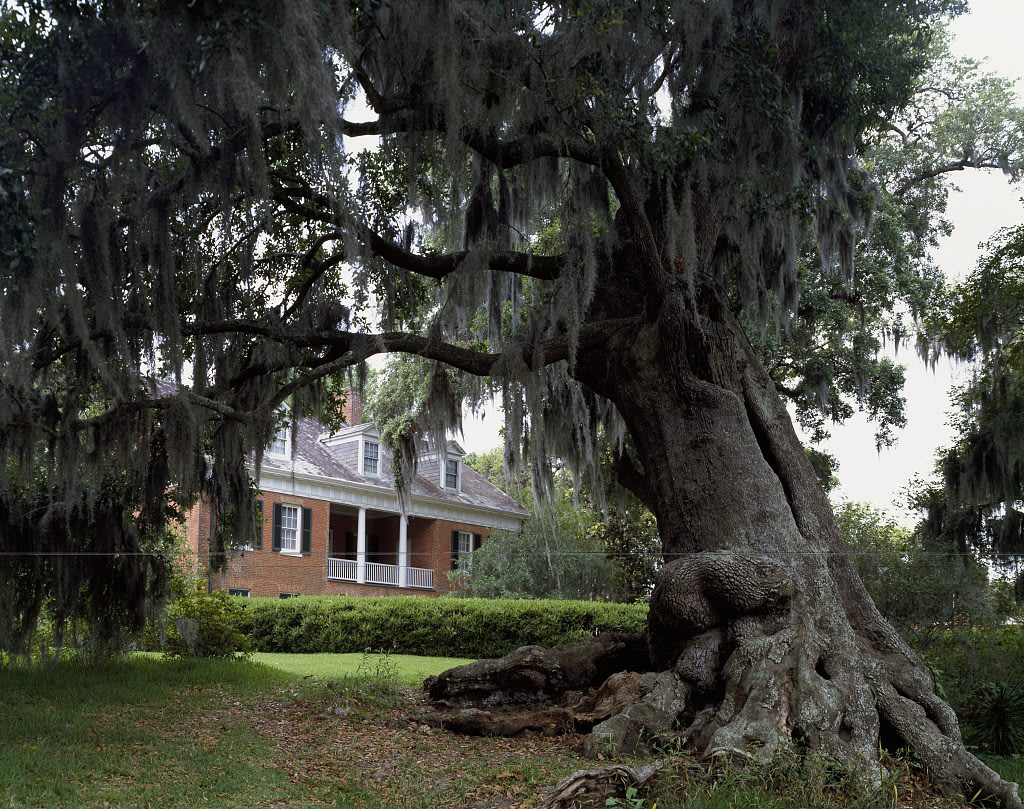
In New Iberia, enslaved people owned by the Weeks family built Shadows-on-the-Teche between 1831 and 1834. By the Civil War the family owned nine Louisiana plantations and had enslaved 1,112 people. Charity Polk was born enslaved at Grand Cote around 1820 to 1823, worked at the Shadows as a domestic, gardener and seamstress, and bore at least thirteen children; an exhibit wall lists about 700 enslaved people identified by researchers.
At Charenton the Chitimacha Museum stands on the tribe's reservation beside the bayou. The tribe's account is plain: slave raids on Chitimacha villages led to a war that began in 1706 and ended with a treaty in 1718, and many Chitimacha were enslaved in those years, more than any other Louisiana people of the time. Of about 5,440 acres claimed on the Teche in 1826, the tribe held 261.54 by 1903. The drive ends in Franklin, founded in 1808 on the Teche, at the Grevemberg House Museum, a Greek Revival townhouse of about 1851 that the Louisiana Landmarks Society says was saved from demolition by one vote.
The Drive, Stop by Stop
7 stops along the route, in driving order from Breaux Bridge, Louisiana to Grevemberg House Museum, Franklin, Louisiana. One of them sits off the road itself — the distance is noted on each.
- 1
- 2
- 3
- 4
- 5
- 6
- 7
That's the drive. Take your time, pull over often, and let The Bayou Teche Byway: Breaux Bridge to Franklin do what it does best.
← Explore more of Open Road Guide