 Carol M. Highsmith / public domain via the Library of Congress
The Story
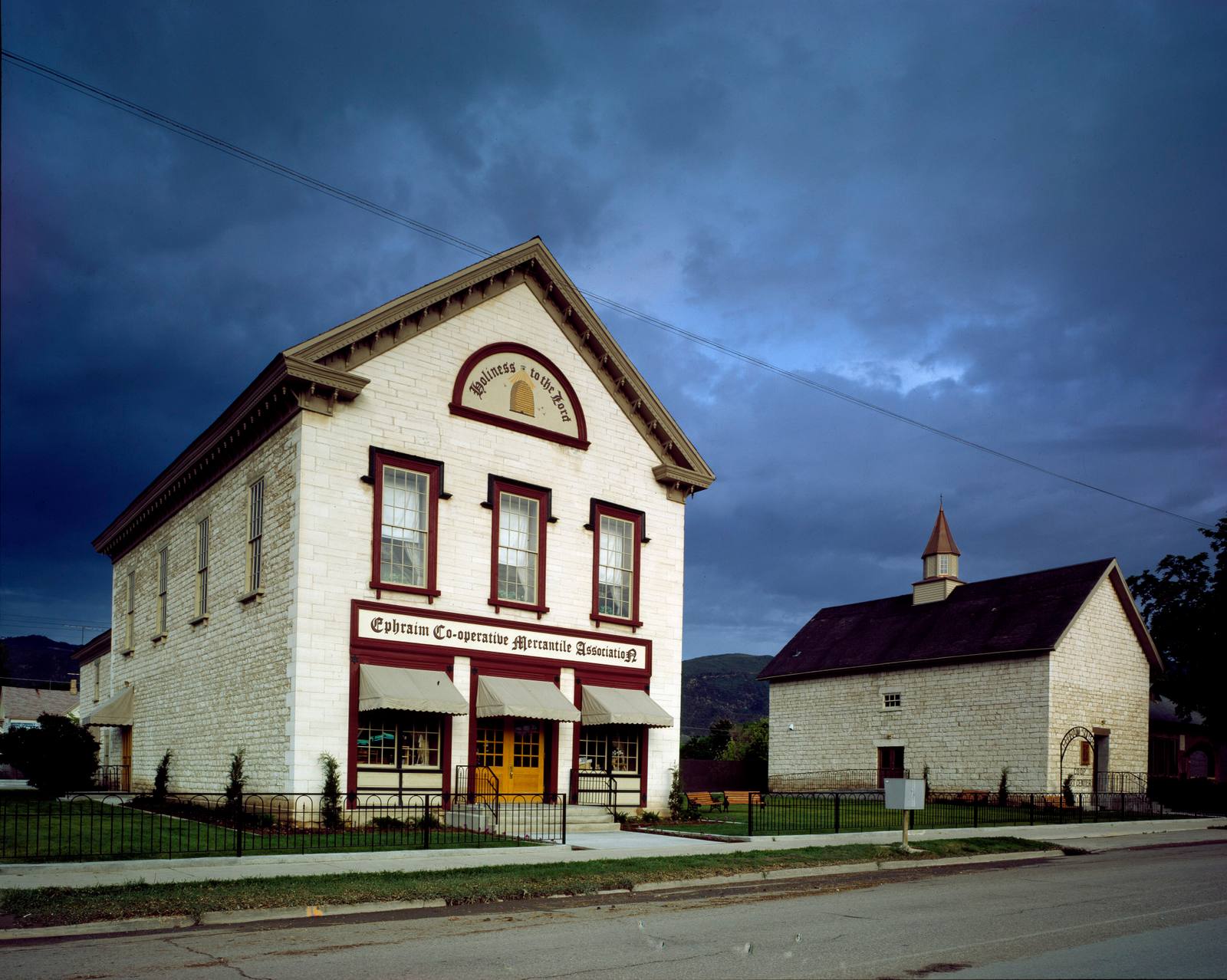
The two-story stone storefront at 96 North Main still wears its branding: a gold beehive and the words "Holiness to the Lord" painted in the pediment arch above the sign band. That is not the slogan of an ordinary store, because this was never an ordinary store. When the transcontinental railroad reached Utah in 1869, Brigham Young saw what was coming with it — outside merchants, outside credit, and the slow economic capture of his people — and answered with a network of more than 120 church-sponsored cooperative stores, branches in spirit of the parent ZCMI in Salt Lake City, most carrying the same "Holiness to the Lord" inscription over the door. Ephraim raised its own in 1871–72 out of the valley's cream-colored oolite limestone, its Greek Revival front faced in finer stone than its sides — a building meant to be admired from Main Street.
The co-op was only the moderate phase of the experiment. After the Panic of 1873 wrecked credit across the territory, Young escalated: the United Order, organized first at St. George in February 1874, asked Latter-day Saints to pool property and labor and withdraw from the open market altogether. Ephraim's store became a United Order store — in its working years the sign band read "Ephraim U.O. Mercantile Institution," and the National Register still lists the building under the Order's name — and like nearly every Order in the territory, the communal experiment had collapsed by Young's death in 1877. The building barely noticed. Its upper hall ran on as the town's social center, hosting dances, theater, and Relief Society meetings, and in 1888 it took in the first classes of the Sanpete Stake Academy, the school that became Snow College.
The ground floor spent the next century adapting: farm implement sales, a car repair garage, and finally part of the Ephraim Roller Mill, which joined the building to the 1876 Relief Society granary next door and ran into the 1950s. Then came decades of vacancy, until a 1989–90 restoration brought the stone back, and the beehive and lettering the decades had worn away were painted bright again — the band today reading "Ephraim Co-operative Mercantile Association." Today the building anchors Ephraim Square, owned by the city along with the granary — now the Granary Arts center — and the cabin of the Danish pioneer painter C.C.A. Christensen. And in the ending the building seems to have been waiting for, the ground floor is once again a cooperative: an artists' co-op run by the volunteer Sanpete Trade Association, selling local work where the bishops once sold ZCMI dry goods. It stands directly on the US-89 Heritage Highway in downtown Ephraim — park once and see all of Ephraim Square on foot.
Visitor Info
On the Map
A story featuring this place
Go deeper into the history and character of this stop
Nearby
The closest stops worth working into your route
Historical markers nearby
Roadside plaques and monuments within a short detour