Highway 9 Scenic Byway
A 57-mile drive from the I-15 gateway through Springdale and Zion National Park to Mount Carmel Junction — climbing the cliff-face switchbacks and the 1930 Zion–Mount Carmel Tunnel along the way.
The Route at a Glance
Highway 9 is the road that made Zion reachable, and most of the 57 miles between Interstate 15 and Mount Carmel Junction are spent either approaching the park or climbing through it. From the west the byway runs east out of Hurricane through Virgin and Rockville — old Mormon farm towns strung along the Virgin River — past the turnoff to the Grafton ghost town and into Springdale, the gateway settlement that has grown up against Zion's south entrance. None of that quite prepares you for what the road does once it enters the park.
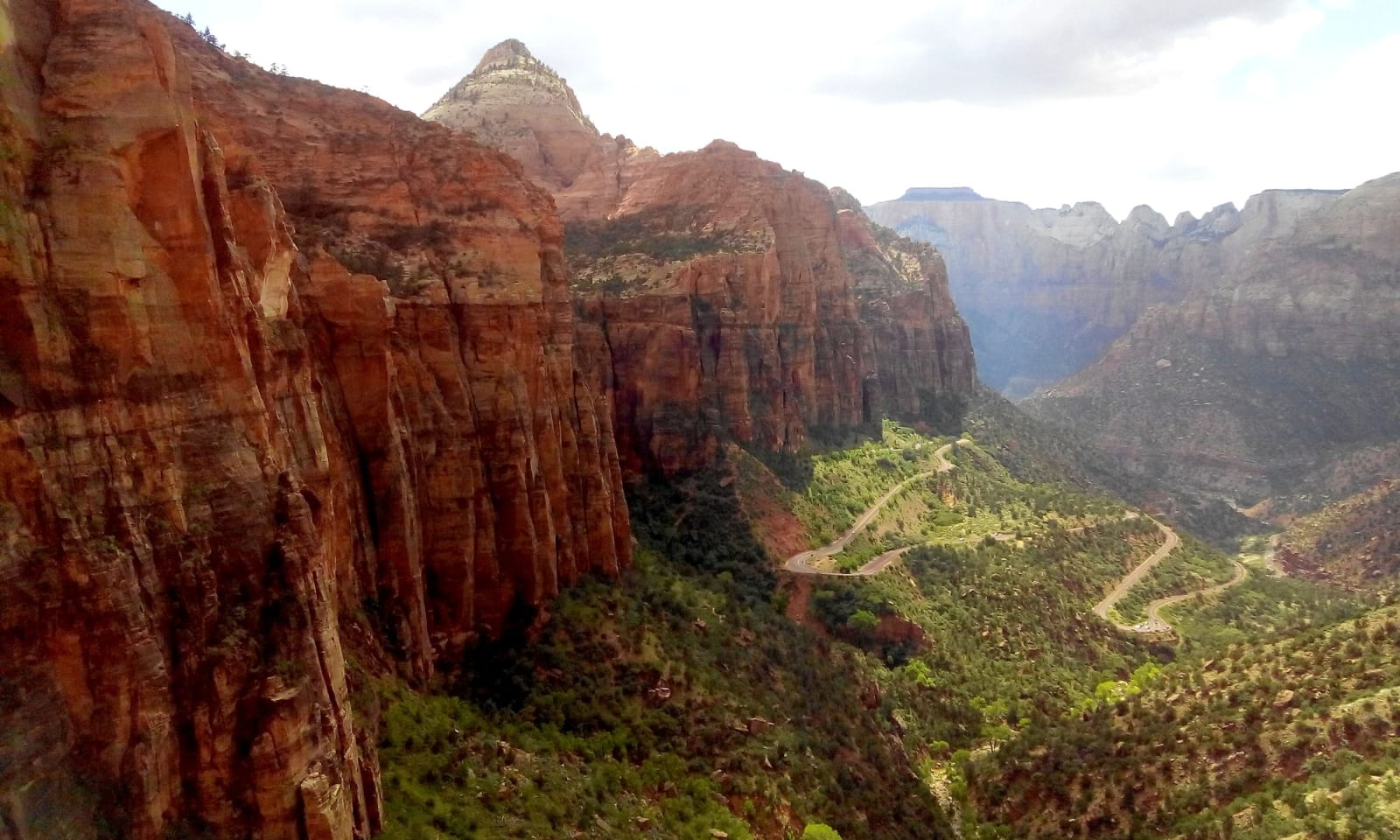
Inside Zion, Highway 9 stops behaving like an ordinary highway. It crosses the Virgin River, turns up Pine Creek Canyon, and climbs a set of switchbacks pinned to the cliff face, gaining more than a thousand feet to reach the mouth of the Zion–Mount Carmel Tunnel — a mile-long passage blasted straight through the sandstone in 1930, with windows cut in the canyon wall to let in light. The tunnel is the hinge of the whole drive: west of it you are in the deep, green, river-cut heart of Zion Canyon; east of it the country opens into a high slickrock plateau of bare domes and cross-hatched stone that looks nothing like the canyon you just left. The Canyon Overlook Trail starts right at the east portal, and a few miles on, Checkerboard Mesa rises beside the road, its face scored into a grid that has become one of the park's signatures.
The road exists because Zion was once almost impossible to reach. When the area was set aside — first as Mukuntuweap National Monument in 1909, then as Zion National Park in 1919 — getting there meant rough wagon roads, with the nearest railhead in Cedar City. The National Park Service and Utah's road builders spent 1927 to 1930 carving the Zion–Mount Carmel Highway and its tunnel out of the cliffs, deliberately built in a rustic style that hid the engineering in the landscape, with the explicit goal of linking Zion to Bryce Canyon and the Grand Canyon in a single driving loop. It worked: the route cut the distance from Zion to Bryce nearly in half and turned three remote parks into a road trip.
A few practical things shape the drive. The entire length is the Zion Park Scenic Byway, and there is a park entrance fee to drive the in-park section even if you are only passing through. Because the tunnel was built for the cars of the 1920s, oversized vehicles — most RVs, trailers, and buses — need a permit and a ranger-escorted, one-way passage during daytime hours, while standard cars drive through anytime. The road is open year-round, but the in-park stretch is narrow, winding, and often crowded, so it rewards an early start. Plan for around two hours end to end without stops — and far longer if you actually get out, which is the entire point.
The Drive, Stop by Stop
8 stops along the route, in driving order from I-15 Exit 16 to Mount Carmel Junction. One of them sits off the road itself — the distance is noted on each.
- 1
- 2
- 3
- 4
- 5
- 6
- 7
- 8
Markers Along This Road
Roadside plaques and monuments worth a pull-over — small history, standing exactly where it happened.
Birth of a Park
Leo Snow's 1908 survey report was persuasive enough that President Taft created Mukuntuweap National Monument the very next year — by 1919 it had grown into Zion National Park.
Birth of Hurricane
Near the spot where wagonloads of neighbors gathered on August 6, 1904, to watch eleven years of hand-dug canal work pay off as Virgin River water finally gushed onto the Hurricane Bench.
Discovery of Zion Canyon
Nephi Johnson's Paiute guides refused to enter the canyon in 1858, so he rode up the river alone to the Narrows — "where the sun is seldom seen" — and returned to the mouth at nightfall.
Historic Irrigation Ditch
A hand-built stretch of red-sandstone ditch, laid sometime between 1898 and 1918 and excavated in 2022 — part of the irrigation network that kept Springdale and Rockville alive when Grafton, Adventure, and Shunesburg failed.
Hurricane Pioneers
A whirlwind tore the top off Erastus Snow's buggy on the descent in 1863 — "Well, that was a hurricane," he said, and the fault, the bench, and eventually the town all took the name.
Rockville Bridge
The 1924 Parker through truss — the only one of its kind left in Utah — gave motorists their first direct link from Zion to the Grand Canyon's North Rim, until the Zion–Mount Carmel Highway took the traffic.
Zion Mt. Carmel Tunnel and Highway
The civil engineers' landmark plaque for the 5,613-foot tunnel — still the longest vehicular tunnel in the National Park System — blasted through the cliff above Pine Creek Canyon between 1927 and 1930.
Stories Along This Route
Go deeper into the history and character of this drive.
That's the drive. Take your time, pull over often, and let Highway 9 Scenic Byway do what it does best.
← Explore more of Open Road Guide