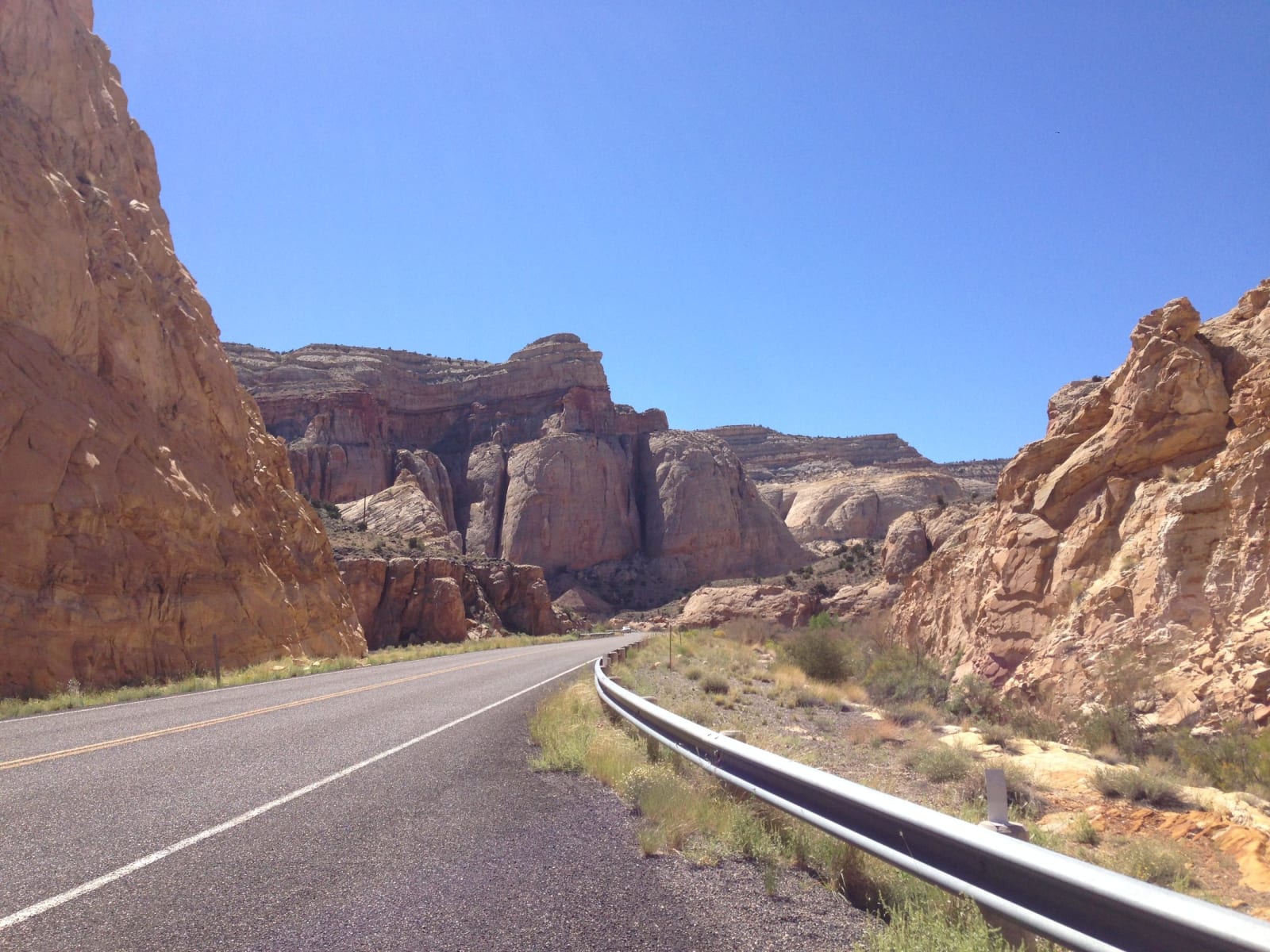
Highway 24 Scenic Byway
A 47-mile drive through the Waterpocket Fold — the geological wave that defines Capitol Reef — from Torrey at Highway 12's eastern terminus to the desert crossroads of Hanksville.
The Route at a Glance
Highway 24 is the road that picks up where Highway 12 leaves off. The two meet in Torrey, and where Highway 12 ends, Highway 24 begins — heading east through the most geologically peculiar 47 miles in Utah.
The peculiarity has a name: the Waterpocket Fold. Around 70 million years ago, the same tectonic forces that lifted the Rocky Mountains caught a section of the earth's crust here and bent it like a fender, creating a 100-mile-long wrinkle that runs north to south through the desert. From the air, it looks exactly like what geologists call it — a monocline, a single steep flexure with one side raised thousands of feet above the other. From the ground, driving Highway 24, you can't quite see the whole shape. What you see are its consequences: cliffs of red Wingate sandstone standing in palisades, white Navajo domes rising in the middle distance, and layer upon layer of rock — Moenkopi, Chinle, Kayenta, Entrada — exposed in the canyon walls like the open pages of a 200-million-year book.
The road threads the fold through Capitol Reef National Park, which protects the most dramatic 15 miles of the formation. The park gets its name from two of those layers: the white Navajo domes that early settlers thought resembled the U.S. Capitol, and the long uplifted ridge of the fold itself, which formed a reef-like barrier to east-west travel for most of human history. Mormon pioneers settled a small fruit-growing community called Fruita in the 1880s in the one place the fold opened — a green valley along the Fremont River, which had cut its way through the sandstone over millennia. The old schoolhouse, orchards, and a wall of Fremont culture petroglyphs are all still there, two minutes off the highway.
East of the park the landscape opens. The Fremont River keeps the road company through Caineville, where badlands of gray Mancos Shale spread out toward the Henry Mountains — the last range in the contiguous United States to be mapped, charted by John Wesley Powell's survey in 1872. Factory Butte, a flat-topped mesa visible for miles, marks the transition to true desert. By the time you reach Hanksville, the elevation has dropped 2,500 feet from Torrey and the air feels different — drier, hotter, more remote.
Hanksville itself is a town of about 200 people at a four-way crossroads. From here Highway 95 runs south toward Lake Powell, Highway 24 continues north to I-70, and the empty country beyond holds Goblin Valley, the Henry Mountains, and the Maze District of Canyonlands — some of the most genuinely remote terrain still accessible by road in the lower forty-eight. Most travelers turn around here, or refuel and keep going. Either is reasonable.
Drive it in either direction, though east-to-west has a particular pleasure: you start in open desert and the cliffs of the fold rise up to meet you, mile by mile, the way they would have for the first wagon teams looking for a way through. Plan two hours minimum if you don't stop, half a day if you do, longer if Capitol Reef catches you the way it tends to.
The Drive, Stop by Stop
6 stops along the route, in driving order from Torrey to Hanksville. One of them sits off the road itself — the distance is noted on each.
- 1
- 2
- 3
- 4
- 5
- 6
Markers Along This Road
Roadside plaques and monuments worth a pull-over — small history, standing exactly where it happened.
Behunin Cabin
Elijah Cutler Behunin put up this one-room sandstone cabin in 1882, and the family lasted barely a year before Fremont River floods wrecked their irrigation and sent them upstream to help settle Fruita.
Fruita Schoolhouse
Fruita built its one-room school in 1896 and hired Nettie Behunin, age twelve, as the first teacher; classes met under the red cliffs until 1941, and the building stands restored to its 1930s appearance. Inscription lane: nothing cast marks the schoolhouse; the panel out front is a printed Park Service sign, as the description records.
Stories Along This Route
Go deeper into the history and character of this drive.
That's the drive. Take your time, pull over often, and let Highway 24 Scenic Byway do what it does best.
← Explore more of Open Road Guide