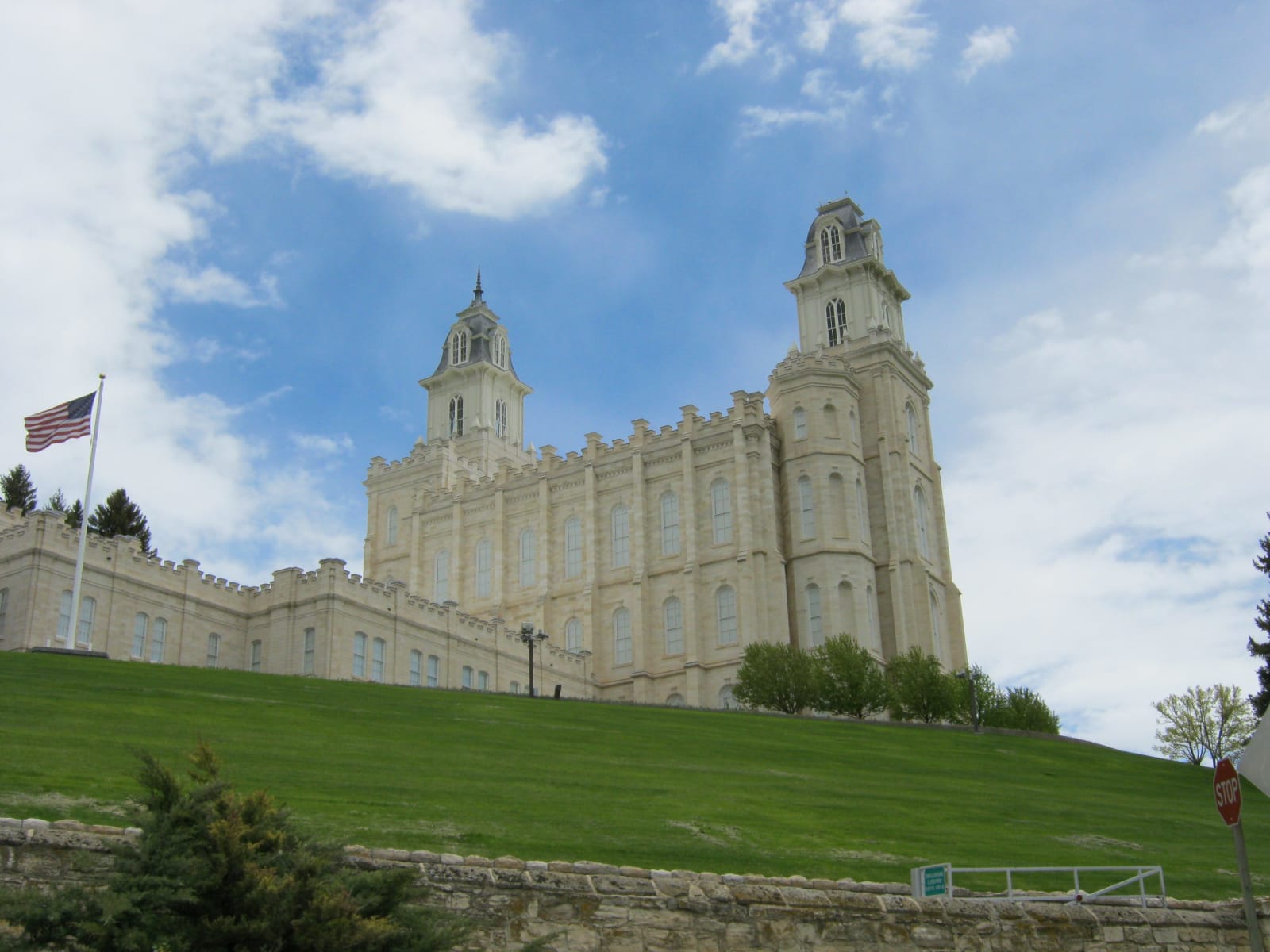
 Rich jj / CC BY-SA 3.0
The Story
The Manti Temple crowns a hilltop above the Sanpete Valley like a limestone fortress, visible for miles in every direction, its twin towers rising against the sky with an authority that transcends denominational boundaries. You do not need to be a member of The Church of Jesus Christ of Latter-day Saints to appreciate what the pioneers accomplished here. They quarried oolite limestone from the hillside beneath the temple site, hauled it upward by hand and ox team, and spent 11 years — from 1877 to 1888 — constructing a building of such scale and craftsmanship that it remains one of the most impressive architectural achievements of the pioneer era in the American West.
The temple was designed by William Folsom, who also designed the Salt Lake Theatre and several other significant pioneer-era buildings. The style is sometimes described as French Renaissance Revival, though the building resists easy categorization — it is a frontier interpretation of European architectural traditions, executed in local stone by craftsmen who were largely self-taught, working from plans that were ambitious by any standard and extraordinary given the resources available. The walls are cream-colored oolite limestone, a sedimentary rock composed of tiny spherical grains that gives the stone a distinctive texture and a warm, luminous quality in the afternoon sun.
The interior of the temple is not open to the general public — only members of the LDS Church with a temple recommend may enter — but the exterior and grounds are accessible to all visitors, and the building rewards careful observation from the outside. The stonework is detailed and precise, with carved ornamental elements around the windows, doorways, and tower bases that demonstrate a level of mastery that would be impressive in a professional urban workshop and is remarkable in a remote agricultural valley in the 1880s. The towers are different from each other — the east tower is slightly taller and more ornate than the west — and the asymmetry gives the building a visual dynamism that perfectly symmetrical structures sometimes lack.
The hilltop setting amplifies the temple's visual impact. The Sanpete Valley stretches north and south below the temple in a broad, flat corridor flanked by mountains, and the temple sits at the highest point of the hill that rises from the eastern edge of the town of Manti. From the valley floor, the building dominates the skyline with a presence that is both spiritual and geographic — it occupies the highest ground, the most visible position, and the spot that draws the eye from every approach road. The pioneers chose this location with the same instinct for placement that has guided temple builders for millennia — put the sacred building where everyone can see it.
The grounds surrounding the temple are well-maintained and open for walking, with paths that circle the building and offer views of the valley from the hilltop. The landscaping includes mature trees, flower beds, and lawn areas that provide a parklike setting around the temple walls. The views from the temple grounds are panoramic — the Sanpete Valley stretches to the horizon in both directions, bounded by the Wasatch Plateau to the east and the San Pitch Mountains to the west, and the patchwork of agricultural fields on the valley floor reflects the farming heritage that has sustained the community since its founding.
The Sanpete Valley itself is one of the most authentically rural regions remaining in Utah. The communities along the valley — Manti, Ephraim, Mt. Pleasant, Spring City — retain the architectural character and agricultural economy of their pioneer origins to a degree that is increasingly rare in a state undergoing rapid urbanization. Spring City, about 10 miles north of Manti, is a designated historic district with a collection of pioneer-era homes and buildings that has attracted artists and preservationists. The valley as a whole offers a glimpse of a Utah that is disappearing — small towns, working farms, and a pace of life governed by seasons rather than commute schedules.
The Manti Temple underwent a significant renovation in recent years, during which the interior was updated while preserving the historical character of the building. The renovation attracted attention and some controversy within the LDS community, as changes to historic temple interiors are sensitive subjects for members who value the continuity of sacred spaces. The exterior — the limestone walls, the towers, the hilltop placement — remains unchanged, as solid and luminous as it was when the last stone was set in 1888.
The temple is best viewed from the valley floor to the west, where the full profile of the building against the sky is visible, or from the grounds themselves, where the stonework can be examined up close. Late afternoon light turns the oolite limestone a warm gold, and the shadows cast by the towers lengthen across the hillside as the sun drops behind the western mountains. The scene has been essentially the same for nearly 140 years — the same stone, the same light, the same valley — and that continuity is part of what makes the Manti Temple so affecting. The pioneers built this building to last, and it has.
Visitor Info
On the Map
Stories featuring this place
Go deeper into the history and character of this stop
Nearby
The closest stops worth working into your route
Historical markers nearby
Roadside plaques and monuments within a short detour