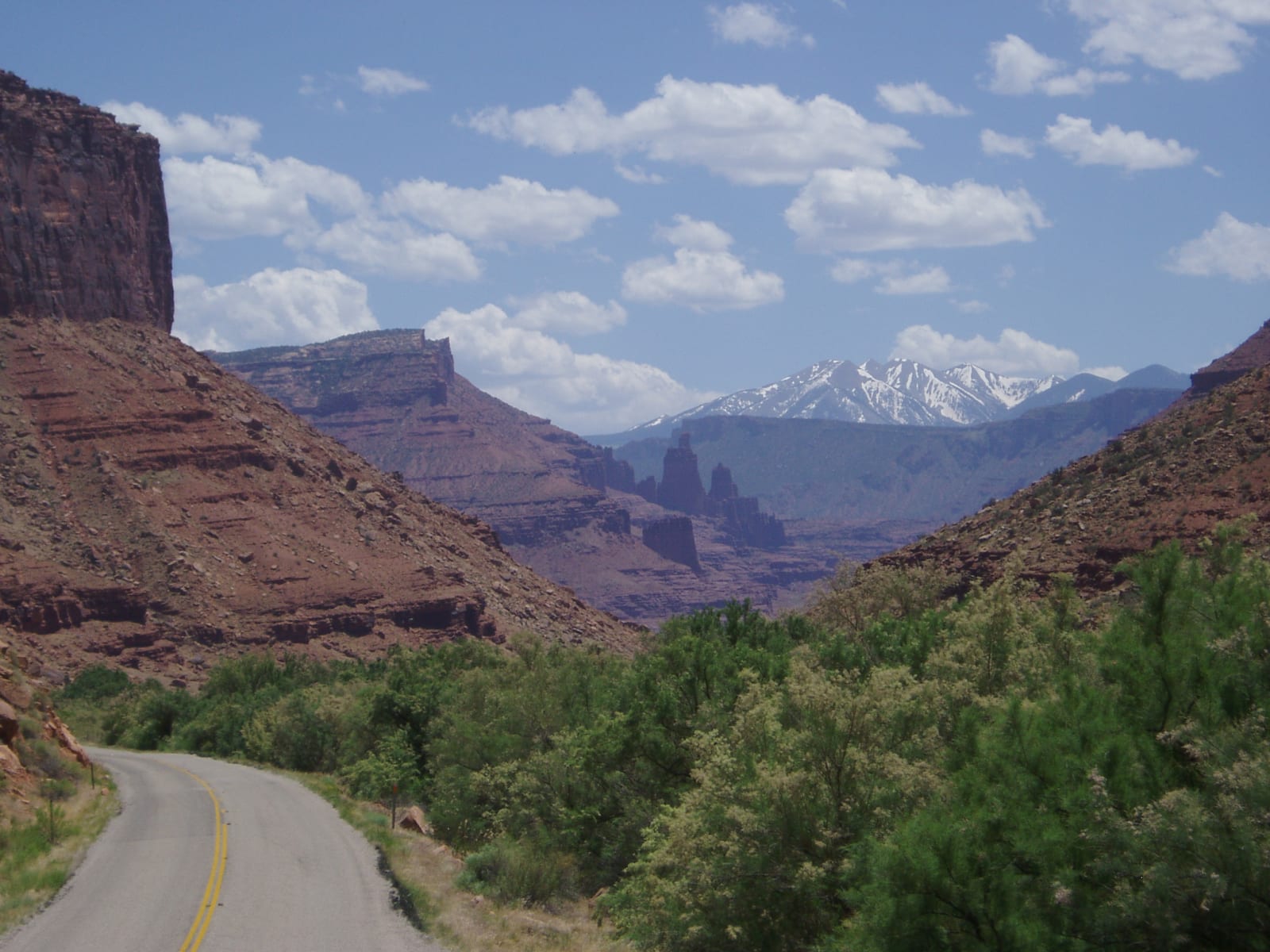
UT-128 Colorado River Road
A 44-mile scenic drive along the Colorado River through towering red-rock canyons — locals' choice for the most beautiful road in Utah.
The Route at a Glance
UT-128 is the road that people who live in Moab tell their friends to drive. Not the highway into Arches. Not the turnoff to Canyonlands. This one — a 44-mile ribbon of asphalt that follows the Colorado River from its confluence with US-191 north of Moab upstream to Interstate 70 near Cisco, winding through a canyon of towering red cliffs that gets deeper, narrower, and more spectacular with every mile. It is routinely called the most beautiful road in Utah, and the competition for that title in this state is fierce.
The road was carved into the canyon wall in the 1960s, replacing a rougher route that had served ranchers and miners for decades. It follows the river closely, sometimes climbing a hundred feet above the water on narrow shelves blasted from the cliff face, sometimes dropping to river level where cottonwood trees shade the bank and the sound of the current fills the car. The curves are constant and often blind, which keeps speeds low and attention high — exactly the conditions under which a scenic drive becomes an experience rather than a commute.
The geology is a layer cake of red rock formations that deepens as you drive upstream. Near the junction with US-191, the canyon walls are relatively modest — Entrada Sandstone cliffs rising a few hundred feet above the river. As you continue northeast, the canyon cuts deeper into older formations, and the walls grow taller and more dramatic. By the time you reach the Castle Valley junction, roughly 15 miles in, the Wingate Sandstone cliffs tower over 500 feet on both sides, their vertical faces stained with dark streaks of desert varnish that look like waterfalls frozen in stone.
The Colorado River is the constant companion throughout the drive. In spring, when snowmelt from the Rocky Mountains swells the flow, the river runs fast and brown, carrying the sediment load that gives the Colorado its name. By late summer the water drops and clears to a greenish hue, and the rapids that churn white in May become gentle riffles. River rafters and kayakers are a common sight, and several outfitters operate put-in points along the road for half-day and full-day float trips through the canyon. The combination of red rock walls, blue sky, and the sound and motion of the river creates a sensory richness that no photograph can fully capture.
The Castle Valley junction, about 15 miles from US-191, offers a detour into one of the most photographed valleys in the Southwest. Castleton Tower, a 400-foot freestanding sandstone spire, dominates the valley like an exclamation point, and the Priest and Nuns formation — a row of dark pinnacles on the canyon rim — adds a skyline that looks deliberately sculpted. Castle Valley has appeared in countless car commercials, adventure films, and magazine covers, and the views from the road justify every frame.
Fisher Towers, accessible via a turnoff about 21 miles from US-191, adds another dimension to the drive. The dark red Cutler sandstone pinnacles rise 900 feet from the desert floor, and the trailhead offers a 4.4-mile out-and-back hike that passes through the base of the formation. The towers are visible from UT-128 itself, and their dark, crumbly profiles contrast dramatically with the smooth, pale Navajo Sandstone cliffs elsewhere in the canyon.
The upper section of the road, between Fisher Towers and Interstate 70, passes through increasingly remote and austere terrain. The canyon opens into broader valleys, the river slows, and the landscape transitions from towering red walls to lower mesas and badlands of gray and brown Mancos Shale. The ghost town of Cisco — once a railroad stop, now a collection of crumbling buildings and rusting vehicles — sits near the eastern end of the road, a reminder that not every community in this landscape survived.
Historic river-crossing sites dot the route. Dewey Bridge, a one-lane suspension bridge built in 1916, was for decades the only vehicle crossing of the Colorado River for over a hundred miles. The original bridge was destroyed by a brush fire in 2008, and a modern replacement now carries traffic across the river at the same spot. The loss of the old bridge — a graceful, swaying structure of wooden planks and steel cables — was felt deeply by locals who considered it a landmark.
UT-128 is best driven in the late afternoon, when the low-angle western sun hits the east-facing canyon walls and turns them incandescent. The reds deepen. The shadows sharpen. The river catches the light and throws it back in flashes of gold. The drive takes about 90 minutes without stops, but stopping is the point — every pullout offers a different view of the canyon, a different angle on the river, a different combination of light and rock and water that will not repeat itself tomorrow.
The road connects to Interstate 70 at its eastern end, making it a natural alternate route between Moab and points east — Denver, Grand Junction, or the towns along the interstate. Most travelers take US-191 north to I-70 because it is faster. UT-128 is not faster. It is better. That is a trade-off worth making every time.
The Drive, Stop by Stop
7 stops along the route, in driving order from Moab to Cisco. 2 of them sit off the road itself — the distance is noted on each.
- 1
- 2
- 3
- 4
- 5
- 6
- 7
Markers Along This Road
Roadside plaques and monuments worth a pull-over — small history, standing exactly where it happened.
Dewey Bridge
The 1916 suspension span — second-longest west of the Mississippi when it opened, and Utah's longest until fire took its wooden deck in 2008 — carried river-road traffic until 1988, and its cables still hang beside the modern bridge. Lead (October 1, 2026): Flickr search by title, county and Utah (search-page payload) returned no frame of this marker; any hits were read and show other objects (a neighbouring monument, the same name elsewhere, or unrelated scenes). Inscription: the 2000 restoration plaque on the sandstone monument, heading read from jacobbarlow.com's July 2007 frame (post 16827), quotation and history paragraph from Commons "Closeup of the historic plaque with details about the historic Dewey Suspension Bridge in Utah on route 128.jpg" (2025). Its Grants, Endowments and Donors lists (about a hundred names) and the "With grateful acknowledgement ... Thanks G.C.H.P.C." block are out as a donor board. The NRHP plate below is merged last, read from the 2007 frame; not confirmed standing in 2025. Description corrected (rule 16): "and little more" understated the plaque's 9,000 pounds of freight (Grand County FAQ agrees). The BLM board nearby says the state legislature paid and the new bridge came in 1986; Grand County's FAQ (county bond after the state refused) and the NRHP record (1988) contradict it, so the description stands on those.
Stories Along This Route
Go deeper into the history and character of this drive.
That's the drive. Take your time, pull over often, and let UT-128 Colorado River Road do what it does best.
← Explore more of Open Road Guide