The Story
For its first decades as a protected place, Zion had a transportation problem: it was magnificent and almost unreachable, set behind a wall of sandstone with only rough wagon roads leading in. The Zion–Mount Carmel Tunnel was the answer, and driving through it is still the strangest couple of minutes on Highway 9.
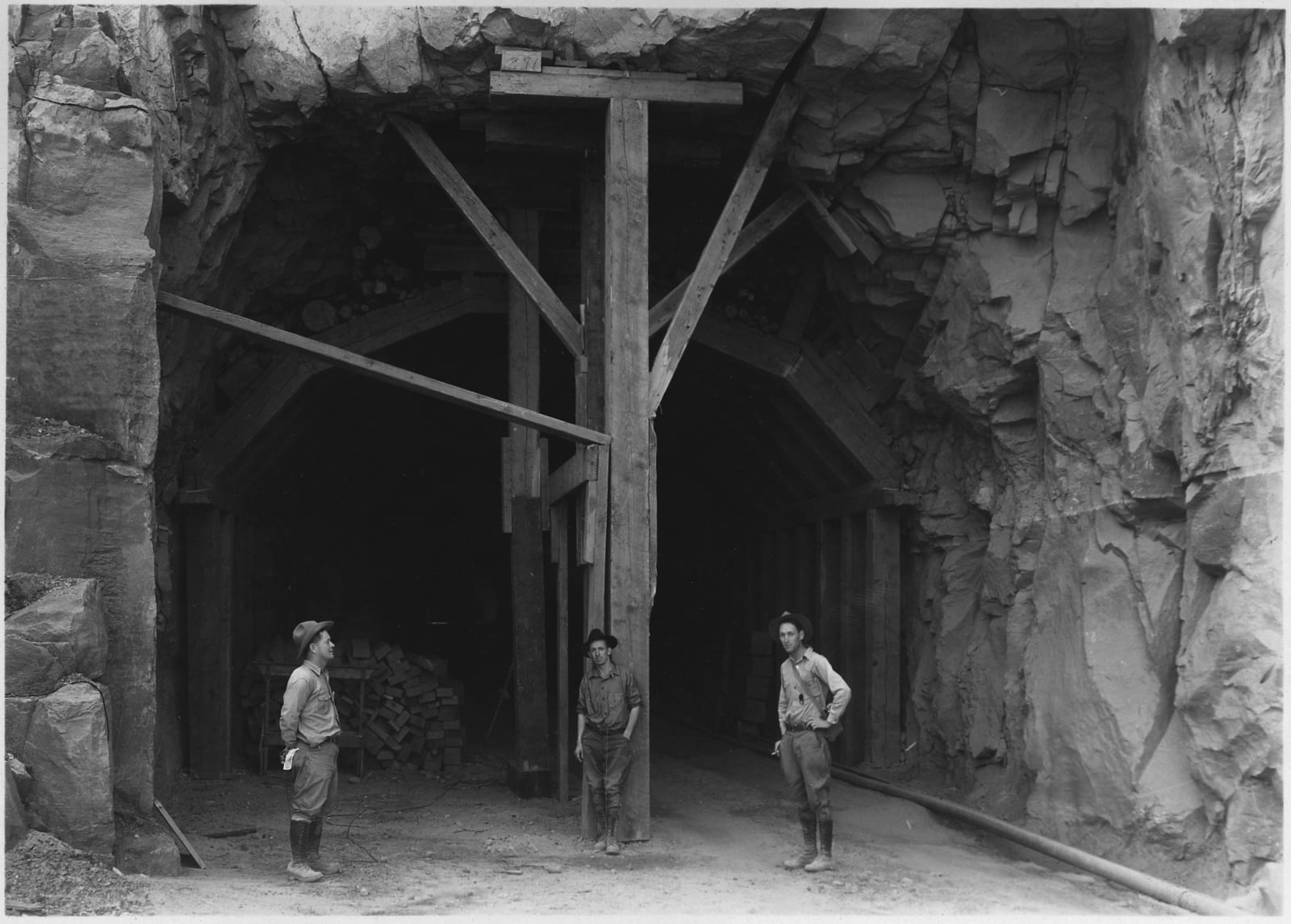
The tunnel runs 5,613 feet — about a mile and an eighth — straight through the cliff above Pine Creek Canyon, and when it was dedicated on July 4, 1930, it was the longest tunnel of its kind in the United States. Building it was an act of stubborn imagination. Between 1927 and 1930, crews working for the National Park Service and Utah's road builders reached an unstable, near-vertical rock face by aerial tram, blasted six windows — the galleries — into the canyon wall, and then dug the tunnel from the inside out through those openings, cutting a passage twenty-two feet wide and sixteen feet high while dumping the broken rock straight down into the canyon below. The whole Zion–Mount Carmel Highway was built in the Park Service's deliberately understated "rustic" style, engineered to disturb the visible landscape as little as possible — which is why, from the canyon floor, the galleries read as small dark openings in the cliff rather than the mouths of a construction project.
The point of all that effort was connection. The new highway was meant to tie Zion to Bryce Canyon and the Grand Canyon in a single loop, and it worked — it cut the drive from Zion to Bryce from 149 miles to 88. The galleries you glimpse while driving through are the same ones the crews dug, though the pullouts that once let visitors stop inside were removed long ago after too many accidents, and a 1958 rock collapse near one of them is why the tunnel is now braced with concrete ribs and monitored electronically around the clock.
The catch is that it was built for the cars of the 1920s. It is narrow and curved, and since 1989 any vehicle too large to hold its own lane — most RVs, trailers, and tour buses — has needed a permit and a ranger-escorted, one-way passage during daytime hours, while bicycles and pedestrians are barred entirely. In a standard car you simply drive through, west to east, and watch the green depths of Zion National Park give way, in the space of a mile of darkness, to the bright slickrock plateau on the far side.
Visitor Info
On the Map
A story featuring this place
Go deeper into the history and character of this stop
Nearby
The closest stops worth working into your route
Historical markers nearby
Roadside plaques and monuments within a short detour