 Ryan Holliday / CC BY-SA 4.0
The Story
Timpanogos Cave asks more of you than most cave experiences. There is no elevator, no escalator, no gentle stroll from the parking lot to the entrance. You earn this one. The trail to the cave mouth climbs 1,092 feet over 1.5 miles of paved switchbacks carved into the steep south face of American Fork Canyon, gaining elevation with every step while the canyon drops away below you. By the time you reach the entrance, you are breathing hard, your legs are warm, and the cool air flowing from the cave mouth feels like a reward the mountain is handing you personally.
What waits inside is worth every step. The cave system consists of three separate caverns — Hansen Cave, Middle Cave, and Timpanogos Cave — connected by hand-carved tunnels blasted through the rock by the Civilian Conservation Corps in the 1930s. The tour passes through all three, and the progression is like a geological crescendo. Hansen Cave is relatively modest, with stalactites and flowstone formations that introduce the basic vocabulary of cave decoration. Middle Cave deepens the experience with larger chambers and more varied formations. And then you enter Timpanogos Cave itself, and the scale and beauty leap to a completely different level.
The signature formation is the Great Heart of Timpanogos — a massive heart-shaped stalactite formation tinted pink by manganese oxide, suspended from the ceiling of the main chamber. It is the most photographed feature in the cave system, and photographs do not do it justice. The formation is three-dimensional, glowing faintly in the guided lighting, and its shape is so precise that it looks intentionally carved. It was not. It formed over tens of thousands of years as mineral-laden water dripped from the ceiling, depositing calcium carbonate one microscopic layer at a time.
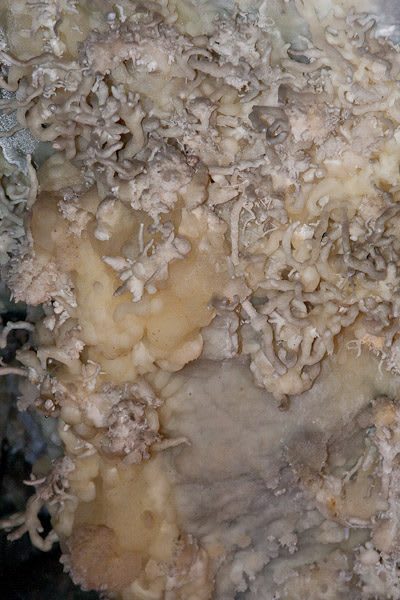
The cave is filled with helictites — small, twisted formations that defy gravity, growing in spirals and curves that seem to ignore the downward pull that shapes stalactites and stalagmites. The helictites at Timpanogos are among the most abundant and varied in any show cave in the United States. They sprout from walls, ceilings, and existing formations in every direction, looking like crystalline coral or frozen fireworks. The mechanism that drives their growth is still debated by geologists — capillary forces, crystal growth pressure, and air currents have all been proposed — but the visual effect is undeniable. The cave looks alive with mineral energy.
The cave system formed in the Deseret Limestone, a layer of rock deposited by an ancient sea roughly 340 million years ago during the Mississippian period. Groundwater, made slightly acidic by absorbing carbon dioxide from the soil above, slowly dissolved the limestone along fractures and bedding planes, creating the voids that became the caves. Once the water table dropped and air filled the chambers, the decoration process began — dripping water depositing the dissolved minerals as formations that are still growing today, imperceptibly, one drop at a time.
The guided tours are the only way to see the caves, and they run from late May through early October, weather and trail conditions permitting. Tours are limited in size and sell out quickly, especially on summer weekends, so reservations through the Park Service website are essentially mandatory. The rangers who lead the tours are knowledgeable and enthusiastic, and they tailor their presentations to the group — families with young children get a more accessible version, while groups of adults get deeper dives into the geology and formation science.
The trail itself, independent of the cave, is one of the finest short hikes along the Wasatch Front. The switchbacks climb through scrub oak and maple forest on the south-facing slope, with views down into American Fork Canyon that grow more dramatic with each turn. In autumn, the canyon explodes with color — reds, oranges, and yellows reflected in the creek far below — and the trail becomes a destination in its own right, cave or no cave. Wildflowers line the path in spring and early summer, and the occasional mule deer or mountain goat appears on the slopes above.
The monument sits just 30 minutes from the sprawl of Provo and Orem, which makes it one of the most accessible natural wonders along the Wasatch Front. The proximity to population centers means it can feel crowded on peak days, but the limited tour capacity and the physical effort of the trail provide natural crowd control. Not everyone who drives to the parking lot makes it to the top.
Timpanogos Cave is a reminder that Utah's geological treasures are not limited to the red rock country in the south. The Wasatch Range has its own stories to tell — stories written in limestone instead of sandstone, underground instead of under open sky, in darkness instead of blazing sunlight. The cave has been here for millions of years, slowly decorating itself one drop at a time, and it will continue long after the trail wears out and the tunnels need reinforcing. Patience is the dominant theme underground, and by the time you emerge blinking into the canyon sunlight, a little of that patience has rubbed off on you.
Visitor Info
On the Map
Stories featuring this place
Go deeper into the history and character of this stop
Nearby
The closest stops worth working into your route
Historical markers nearby
Roadside plaques and monuments within a short detour