 CGP Grey / CC BY 2.0
The Story
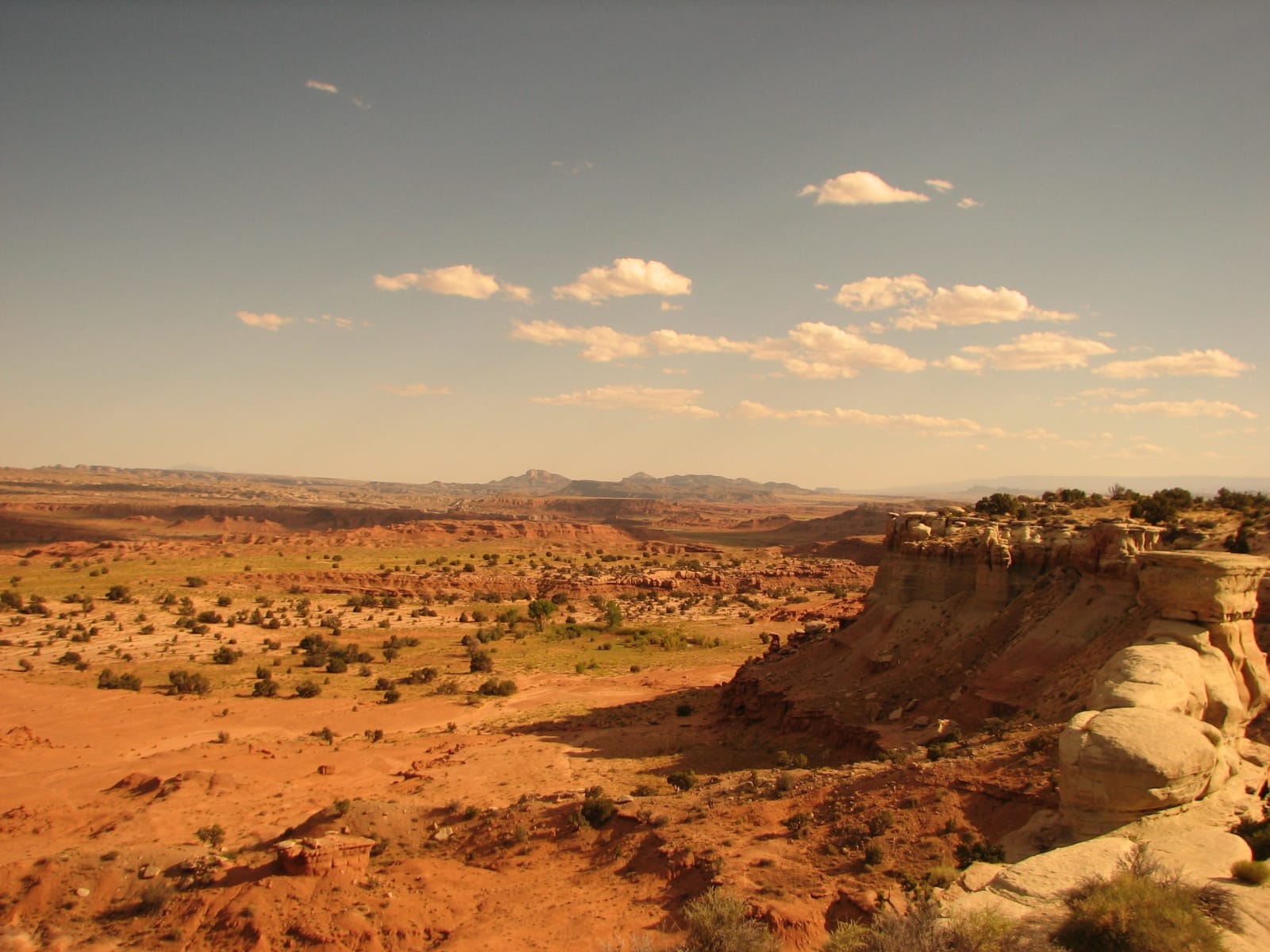
The San Rafael Swell is the great undiscovered country of Utah geology. While millions of visitors pour into the national parks to the south, this massive dome of exposed rock — 75 miles long, 40 miles wide, and containing slot canyons, natural bridges, petroglyphs, and formations that rival anything in the park system — sits largely empty and unvisited along Interstate 70 in central Utah. Most people drive across it at 80 miles per hour without realizing they are crossing one of the most spectacular geological features in the American West.
The Swell is an anticline — a giant upward bulge in the Earth's crust created roughly 50 to 70 million years ago during the Laramide orogeny, the same tectonic event that built the Rocky Mountains. The forces that pushed the rock upward also cracked and fractured it, and over millions of years erosion carved into those fractures, stripping away the younger layers and exposing a layer cake of geological history spanning 200 million years. The result is a kidney-shaped dome surrounded by a dramatic ring of cliffs called the San Rafael Reef — a jagged wall of Wingate Sandstone that marks the boundary between the uplifted interior and the surrounding desert.
The Reef is visible for miles from Interstate 70 and from the small towns along Highway 10 to the west. It looks like a fortress wall, which is functionally what it was for early travelers. The Reef blocked east-west passage just as effectively as Capitol Reef's Waterpocket Fold, and the few gaps where washes have cut through the sandstone wall became critical routes for indigenous peoples, explorers, and settlers.
Inside the Reef, the landscape opens into a wonderland of canyons, mesas, buttes, and badlands that few people ever see. The Wedge Overlook — sometimes called the Little Grand Canyon — offers a view into the San Rafael River canyon that genuinely rivals its famous Arizona counterpart. The river has carved a gorge over a thousand feet deep through layers of red, white, and chocolate-colored rock, and the overlook sits right on the edge of the precipice with no railing and no crowds. On most days you will be the only person there.
The slot canyons of the Swell are among the best in Utah. Little Wild Horse Canyon and Bell Canyon, accessible from a trailhead near Goblin Valley State Park, form a loop hike through narrow corridors of sculpted sandstone where the walls close in to shoulder width and tower a hundred feet overhead. The rock has been polished smooth by flash floods, and the colors — salmon, lavender, cream, and burnt orange — shift with every bend. It is the slot canyon experience that people pay hundreds of dollars for at commercial operations in Arizona, available here for free on public land.
Crack Canyon, Black Dragon Canyon, and Chute Canyon offer additional slot canyon experiences of varying difficulty, from easy walking to technical canyoneering requiring ropes and harnesses. The density of slot canyons in the Swell is comparable to the Escalante region, but with a fraction of the permit requirements and foot traffic.
The rock art in the Swell is extraordinary. The Black Dragon pictograph panel, visible from a short walk off Interstate 70, features large, dark figures painted by Barrier Canyon-style artists roughly 2,000 to 4,000 years ago. The figures are haunting — elongated, eyeless, with arms spread wide — and their meaning and purpose remain debated by archaeologists. The Head of Sinbad pictograph panel, deeper in the Swell, is even more striking — a row of large, red anthropomorphic figures painted on a sheltered cliff face with a craftsmanship and intentionality that suggests deep ceremonial significance.
The Swell is managed by the Bureau of Land Management, and much of it was designated as wilderness and a national conservation area in 2019 under the Emery County Public Land Management Act. The designation provided some protection while still allowing dispersed camping, hiking, and vehicle access on existing roads. There are no entrance fees, no visitor centers, and no developed campgrounds in the interior — just dirt roads, unsigned trailheads, and a landscape that rewards self-sufficiency and route-finding skills.
That lack of infrastructure is both the Swell's greatest asset and its greatest barrier. You need a map, a plan, and enough water and fuel to be self-sufficient for a full day. Cell service is nonexistent in most of the interior. Roads range from well-graded dirt to rocky two-track that requires high clearance. The reward for that preparation is access to a landscape that feels genuinely wild — not wild in the managed, designated-wilderness sense, but wild in the sense that you are on your own, making your own decisions, in a place where the rock is 200 million years old and the nearest human might be 20 miles away.
The San Rafael Swell is what Utah looked like before the national parks got famous. It is raw, unmarked, and unimproved. It asks more of you than a park does, and it gives more back. For visitors who are willing to do the homework and bring the right gear, it is one of the most rewarding landscapes in the state — a place where the geology is world-class, the solitude is real, and the only crowds are the ones you brought with you.
Visitor Info
On the Map
Stories featuring this place
Go deeper into the history and character of this stop
Nearby
The closest stops worth working into your route
Historical markers nearby
Roadside plaques and monuments within a short detour