The Story
Cleveland-Lloyd Dinosaur Quarry holds a record that no one has been able to explain for over a century: the densest concentration of Jurassic-era dinosaur bones ever found, anywhere on Earth. Over 12,000 individual bones from at least 74 dinosaurs have been excavated from a single layer of mudstone in a remote valley of the San Rafael Swell, and the majority of them — roughly 70 percent — belong to a single species: Allosaurus, the apex predator of the late Jurassic. No other site on the planet has produced this many Allosaurus bones, and no one is entirely sure why they are all here.
The quarry sits in the Morrison Formation, the same layer of Jurassic-age sediment that has produced dinosaur fossils across the American West. But most Morrison Formation sites contain a mix of species in proportions that reflect a normal ecosystem — many herbivores, fewer predators. Cleveland-Lloyd inverts that ratio dramatically. The predator-to-prey ratio here is roughly 3-to-1, which is ecologically bizarre. In a healthy ecosystem, predators are always outnumbered by their prey. Something unusual happened at this site to concentrate so many predators in one place.
The leading theory is the predator trap hypothesis. The idea is that a shallow, muddy watering hole or bog in the late Jurassic landscape trapped herbivorous dinosaurs that came to drink. Their struggles attracted predators — Allosaurus, primarily — who came to feed on the trapped animals and became stuck themselves. More predators arrived, attracted by the commotion, and they too became mired. The process repeated over years or decades, building up the extraordinary concentration of predator bones that excavators would find 150 million years later. It is essentially a natural tar pit scenario, similar to the La Brea Tar Pits in Los Angeles, but operating in Jurassic mud rather than Pleistocene asphalt.
Other theories have been proposed. Some researchers suggest the bones were transported by floodwaters and concentrated in a natural depression. Others propose that a drought drove large numbers of animals to a shrinking water source where they died together. The debate continues, and the quarry remains one of the most studied and most puzzling paleontological sites in North America.
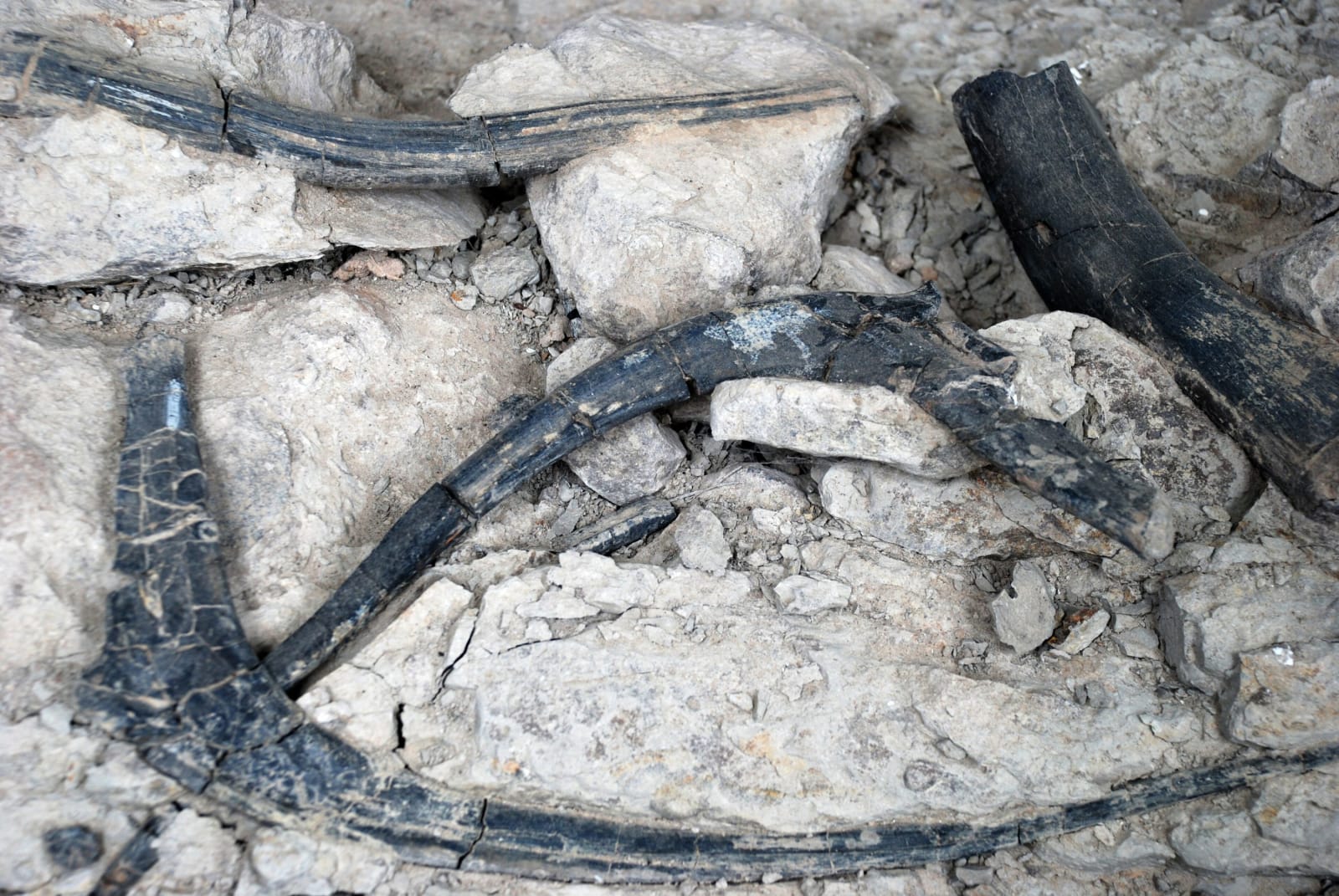
The visitor center, operated by the Bureau of Land Management, is built adjacent to the quarry and houses a modest but well-designed exhibit that explains the site's history, geology, and ongoing mysteries. The centerpiece is the quarry building itself — an enclosed structure built over a section of the bone bed where partially excavated fossils are visible in the rock, still embedded in the gray-green mudstone where they have lain for 150 million years. You can stand on a platform and look down at femurs, vertebrae, and rib fragments emerging from the ground, frozen in the process of being unearthed. The bones are real, the rock is real, and the proximity — you are standing feet away from fossils that are older than flowers, older than birds, older than grass — produces a sensation that replica skeletons in a museum cannot match.
Bones excavated from Cleveland-Lloyd have been shipped to museums and universities around the world. Over 60 institutions in more than a dozen countries have specimens from this quarry, making it one of the most widely distributed paleontological collections in existence. The University of Utah has the largest single collection, and several complete or near-complete Allosaurus skeletons assembled from Cleveland-Lloyd bones are on public display across the country.
The quarry is located about 30 miles south of the town of Price, accessed via a mix of paved and well-graded dirt roads that wind through the San Rafael Swell. The drive itself is scenic — the Swell's colorful layers of sandstone and shale rise on all sides — and the remoteness of the site adds to the experience. This is not a museum in a city. This is a bone bed in the desert, surrounded by the same landscape that these animals lived and died in 150 million years ago. The junipers and sagebrush are different, the climate has changed, and the shallow sea that once bordered this region has been gone for eons — but the rock is the same rock, and the bones are in the same mud.
The quarry is open seasonally, typically from spring through early fall, and hours can be limited. Checking the BLM website or calling the Price Field Office before visiting is recommended. The facilities are basic — a small visitor center, restrooms, and a picnic area — and there is no food or water available on site. Bring supplies and plan to spend at least an hour, because the drive is too long and the site too significant to rush through.
Cleveland-Lloyd Dinosaur Quarry is the kind of place that makes the Jurassic period feel less like a chapter in a textbook and more like something that actually happened — here, in this specific valley, in this specific mud, to these specific animals whose bones you can see with your own eyes. The predator trap may or may not be the correct explanation, but the mystery itself is part of the appeal. Something extraordinary happened here 150 million years ago, and we are still trying to figure out what it was.
Visitor Info
On the Map
Stories featuring this place
Go deeper into the history and character of this stop
Nearby
The closest stops worth working into your route
Historical markers nearby
Roadside plaques and monuments within a short detour