There is a moment in the late Jurassic, about 150 million years ago, that this whole landscape keeps trying to tell you about. It is the dry season. A shallow pond that was full in spring has shrunk to a ring of cracked mud and green water, and the animals that need it have no choice but to come anyway. Sauropods the length of buses, armored stegosaurs, and the lean, big-clawed predators that hunted them all crowd the same falling shoreline, churning the banks to a soup, breathing the sulfur stink of a pond going bad. Some of them will not walk away. The dry season is the killing season, and in this country the dry season comes again and again.
That scene — repeated across a parched continent over tens of millions of years — is the reason Utah holds more dinosaur bone than almost anywhere on Earth. The drought did not just kill the animals. It gathered them, in numbers, at the few places water still stood, and then buried them well enough that we could dig them up an eon and a half later. Two of the richest dinosaur quarries ever found sit roughly a hundred miles apart in the same layer of Utah rock, and for a century they were told as two separate mysteries. They are really the same story, told two different ways.
The country that ran out of water
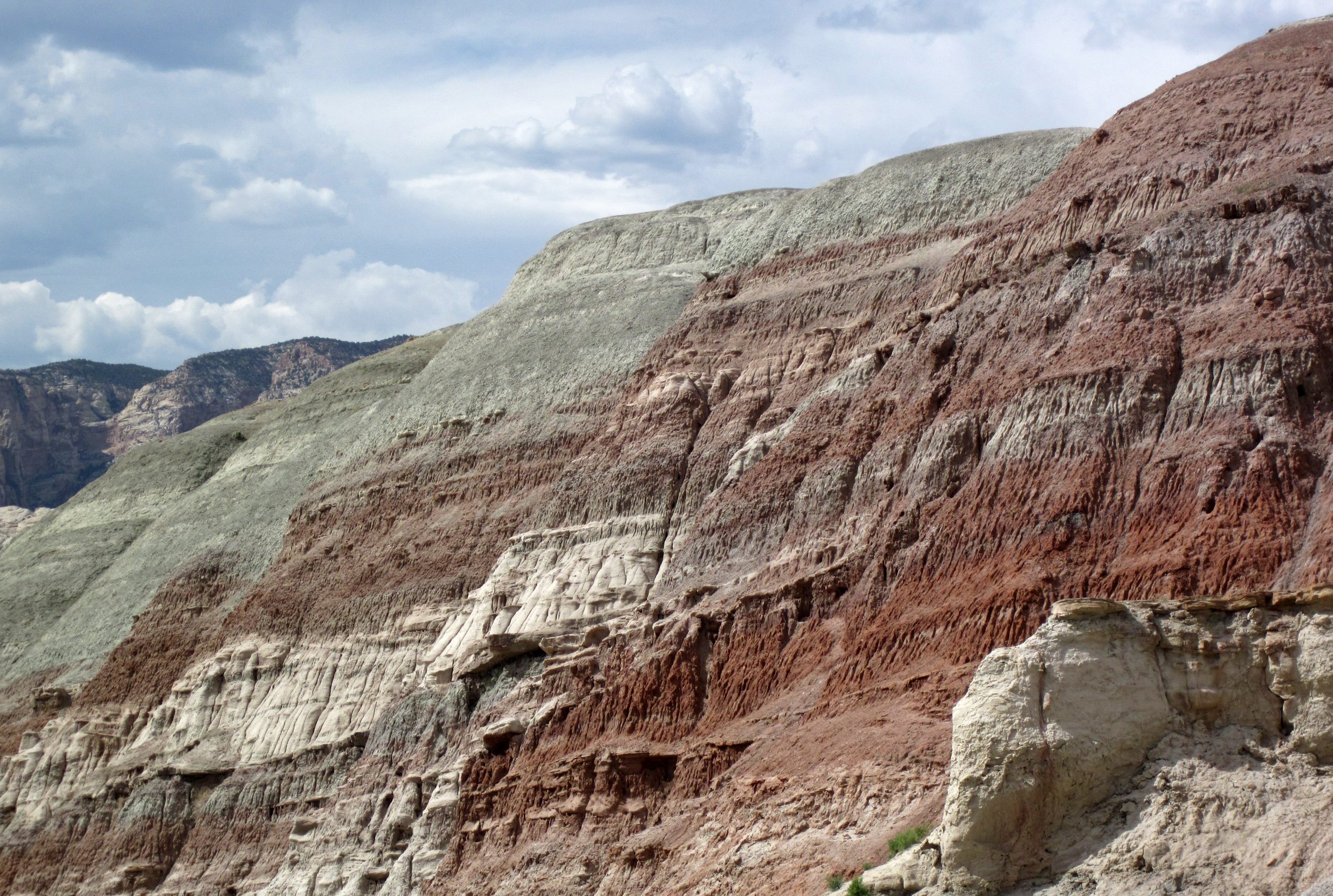
The rock under both quarries is the Morrison Formation, a band of Late Jurassic mudstone and sandstone that runs up through the intermountain West and has produced more dinosaur fossils than any other rock unit in North America. Where it surfaces in central Utah — most spectacularly across the great upwarp of the San Rafael Swell — it records a world very unlike the one sitting on top of it now.
Utah then lay near the latitude of southern Arizona today, in a warm, dry, strongly seasonal landscape closer to an African savannah than a swamp. Most of the rain fell on mountains to the west and wrung itself out before it ever reached the basin, so the country lived on borrowed water: a few intermittent rivers fed from distant uplands, and scattered ponds where the floodplain dipped low enough to meet the groundwater. Water was the scarcest thing in that world, and at the wrong time of year it was also the most dangerous. Every shrinking pond and dwindling river became a place animals were forced to gather — and a place where, when the water finally failed or turned foul, they died together.
A pond that kept its dead
The first quarry is the strange one. Cleveland-Lloyd Dinosaur Quarry, out on the back roads south of Price and now the heart of Jurassic National Monument, is the densest concentration of Jurassic dinosaur bones found anywhere on the planet. More than twelve thousand bones have come out of a single thin layer of mudstone, and the thing that has puzzled people for nearly a century is the ratio: the overwhelming majority belong not to the plant-eaters that should dominate a healthy ecosystem, but to a single predator, Allosaurus. The carnivore-to-herbivore ratio runs about three to one — backward from how the living world works.
The story on the visitor-center sign is the predator trap: herbivores mired in mud, predators drawn to the easy meal and mired in turn, the cycle repeating until the bog was full of dead hunters. It is a tidy story, and it may be wrong. Over the last two decades the quarry has become a genuine cold case, and the newer evidence keeps pointing away from a trap. The bones show very little of the tooth-marking you would expect if predators had really been feeding here, and almost no weathering, as though they were buried fast and left undisturbed. They lie every which way, with no current to line them up. And the detail that undoes the romantic version: most of the Allosaurus at the site were young — juveniles and subadults — not the seasoned hunters a baited trap should catch.
What the rock does carry is chemistry. The mud is laced with barite and sulfide minerals, the signature of a stagnant, oxygen-starved pond — at times, quite possibly, a poisonous one. The explanation that has gained the most ground is a drought assemblage: a small, shrinking, fouling pond in a brutal dry season, where animals concentrated, sickened, and died around the last bad water, and the still pool kept their bones where they fell, jumbled and rarely connected. The mystery is not fully solved — the site still has nearly as many theories as it has had good summers of digging — but the predator trap is no longer the safe answer it once seemed. Fittingly, the bones that built the puzzle also built Utah's identity: Allosaurus became the official state fossil in 1988, largely on the strength of this one quarry, and you can stand close to its kin at the Prehistoric Museum at USU Eastern in Price.
A river that stacked them like driftwood
A hundred-odd miles north, the rock tells the other version. At Dinosaur National Monument, above the town of Vernal, the famous quarry wall is not a still pond at all but an ancient river channel — and the bones in it behave like things that were carried. Here the carcasses seem to have gathered at a dwindling Jurassic stream in the same kind of dry-season die-off, and then a flood did the rest, sweeping bones downstream until they snagged and piled against an obstruction the way driftwood stacks on a sandbar. Buried fast in river sand, many of the skeletons stayed articulated — their bones still in life order, locked into the sandstone where the flood set them down.
That is the quiet revelation when you put the two quarries side by side. At Cleveland-Lloyd the water stood still and held its dead in a jumble; here the water moved and arranged them. The killer was the same — a country running short of water — but the undertaker was different, and the difference is written in whether the bones lie scattered or strung together. You can meet the monument's dinosaurs brought back to full size a short drive away at the Utah Field House in Vernal, but the real exhibit is the cliff face itself: a flood's worth of skeletons, frozen mid-journey.
The same death, told two ways
For most of the last century the two bone beds were filed as separate riddles — a predator trap down in Castle Country, a river logjam up in Dinosaurland. Read together, in the light of what the Morrison rock now says about its own climate, they stop being riddles at all. This was a land defined by the absence of water, where drought was the reliable killer and the few places water lingered became the places animals concentrated and died. The great quarries are not flukes. They are what a dry country does with its dead, recorded twice: once in the mud of a pond that would not let go, once in the sand of a river that carried everything off and laid it back down.
Stand at either site today and the loop nearly closes. The junipers and sagebrush are different, the inland sea that once edged this region is long gone, but the heat is the same heat, the rock is the same rock, and the country is still short of water. The bones are the receipt — proof that the thing most likely to kill you here, then as now, was the one thing you could not live without.